


Winter Combination Skin Routine: How to Comfort Dry Areas Without Greasiness
Winter can make combination skin feel difficult to balance.
The cheeks may feel tight.
The skin may look dull.
Makeup may cling to dry patches.
The area around the mouth may feel uncomfortable.
Moisturizer may suddenly feel like it is not enough.
But the T-zone may still become shiny, greasy, or heavy if richer products are applied everywhere.
This is why winter combination skin needs comfort without overloading oily areas.
At Zendevie, we do not recommend changing the entire routine just because the weather becomes colder. For the broader seasonal explanation, review why combination skin changes with the weather before rebuilding the entire routine. In consultation, our licensed esthetician reviews your T-zone, cheeks, cleanser, moisturizer, SPF habits, makeup behavior, hydration level, sensitivity, exfoliation use, active products, and seasonal triggers before recommending winter adjustments.
Winter skincare should protect dry areas.
But it should still respect oily zones.
Quick Answer
A simple winter combination skin routine may look like this:
Morning: Gentle cleanser → hydration support if appropriate → moisturizer by zone → SPF when exposed
Evening: Gentle cleanser → moisturizer by zone
If wearing makeup or SPF:
Makeup/SPF removal step if needed → gentle cleanser → moisturizer by zone
For winter combination skin, the goal is to:
- Comfort dry cheeks
- Keep the T-zone light
- Avoid harsh cleansing
- Reduce over-exfoliation
- Avoid clay masks on dry cheeks
- Use richer moisturizer only where needed
- Keep SPF in the morning
- Support hydration without making the whole face greasy
Winter combination skin needs more comfort.
Not more heaviness everywhere.
Why Combination Skin Feels Different in Winter
Winter can make the dry zones of combination skin more noticeable.
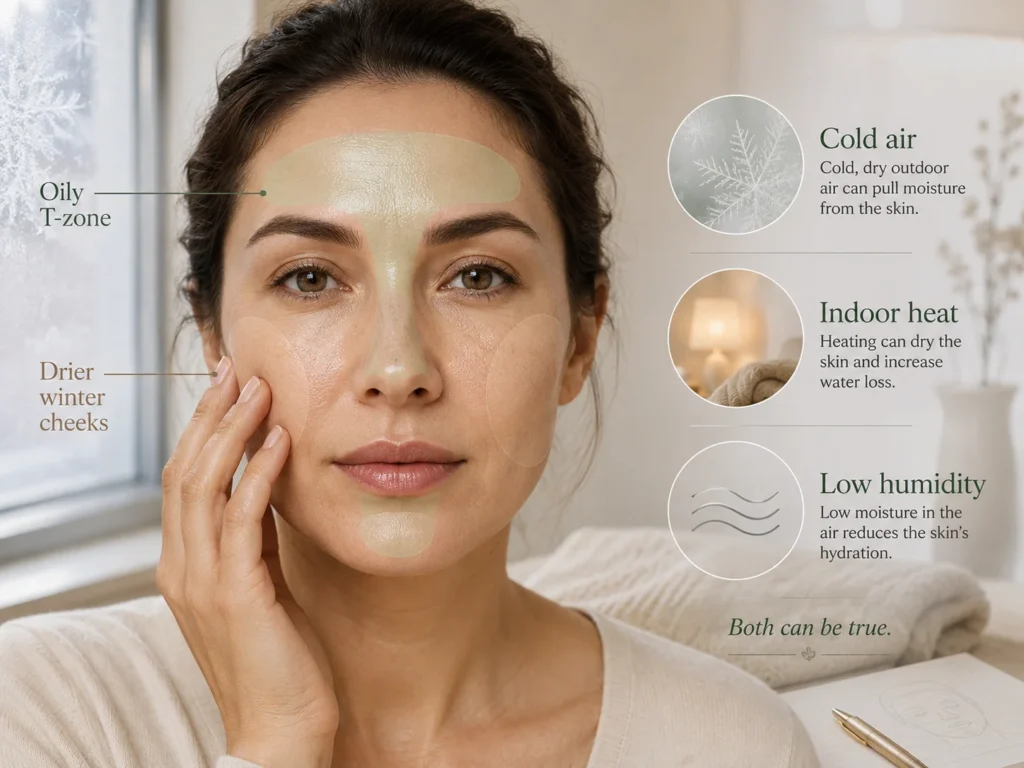
The cheeks may feel tighter because of:
- Cold air
- Wind
- Indoor heating
- Hot showers
- Low humidity
- Over-cleansing
- Drying toner
- Too much exfoliation
- Not enough moisturizer
- Active products that feel stronger in dry weather
At the same time, the T-zone may still produce oil.
This is why combination skin can feel dry and greasy in the same season.
The routine must be adjusted by zone.
Why Cheeks Get Drier in Winter
The cheeks often have less oil than the T-zone.
In winter, they may lose comfort faster.
Winter cheeks may feel:
- Tight
- Rough
- Flaky
- Dull
- Sensitive
- Stingy after cleansing
- Dry under makeup
- Less comfortable with toner
- Less tolerant of exfoliation
- More reactive to SPF
Dry cheeks usually need gentler cleansing, better moisture support, and less active pressure.
They do not need the same oil-control products as the T-zone.
Why the T-Zone Can Still Be Oily in Winter
Even when the cheeks are dry, the T-zone may still become oily.
The forehead, nose, and chin may feel:
- Shiny
- Greasy
- Coated
- More pore-visible
- Heavy under moisturizer
- More likely to separate makeup
- Uncomfortable with rich cream
This can make winter routine choices confusing.
The cheeks may ask for more comfort.
The T-zone may ask for lighter layers.
Both can be true.
The Winter Goal: Comfort Without Greasiness
The goal is not to make the whole face rich and heavy.
The goal is to comfort dry areas while keeping oily areas breathable.
A good winter combination skin routine should help:
- Cheeks feel less tight
- T-zone feel less heavy
- Makeup cling less
- SPF sit more comfortably
- Skin feel less oily and dry at the same time
- Moisturizer feel balanced
- Dry patches look less noticeable
- Routine feel easier to repeat
Winter care should feel protective.
Not greasy.
Morning Winter Routine for Combination Skin
A simple morning routine:
Gentle cleanser → moisturizer by zone → SPF when exposed
If skin feels dehydrated:
Gentle cleanser → lightweight hydration if appropriate → moisturizer by zone → SPF when exposed
Use:
- More moisturizer on cheeks
- Less moisturizer on T-zone
- Extra comfort only on dry patches
- SPF as the final morning step
- Fewer strong active products if skin feels sensitive
- Lighter layers under makeup
The morning routine should prepare the skin for cold air, indoor heat, and daytime exposure.
Evening Winter Routine for Combination Skin
A simple evening routine:
Gentle cleanser → moisturizer by zone
If wearing makeup or SPF:
Makeup/SPF removal step if needed → gentle cleanser → moisturizer by zone
Evening is when winter skin can receive more comfort.
But still use zone placement.
The cheeks may need more support.
The T-zone may need a lighter layer.
Step 1: Cleanse Gently
Winter combination skin can become uncomfortable if cleanser is too strong.
A winter cleanser should leave the skin feeling:
- Clean
- Comfortable
- Not greasy
- Not coated
- Not tight
- Not squeaky
- Not stingy
- Not stripped
If cheeks feel tight immediately after cleansing, the cleanser may be too drying or the cleansing method may be too harsh.
Clean skin should not feel punished.
Step 2: Avoid Hot Water
Hot water can make winter dryness and sensitivity worse.
Avoid:
- Washing the face with very hot water
- Long hot showers on the face
- Harsh washcloth rubbing
- Scrubbing dry patches
- Cleansing brushes if the skin feels irritated
Use lukewarm water.
Pat the skin dry gently.
Technique matters.
Step 3: Add Hydration Support if Needed
Winter combination skin may become dehydrated.
Dehydrated skin lacks water, even if the T-zone still produces oil.
Signs include:
- Oily but tight T-zone
- Tight cheeks
- Dull-looking skin
- Fine dehydration lines
- Makeup clinging
- SPF pilling
- Moisturizer disappearing quickly
- Skin feeling uncomfortable after cleansing
Lightweight hydration may be reviewed when appropriate.
Hydration support should be followed with moisturizer.
Step 4: Moisturize by Zone
Moisturizer placement is one of the most important winter steps.
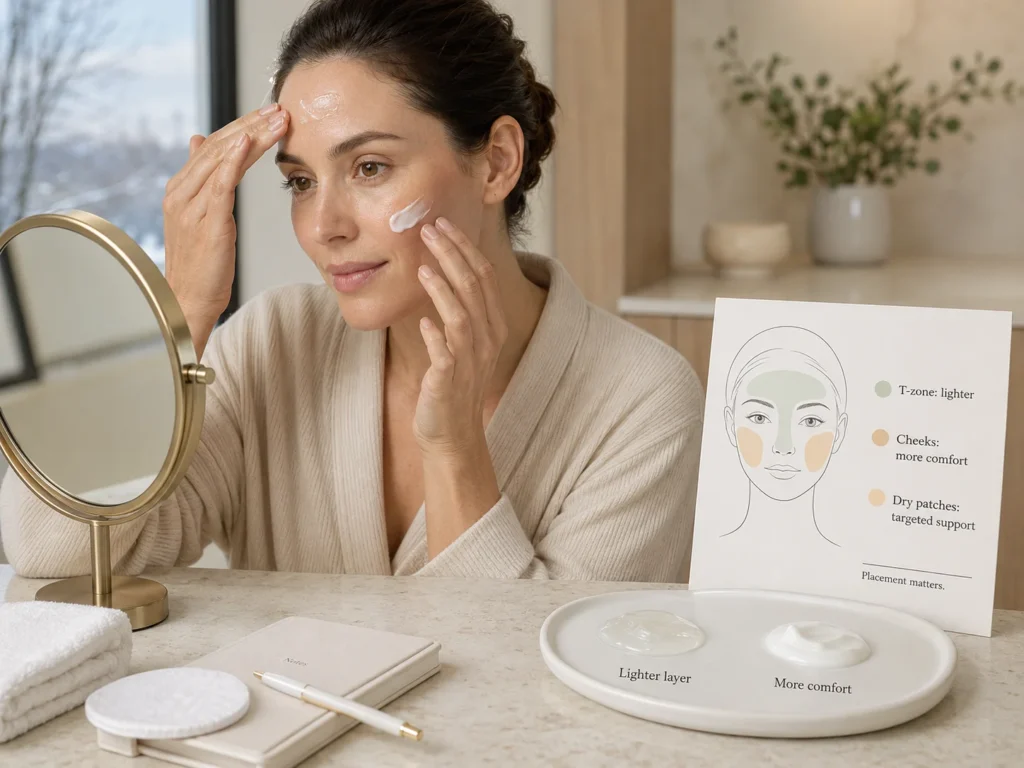
Use:
- More comfort on cheeks
- A lighter layer on the T-zone
- Extra support around dry patches
- Less product on the nose if it gets greasy
- Gentle support around the mouth if dry
- SPF evenly in the morning
Do not apply the same heavy amount everywhere unless the whole face truly needs it.
Combination skin needs zone care.
Step 5: Keep SPF in the Morning
SPF still matters in winter.
Even when it is cold, the skin still needs daytime protection when exposed.
A simple order:
Gentle cleanser → moisturizer by zone → SPF
If SPF stings, pills, or feels uncomfortable, review the routine underneath:
- Is cleanser too harsh?
- Are cheeks over-exfoliated?
- Is toner drying?
- Is moisturizer too heavy on the T-zone?
- Is the skin dehydrated?
- Are active products making the skin sensitive?
Do not skip SPF as the first solution.
Adjust the layers.
Why Winter Makeup Clings to Combination Skin
In winter, makeup may cling to dry cheeks and still separate on the T-zone.
This can happen because of:
- Dry cheeks
- Dehydration
- Flaking
- Over-exfoliation
- Harsh cleanser
- Drying toner
- Not enough moisturizer
- Heavy cream on T-zone
- SPF texture mismatch
- Indoor heating
- Cold wind
Makeup often improves when the skincare underneath becomes more balanced.
Winter Makeup Prep for Combination Skin
A simple winter makeup-prep routine:
Gentle cleanser → moisturizer by zone → SPF → makeup
If cheeks are dry:
- Use more comfort on cheeks.
- Let moisturizer settle.
- Avoid heavy powder on dry areas.
- Do not scrub flakes aggressively.
- Avoid clay mask on cheeks.
- Use lighter layers on the T-zone.
If T-zone gets oily:
- Use less moisturizer there.
- Avoid rich cream on the nose.
- Keep morning layers simple.
Why Moisturizer Feels Too Heavy and Not Enough
Combination skin can make moisturizer confusing in winter.
The same product may feel:
- Too heavy on the T-zone
- Not enough on the cheeks
- Greasy on the nose
- Too light around the mouth
- Comfortable for a few hours, then dry again
This does not always mean the product is wrong.
It may mean the amount and placement need adjustment.
Use more where dry.
Use less where oily.
Should Combination Skin Use a Rich Cream in Winter?
Sometimes, but not everywhere automatically.
A richer cream may be useful for:
- Dry cheeks
- Around-mouth dryness
- Wind-stressed areas
- Flaky patches
- Nighttime comfort
- Areas that feel tight
But rich cream may feel too heavy on:
- Nose
- Forehead
- Chin
- Oily T-zone
- Clogged-looking areas
- Areas where makeup separates
Use richer comfort only where needed.
Should Combination Skin Use Gel Cream in Winter?
A gel cream or lighter moisturizer may still be useful on the T-zone in winter.
The T-zone may not need a heavy cream just because the cheeks are dry.
A lighter texture may work well for:
- Forehead
- Nose
- Chin
- Oily zones
- Makeup prep
- SPF layering
The cheeks may need something more comforting.
This is why one texture may not work equally everywhere.
Should Combination Skin Use Two Moisturizers?
Sometimes, yes.
Some winter combination skin routines may benefit from using:
- A lighter moisturizer on the T-zone
- A more comforting moisturizer on the cheeks
This does not need to be complicated.
It can simply mean using different amounts or using a richer product only on dry areas.
The goal is comfort and balance.
Not a heavy routine.
Winter and Dehydrated Combination Skin
Dehydration can become more noticeable in winter.
You may notice:
- Oily but tight T-zone
- Cheeks that feel thirsty
- Makeup clinging
- SPF pilling
- Fine dehydration lines
- Dull-looking skin
- Moisturizer disappearing quickly
- Skin feeling uncomfortable after cleansing
If this happens, do not respond with more exfoliation immediately.
Hydration and moisturizer may come first.
Winter and Sensitive Combination Skin
Winter can make sensitive areas more reactive.
Sensitive zones may include:
- Cheeks
- Around-mouth area
- Sides of nose
- Jawline
- Neck
Signs of sensitivity include:
- Stinging
- Burning
- Heat
- Tightness
- Redness-looking irritation
- SPF discomfort
- Moisturizer stinging
- Toner burning
- Exfoliation feeling too strong
If sensitivity increases, simplify the routine.
Calm comes before active support.
Winter and Over-Exfoliation
Over-exfoliation is common in winter because people try to remove flakes.
But flakes may come from dryness, dehydration, irritation, or overuse of active products.
Signs of over-exfoliation include:
- Burning
- Stinging
- Flaking
- Tight cheeks
- Oily but tight T-zone
- Moisturizer stinging
- SPF stinging
- Makeup clinging more
- Skin feeling raw
If this happens, pause exfoliation and active products.
Use a gentle reset routine.
Winter and Clay Masks
Clay masks may be less tolerated in winter.
They may still help oily T-zone areas when appropriate, but they should not be used on dry cheeks.
A safe approach:
Gentle cleanser → clay mask on oily T-zone only if appropriate → rinse → moisturizer by zone
Avoid clay mask if skin feels:
- Tight
- Flaky
- Sensitive
- Over-exfoliated
- Burning
- Stinging
- Rash-like
- Broken or freshly picked
Clay mask should not leave winter skin uncomfortable.
Winter and BHA
BHA may be reviewed for clogged-looking T-zone areas when the skin is stable.
But winter skin may tolerate BHA less often.
Use caution if the skin is:
- Dry
- Tight
- Sensitive
- Flaky
- Over-exfoliated
- Reacting to moisturizer
- Reacting to SPF
Avoid BHA on dry or sensitive cheeks.
Use targeted support only where appropriate.
Winter and AHA
AHA may feel stronger in winter because the skin may already be dry or sensitive.
Use caution if the skin has:
- Tight cheeks
- Flaking
- Stinging
- Dry patches
- SPF discomfort
- Moisturizer discomfort
- Over-exfoliation signs
- Around-mouth dryness
Do not use AHA just because winter skin looks dull.
Dullness may come from dehydration or dryness.
Winter and Retinol-Style Products
Retinol-style products need caution in winter.
Dry weather can make skin less tolerant.
Avoid layering retinol-style products blindly with:
- AHA
- BHA
- Scrubs
- Exfoliating toner
- Strong vitamin C
- Clay masks
- Strong brightening-support products
If the skin becomes dry, flaky, tight, or stingy, pause and simplify.
Retinol-style support should not make the skin feel stressed.
Winter and Vitamin C
Vitamin C support may be appropriate for some routines when the skin is stable.
But strong vitamin C can feel uncomfortable if the skin is dry, sensitive, or over-exfoliated.
If vitamin C stings in winter, review:
- Cleanser strength
- Toner use
- Exfoliation frequency
- Moisturizer amount
- Skin hydration
- Active product layering
- SPF comfort
Radiance support should not create irritation.
Winter and Brightening Support
Winter can make dullness or uneven-looking tone more noticeable.
But brightening-support routines should remain gentle and SPF-led.
Avoid trying to brighten faster with:
- Daily exfoliation
- Multiple acids
- Strong vitamin C on sensitive skin
- Retinol-style products layered too aggressively
- Clay masks on dry areas
- Scrubbing flakes
A more even-looking complexion needs patience, comfort, and daytime protection.
Winter and SPF Pilling
SPF may pill in winter if the skin is dry or if layers are too heavy.
Possible causes include:
- Too much moisturizer
- Thick cream on the T-zone
- Dry flakes
- Product buildup
- Applying SPF too quickly
- Rubbing too much
- Texture mismatch
- Too many serums
Simplify:
Gentle cleanser → moisturizer by zone → SPF
Let layers settle.
Use more comfort only where needed.
Winter and Around-Mouth Dryness
The area around the mouth can become especially dry in winter.
It may be affected by:
- Cold air
- Wind
- Toothpaste residue
- Lip products
- Active product migration
- Hair removal
- Hot water
- Indoor heat
Avoid applying strong active products, clay masks, or exfoliation to irritated around-mouth skin.
If the area is painful, swollen, crusted, bleeding, oozing, rash-like, or worsening, seek dermatologist guidance.
Winter and the Sides of the Nose
The sides of the nose can become irritated in winter, even if the nose itself is oily.
This area may be affected by:
- Tissue use
- Cold air
- Dryness
- Scrubbing
- BHA overuse
- Clay mask overuse
- Harsh cleanser
- Active products
Avoid applying strong products to irritated sides of the nose.
Support the area gently.
Winter and the Forehead
The forehead may still feel oily in winter.
It may also be affected by hats, scarves, hair products, sweat, and indoor heating.
Support the forehead with:
- Gentle cleansing
- Lightweight moisturizer
- SPF
- Proper evening cleansing
- Avoiding heavy cream if it feels coated
- Targeted support only if appropriate
Do not apply cheek-level richness to the forehead if it becomes greasy.
Winter and the Chin
The chin may be oily, dry, sensitive, or post-blemish-mark-prone-looking.
In winter, avoid using strong active products on the chin if it is:
- Dry
- Flaky
- Freshly picked
- Broken
- Crusted
- Bleeding
- Painful
- Irritated
- Rash-like
If the chin is oily and stable, targeted support may be reviewed.
But do not over-dry the area.
Winter and Enlarged-Looking Pores
Pores may look more noticeable in winter when the skin surface is dry, rough, or dehydrated.
The T-zone may also look pore-visible if it feels coated by heavy moisturizer.
Support pore appearance with:
- Gentle cleansing
- Moisturizer by zone
- SPF
- Proper evening cleansing
- Lightweight T-zone layers
- Hydration support if needed
- No scrubbing
- No picking
Pores are normal and cannot be erased.
Winter and Clogged-Looking T-Zone
A clogged-looking T-zone in winter may happen from heavy creams, SPF, makeup, hair products, or incomplete cleansing.
Before adding stronger active products, review:
- Moisturizer texture
- T-zone product amount
- SPF removal
- Makeup removal
- Hair product contact
- BHA suitability
- Clay mask frequency
- Dehydration
- Over-exfoliation
Clogged-looking texture needs targeted review.
Not a harsh full-face routine.
Winter and Blackhead-Looking Areas
Blackhead-looking areas may still appear on the nose in winter.
Support may include:
- Gentle cleanser
- Proper evening cleansing
- Lightweight moisturizer
- SPF
- BHA only if appropriate and skin is stable
- Clay mask only on oily zones if appropriate
- No picking
- No harsh scrubbing
Do not scrub the nose just because the cheeks are flaky.
Each concern needs its own approach.
Winter and Whitehead-Looking Texture
Whitehead-looking texture may appear when the T-zone feels coated.
Possible contributors include:
- Heavy moisturizer
- Rich cream on oily zones
- Makeup residue
- SPF residue
- Hair products
- Product buildup
- Dehydration
- Incomplete evening cleansing
Use targeted support only when skin is stable.
Avoid drying out the cheeks.
Winter and Post-Blemish Mark Appearance
Post-blemish mark appearance may look more noticeable when skin is dry, dull, or irritated.
Support a more even-looking complexion with:
- SPF in the morning
- No picking
- Gentle cleansing
- Moisturizer
- Hydration support if appropriate
- Brightening-support products only when appropriate and tolerated
- Avoiding over-exfoliation
Do not use harsh exfoliation to force faster-looking results.
Winter and Dullness
Winter dullness is common.
It may come from:
- Dehydration
- Dryness
- Cold air
- Indoor heating
- Less smooth surface texture
- Product buildup
- Over-exfoliation
- Inconsistent SPF
- Makeup clinging
Dullness does not always mean more acids are needed.
Sometimes the skin needs hydration, moisturizer, and a calmer routine.
Winter Cleanser Tips
In winter, choose cleansing that respects dry areas.
Helpful cleanser habits:
- Use lukewarm water.
- Massage gently.
- Avoid rough cloths.
- Do not cleanse until squeaky.
- Avoid scrubbing flakes.
- Remove makeup and SPF gently.
- Moisturize after cleansing.
If the skin feels tight after cleansing, review cleanser type, cleansing time, and water temperature.
Winter Toner Tips
Toner may need to be reduced in winter.
If toner feels drying, use caution.
Avoid toner if it causes:
- Burning
- Stinging
- Tightness
- Flaking
- Cheeks feeling dry
- Moisturizer stinging
- SPF stinging
If toner helps the T-zone but dries the cheeks, use it only where appropriate or pause it.
Toner is optional.
Winter Serum Tips
Serum can be helpful when it has a clear purpose.
In winter, serum may support:
- Lightweight hydration
- Comfort
- Radiance when skin is stable
- Targeted T-zone support when appropriate
- Calming support for sensitive areas
Do not layer too many serums.
Too many layers may pill under SPF or overwhelm sensitive winter skin.
Choose one clear purpose at a time.
Winter Moisturizer Tips
Winter moisturizer should be adjusted by zone.
Try:
- More moisturizer on cheeks
- Less moisturizer on T-zone
- Richer comfort only on dry areas
- Lighter texture on oily areas
- Extra support around the mouth if dry
- Gentle night comfort when needed
- No heavy layer on clogged-looking areas
Moisturizer should help skin feel comfortable.
Not coated.
Winter SPF Tips
SPF remains part of morning care.
To make SPF more comfortable in winter:
- Keep cleanser gentle.
- Moisturize dry areas first.
- Avoid over-exfoliation.
- Let moisturizer settle.
- Use less product on the T-zone if it gets greasy.
- Avoid too many layers under SPF.
- Do not apply SPF over irritated active-product reactions without reviewing the routine.
SPF should feel wearable.
If it stings, the skin may need calming support.
Winter Exfoliation Tips
Reduce exfoliation if winter skin becomes tight, flaky, or sensitive.
Use caution with:
- Scrubs
- AHA
- BHA
- Exfoliating toner
- Exfoliating cleanser
- Retinol-style products
- Strong vitamin C
- Brightening-support products
Do not exfoliate just because cheeks are flaky.
Flakes may be from dryness or irritation.
Comfort may need to come first.
Winter Mask Tips
Masks should be chosen by zone.
For oily T-zone:
Clay mask only on oily zones if appropriate
For dry cheeks:
Hydrating mask if appropriate
For sensitive areas:
Calming mask if appropriate
For irritated skin:
No mask
Avoid clay mask on dry cheeks.
Avoid active masks on over-exfoliated skin.
Moisturize afterward.
Winter Routine for Oily T-Zone and Dry Cheeks
Morning:
Gentle cleanser → more comfort on cheeks → lighter layer on T-zone → SPF when exposed
Evening:
Gentle cleanser → moisturizer by zone
If wearing makeup or SPF:
Removal step if needed → gentle cleanser → moisturizer by zone
Optional:
- Lightweight hydration if tight
- Clay mask only on oily T-zone if appropriate
- BHA only on clogged-looking T-zone areas if skin is stable
Avoid drying the cheeks.
Winter Routine for Dry Cheeks
Morning:
Gentle cleanser → hydration support if appropriate → comforting moisturizer on cheeks → light layer on T-zone → SPF
Evening:
Gentle cleanser → moisturizer by zone
Avoid:
- Hot water
- Harsh cleanser
- Drying toner
- Clay mask on cheeks
- Scrubs on cheeks
- Daily exfoliation
- Strong active products on irritated areas
Dry cheeks need comfort first.
Winter Routine for Oily but Tight Skin
Morning:
Gentle cleanser → lightweight hydration if appropriate → moisturizer by zone → SPF
Evening:
Gentle cleanser → lightweight hydration if appropriate → moisturizer by zone
Avoid:
- Harsh cleanser
- Drying toner
- Skipping moisturizer
- Frequent clay mask
- BHA too often
- Over-exfoliation
Oily but tight skin often needs hydration and comfort, not stronger stripping.
Winter Routine for Sensitive Combination Skin
Morning:
Mild cleanser → gentle moisturizer by zone → SPF when exposed
Evening:
Mild cleanser → gentle moisturizer by zone
Pause:
- Scrubs
- AHA
- BHA
- Active toner
- Clay masks
- Retinol-style products
- Strong vitamin C
- Strong brightening-support products
Sensitive winter skin needs calm before active support.
Winter Routine for Makeup Wearers
Morning:
Gentle cleanser → moisturizer by zone → SPF → makeup
Helpful habits:
- Use more comfort on cheeks.
- Use less product on the T-zone.
- Let moisturizer settle.
- Avoid heavy powder on dry cheeks.
- Avoid thick cream on the nose.
- Do not scrub flakes before makeup.
- Keep SPF even.
Evening:
Makeup/SPF removal step if needed → gentle cleanser → moisturizer by zone
Good winter makeup starts with comfort.
Winter Routine for SPF Pilling
If SPF pills in winter:
Morning:
Gentle cleanser → moisturizer by zone → SPF
Adjust:
- Use less moisturizer on the T-zone.
- Allow moisturizer to settle.
- Avoid too many serums.
- Smooth gently instead of rubbing.
- Support dry flakes on cheeks.
- Avoid over-exfoliation.
- Review product texture compatibility.
Pilling often means layering needs adjustment.
Winter Routine After Wind Exposure
After wind exposure:
Evening:
Mild cleanser → moisturizer by zone
Morning:
Mild cleanser → moisturizer by zone → SPF
Pause active products if the skin feels raw, stingy, or tight.
Avoid:
- Scrubs
- Acids
- Clay masks
- Strong vitamin C
- Retinol-style products
- Active toner
Wind-stressed skin needs comfort.
Winter Routine After Travel
Travel can make winter combination skin dehydrated and reactive.
A simple travel recovery routine:
Morning:
Gentle cleanser → moisturizer by zone → SPF
Evening:
Gentle cleanser → moisturizer by zone
If skin feels tight:
Add lightweight hydration if appropriate
Avoid testing strong new products during or right after travel.
Let the skin settle.
Winter Routine After Over-Exfoliation
If the skin feels over-exfoliated:
Morning:
Mild cleanser → moisturizer by zone → SPF
Evening:
Mild cleanser → moisturizer by zone
Pause:
- Scrubs
- AHA
- BHA
- Exfoliating toner
- Exfoliating cleanser
- Retinol-style products
- Strong vitamin C
- Clay masks
- Strong brightening-support products
Let the skin feel calm before restarting active products.
Winter Routine for Clogged-Looking T-Zone
Morning:
Gentle cleanser → light moisturizer on T-zone → more comfort on cheeks → SPF
Evening:
Gentle cleanser → moisturizer by zone
Optional if appropriate:
BHA only on clogged-looking T-zone areas when skin is stable
or:
Clay mask only on oily T-zone areas occasionally
Avoid using clogged-pore support on dry cheeks.
Winter Routine for Enlarged-Looking Pores
Morning:
Gentle cleanser → light moisturizer on T-zone → more comfort on cheeks → SPF
Evening:
Gentle cleanser → moisturizer by zone
Optional:
- Better evening cleansing
- BHA only if clogged-looking pores are present and skin is stable
- Clay mask only on oily zones if appropriate
- Hydration support if skin feels tight
- No picking
- No scrubbing
Pores are normal.
The goal is a smoother-looking, less coated surface.
Winter Routine for Dullness
Morning:
Gentle cleanser → hydration support if appropriate → moisturizer by zone → SPF
Evening:
Gentle cleanser → moisturizer by zone
If skin is stable, radiance-support products may be reviewed.
But do not over-exfoliate dull winter skin.
Dullness may be from dryness or dehydration.
Comfort can help the skin look fresher.
Winter Routine for Post-Blemish Mark Appearance
Morning:
Gentle cleanser → moisturizer by zone → SPF
Evening:
Gentle cleanser → moisturizer by zone
Support habits:
- Do not pick.
- Avoid harsh scrubbing.
- Do not apply active products to broken areas.
- Use brightening-support products only when appropriate and tolerated.
- Keep SPF consistent.
- Be patient.
Winter dryness can make marks look more noticeable, so comfort matters.
What to Add First in Winter
If winter combination skin feels unbalanced, start with small adjustments.
Add or adjust:
- More moisturizer on cheeks
- Less moisturizer on T-zone
- Lightweight hydration if skin feels tight
- Gentler cleanser
- Less hot water
- Less exfoliation
- Less clay mask
- Better evening cleansing
- SPF-friendly layering
Do not change everything at once.
What to Pause First in Winter
If the skin feels tight, stingy, flaky, or irritated, pause:
- Harsh cleanser
- Drying toner
- Daily exfoliation
- Scrubs
- AHA
- BHA
- Frequent clay masks
- Retinol-style products
- Strong vitamin C
- Strong brightening-support products
- Too many new products
Return to:
Morning: Mild cleanser → moisturizer by zone → SPF
Evening: Mild cleanser → moisturizer by zone
Let the skin feel comfortable again.
Signs Your Winter Routine Is Working
Your winter routine may be working if:
- Cheeks feel less tight
- T-zone feels less greasy
- Skin does not feel stripped after cleansing
- Moisturizer feels comfortable
- SPF applies more smoothly
- Makeup clings less
- Makeup separates less
- Dry patches look less noticeable
- Skin feels less oily and tight at the same time
- Routine feels simple to repeat
Winter routine success should feel calm and balanced.
Signs Your Winter Routine Is Too Drying
Your routine may be too drying if:
- Cheeks feel tight
- Skin flakes
- Toner stings
- SPF stings
- Moisturizer burns
- Makeup clings more
- Skin feels rough
- T-zone feels oily but tight
- Skin feels hot
- Redness-looking irritation appears
If this happens, reduce strong steps and focus on comfort.
Signs Your Winter Routine Is Too Heavy
Your routine may be too heavy if:
- T-zone gets greasy quickly
- Nose feels coated
- Forehead looks shiny soon after skincare
- Makeup separates fast
- SPF pills
- Chin feels heavy
- Products sit on the skin
- Pores look more noticeable from shine
- You feel like you need to wash again soon
If this happens, lighten the T-zone, not the whole face.
When Professional Guidance Helps
Professional guidance may help if:
- Your cheeks are very dry in winter
- Your T-zone still gets oily
- Moisturizer feels too heavy and not enough
- SPF stings or pills
- Makeup clings and separates
- BHA dries your skin
- Clay masks make your skin tight
- Toner becomes uncomfortable in winter
- Your routine feels confusing every season
- You do not know whether to hydrate, calm, exfoliate, or moisturize more
A consultation can help adjust your routine by zone instead of overcorrecting.
When to See a Dermatologist
A dermatologist should evaluate the skin if there are warning signs such as:
- Persistent rash-like irritation
- Swelling
- Pain
- Severe itching
- Burning that does not settle
- Crusting
- Bleeding
- Oozing
- Infection-looking areas
- Blistering
- Sudden discoloration
- A spot changing in size, shape, or color
- A spot that looks very different from others
- Rapid worsening
- Skin reacting strongly to basic products
- Severe cold-related discomfort or worsening skin changes
Cosmetic skincare can support comfort and appearance, but medical-looking changes need medical evaluation.
Where Janssen Cosmetics Fits
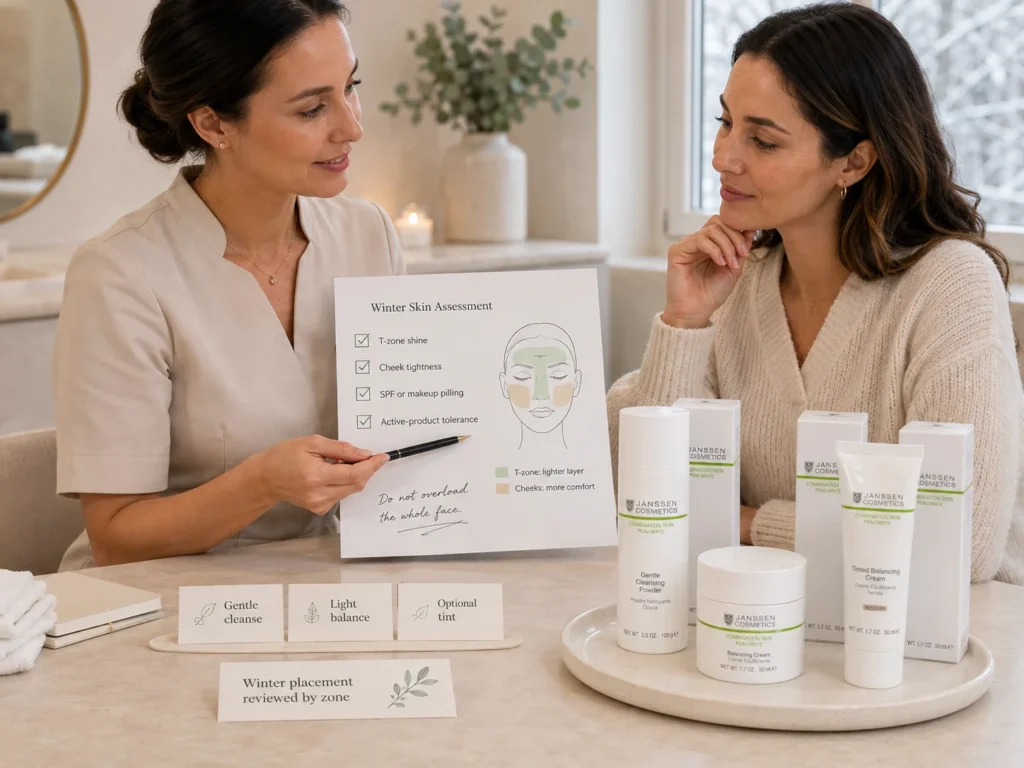
After consultation, our licensed esthetician may consider Janssen Cosmetics options depending on whether winter combination skin needs dry-zone comfort, lightweight hydration, calming support, T-zone balance, or a simpler reset first.
For combination skin balance, possible options may include:
- Gentle Cleansing Powder as a mild cleansing step for oily T-zone and normal or dry cheeks
- Balancing Cream as a light balancing moisturizer
- Tinted Balancing Cream when a low-lipid tinted moisturizer may support a more even-looking finish
For winter dehydration or dry-feeling cheeks, possible options may include:
- Deep Xpress Moist Serum
- Hydro Active Gel
- Super Hydrating Cream
- Hyaluron³ Replenish Cream
- Deep Xpress Hydro Mask
- Mild Creamy Cleanser
- Radiant Firming Tonic if tolerated
For sensitive, winter-stressed, or overworked areas, possible comfort-focused options may include:
- Soft Cleansing Mousse
- Soft Soothing Tonic if tolerated
- Intense Calming Serum
- Intense Calming Cream or Intense Calming Lotion
- Instant Soothing Mask
For oily T-zone or clogged-looking areas when the skin is stable, possible options may include:
- Purifying Cleansing Gel
- Purifying Tonic only if tolerated
- Purifying BHA Serum only when clogged-looking pores, blackheads, whiteheads, or T-zone buildup are present and the skin is stable enough
- Light Mattifying Cream
- Intense Clearing Mask only on oily zones when appropriate
For dullness, post-blemish mark appearance, or uneven-looking tone when the skin is calm and stable, possible radiance-support options may include:
- Brightening Face Cleanser
- Brightening Face Freshener
- Magic Glow Serum
- Vitaforce C Skin Complex only when vitamin C support is appropriate and tolerated
- Vitaforce C Cream
- Sensational Glow Cream
For morning winter routines, Face Guard Advanced SPF 30 may be considered as the final daytime protection step when appropriate and tolerated.
These are not automatic recommendations. Winter combination skin should be reviewed by zone so the cheeks receive comfort while the T-zone stays balanced and breathable.
What Not to Do
Do not apply heavy cream everywhere automatically.
Do not skip moisturizer because the T-zone is oily.
Do not use harsh cleanser because the T-zone still gets shiny.
Do not wash with very hot water.
Do not scrub dry flakes.
Do not use clay mask on dry cheeks.
Do not increase exfoliation because winter skin looks dull.
Do not apply BHA all over the face unnecessarily.
Do not layer exfoliating toner, AHA, BHA, scrubs, retinol-style products, strong vitamin C, and brightening-support products blindly.
Do not apply active products to cold-stressed, wind-stressed, broken, crusted, bleeding, painful, freshly picked, or rash-like skin.
Do not ignore persistent irritation, swelling, pain, oozing, crusting, blistering, or worsening skin changes.
Frequently Asked Questions
What is the best winter routine for combination skin?
A simple winter routine is gentle cleanser, moisturizer by zone, and SPF in the morning. At night, cleanse gently and moisturize by zone.
Why are my cheeks dry but my T-zone oily in winter?
Your cheeks may be affected by cold air, wind, indoor heating, hot water, or dehydration, while the T-zone may still naturally produce more oil.
Should I use a richer cream in winter?
You may need richer comfort on dry cheeks, but the T-zone may still need a lighter layer.
Should combination skin skip moisturizer in winter if the T-zone is oily?
No. Use moisturizer by zone: lighter on oily areas and more comforting on dry areas.
Why does makeup cling more in winter?
Makeup may cling because of dryness, dehydration, flaking, over-exfoliation, or not enough moisturizer on dry zones.
Should I exfoliate more in winter to remove flakes?
Not automatically. Flakes may come from dryness or irritation. Comfort and hydration may need to come first.
Can I use clay mask in winter?
Yes, if appropriate, but use clay mask only on oily zones and avoid dry or sensitive cheeks.
Why does my SPF sting in winter?
SPF may sting if the skin is dry, over-exfoliated, irritated, or affected by harsh cleansing or active products.
What should I do if my skin feels oily and tight in winter?
Use gentle cleanser, lightweight hydration if appropriate, moisturizer by zone, and SPF. Avoid harsh oil-control products.
When should I see a dermatologist?
Seek dermatologist guidance if irritation is persistent, rash-like, swollen, painful, oozing, crusting, bleeding, blistering, suddenly changing, or worsening.
At Zendevie, a free virtual consultation helps us review your T-zone, cheeks, winter dryness, hydration level, sensitivity, cleanser, moisturizer, SPF habits, makeup behavior, exfoliation use, active products, and seasonal triggers before recommending anything.
Winter combination skin needs comfort.
But comfort should still feel balanced.

About the Esthetician Behind Zendevie
Zendevie is guided by Haby Diallo, a licensed esthetician with more than 20 years of professional skincare experience. Her approach is rooted in education, professional judgment, and personal care.
20+
years of experience