



If your dry skin routine is not working, it can feel frustrating. You may be using moisturizer every day, trying hydrating products, avoiding harsh ingredients, and still feeling tight, rough, flaky, or uncomfortable.
Sometimes the problem is not that you are doing nothing. Sometimes the problem is that the routine is missing one important step, using the wrong texture, or asking the skin to tolerate too much too soon.
Dry skin needs more than a random cream. It needs the right cleansing method, hydration support, moisturizer texture, barrier comfort, and daytime protection.
At Zendevie, we look at the full routine before recommending products. The goal is to understand why the skin still feels dry instead of simply adding more products.
Your dry skin routine may not be working because your cleanser is too harsh, your moisturizer is too light, your skin is dehydrated, you are skipping hydration before cream, you are over-exfoliating, your skin barrier feels stressed, or you are not using SPF consistently.
Dry skin usually needs a gentle routine with hydration, emollient comfort, richer moisture when appropriate, and daytime protection.
If your skin is painful, cracked, bleeding, swollen, infected-looking, rash-like, or suddenly changing, it should be checked by a dermatologist or healthcare professional.
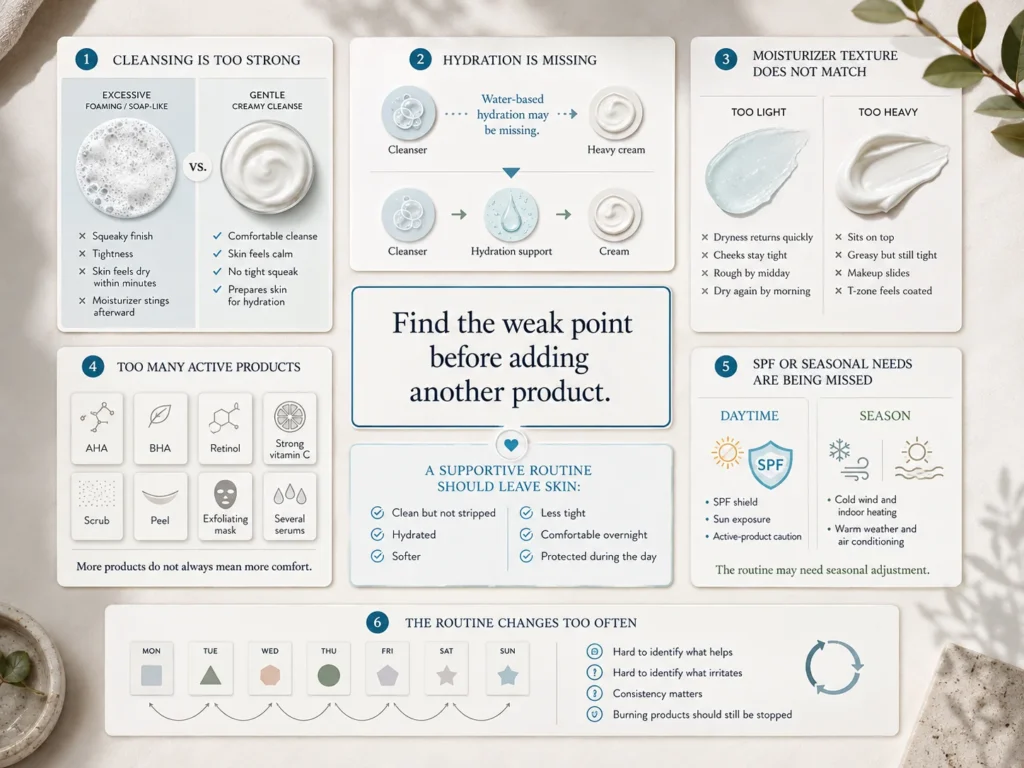
A dry skin routine can fail from the very first step.
If your cleanser leaves your face tight, squeaky, or uncomfortable, it may be removing too much from the skin. Even a good moisturizer may struggle if the cleanser keeps leaving the skin stripped.
Signs your cleanser may be too strong:
Dry skin needs cleansing that leaves the face clean but comfortable.
Many people with dry skin go straight from cleanser to cream. Sometimes that works. But if the skin is dehydrated, it may need hydration before moisturizer.
Dry skin and dehydrated skin are not always the same. Dry skin lacks oil or lipid comfort. Dehydrated skin lacks water.
If your skin feels tight but your cream feels like it just sits on top, you may need a hydrating step first.
A better order may be:
Cleanser → Tonic → Hydrating Serum → Cream
Hydration helps the skin feel fresher. Cream helps support softness and comfort.
A lightweight lotion may feel nice at first, but it may not be enough for true dry skin.
Your moisturizer may be too light if:
In this case, your routine may need a cream, a richer night cream, or a hydrating serum underneath your moisturizer.
This surprises many people.
A rich cream can feel heavy but still not solve tightness if the skin is missing hydration underneath. Heavy texture does not always mean the skin is properly supported.
Your moisturizer may be too heavy or not balanced if:
Dry skin does not always need the thickest product. It needs the right balance of hydration, softness, and comfort.
Dry skin can look rough or flaky, so it is tempting to exfoliate more. But too much exfoliation can make dryness worse.
Over-exfoliation can leave the skin feeling:
If your dry skin routine includes scrubs, acids, peeling products, or exfoliating masks too often, the skin may need a break.
Smooth skin should not come from irritation.
A dry skin routine may stop working when the skin barrier feels stressed.
This can happen after harsh cleansing, over-exfoliation, weather changes, strong active ingredients, or using too many new products at once.
Signs your barrier may feel stressed include:
When this happens, the routine should be simplified. Comfort comes before correction.
Dry skin does not always need a stronger routine. Sometimes it needs a calmer one.
Be careful with layering:
These products may have a place in some routines, but dry skin can become irritated if too many are used at once.
A dry skin routine should first support comfort, hydration, and barrier care.
SPF is part of dry skin care, not just uneven tone care.
Sun exposure can make the skin look drier, duller, rougher, and less comfortable over time. If you use exfoliation, vitamin C, retinol, or renewal-support products, daytime protection becomes even more important.
A morning dry skin routine should usually finish with SPF.
Without SPF, the skin may not look as healthy, smooth, or supported as it could.
Dry skin can change with weather.
In winter, indoor heat, cold air, and wind can make the skin feel tighter. In summer, SPF texture, sweating, and air conditioning can change how products feel.
Your dry skin routine may need small seasonal adjustments.
In colder weather, you may need:
In warmer weather, you may need:
Your routine should be flexible, not fixed forever.
Dry skin routines need consistency.
If you switch products every few days, it becomes hard to understand what is helping and what is not. The skin needs time to respond to a steady routine.
However, consistency does not mean forcing a product that burns or irritates the skin.
A product that repeatedly stings, burns, or makes the skin feel worse should be reconsidered.
A good dry skin routine should help the skin feel:
The routine should not leave the skin burning, squeaky, greasy but tight, or more irritated.
If your current dry skin routine is not working, simplify first.
Step 1: Gentle Cleanser
Use a cleanser that does not leave the skin tight.
Step 2: Hydrating Tonic
Prepare the skin for moisture support.
Step 3: Hydrating Serum
Support water-based hydration if the skin feels tight or dull.
Step 4: Comfort Cream
Choose a cream texture based on your dryness level.
Step 5: SPF
Finish with daytime protection.
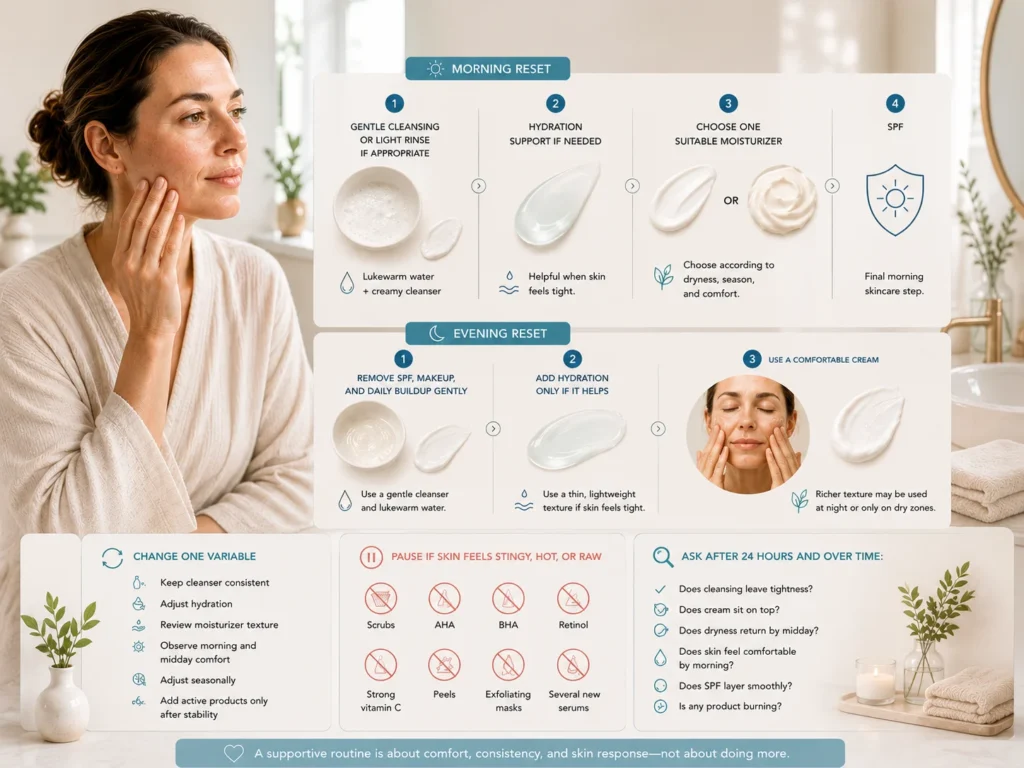
Step 1: Gentle Cleanse
Remove makeup, sunscreen, and daily buildup without stripping.
Step 2: Tonic
Refresh and prepare the skin.
Step 3: Hydrating Serum
Support moisture if needed.
Step 4: Richer Cream if Appropriate
Help the skin feel supported overnight.
Pause strong products if your skin feels:
During this time, focus on gentle cleansing, hydration, comfort cream, and SPF.
Once the skin feels more stable, active products can be reconsidered slowly and one at a time.

Products that may be discussed during a Zendevie dry skin consultation include:
If the skin feels reactive or barrier-stressed, sensitive skin support may also be discussed, such as:
These are examples only. A consultation helps decide whether your routine needs more hydration, richer texture, fewer active products, or barrier-focused comfort.
Do not keep using a cleanser that leaves your skin tight.
Do not assume the thickest cream is always the answer.
Do not skip hydration if your skin feels tight.
Do not over-exfoliate dry or flaky skin.
Do not layer too many active products at once.
Do not skip SPF.
Do not keep changing products every few days.
Do not ignore burning, cracking, swelling, bleeding, or rash-like irritation.
Your routine may not be working because your cleanser is too harsh, your moisturizer is the wrong texture, your skin is dehydrated, you are over-exfoliating, your barrier feels stressed, or your routine is missing SPF.
Your skin may need hydration underneath, a richer cream, gentler cleansing, or barrier support. Sometimes the moisturizer texture is not the right match.
Yes. Too many active products can overwhelm dry skin and make it feel tighter, more sensitive, or more irritated.
Be careful. Gentle exfoliation may help sometimes, but if the skin is stingy, tight, or irritated, focus on comfort first.
Not always, but many dry skin routines benefit from a hydrating serum before cream, especially when the skin feels tight or dehydrated.
Yes. SPF supports daytime protection and helps maintain a healthier-looking complexion.
If your skin burns, stings, feels warm, reacts to products, or becomes more sensitive than usual, your barrier may need support.

Zendevie is guided by Haby Diallo, a licensed esthetician with more than 20 years of professional skincare experience. Her approach is rooted in education, professional judgment, and personal care.
years of experience