

Mature skin does not need to be treated as a problem.
It does not need to be scrubbed, tightened, or covered with the strongest products available.
It may simply need a different kind of support than it needed several years ago.
Over time, the skin may begin to feel:
A lightweight moisturizer that once felt sufficient may no longer provide lasting comfort.
A foaming cleanser that worked for years may begin leaving the cheeks tight.
Foundation may settle more noticeably when the skin is dry.
Retinol may become harder to use at the same frequency.
These changes do not mean the skin has failed.
They may mean the routine needs to be reassessed.
At Zendevie, our licensed esthetician begins by understanding how the skin feels—not by immediately recommending the strongest well-aging product.
The first questions are often simple:
Hydration and comfort are the foundation of a mature-skin routine.
Everything else should be built around that foundation.
Mature skin may need more hydration and comfort because it can become less able to maintain the same soft, flexible, and moisturized feeling it had previously.
Common signs include:
A simple mature-skin routine may be:
Gentle cleanser or lukewarm-water rinse if appropriate → hydrating serum if needed → moisturizer → SPF
Gentle cleanser → hydrating or comfort-focused serum if needed → moisturizer
Optional products such as exfoliants, retinol, masks, facial oils, ampoules, and richer treatments should be added only when they serve a clear purpose and the skin can tolerate them.
Mature skin should not automatically use every rich product or every strong active ingredient.
The correct routine depends on whether the skin is:
Persistent burning, significant swelling, severe itching, painful cracking, bleeding, crusting, blistering, infection-looking changes, or reactions affecting the eyes should be evaluated by a dermatologist.
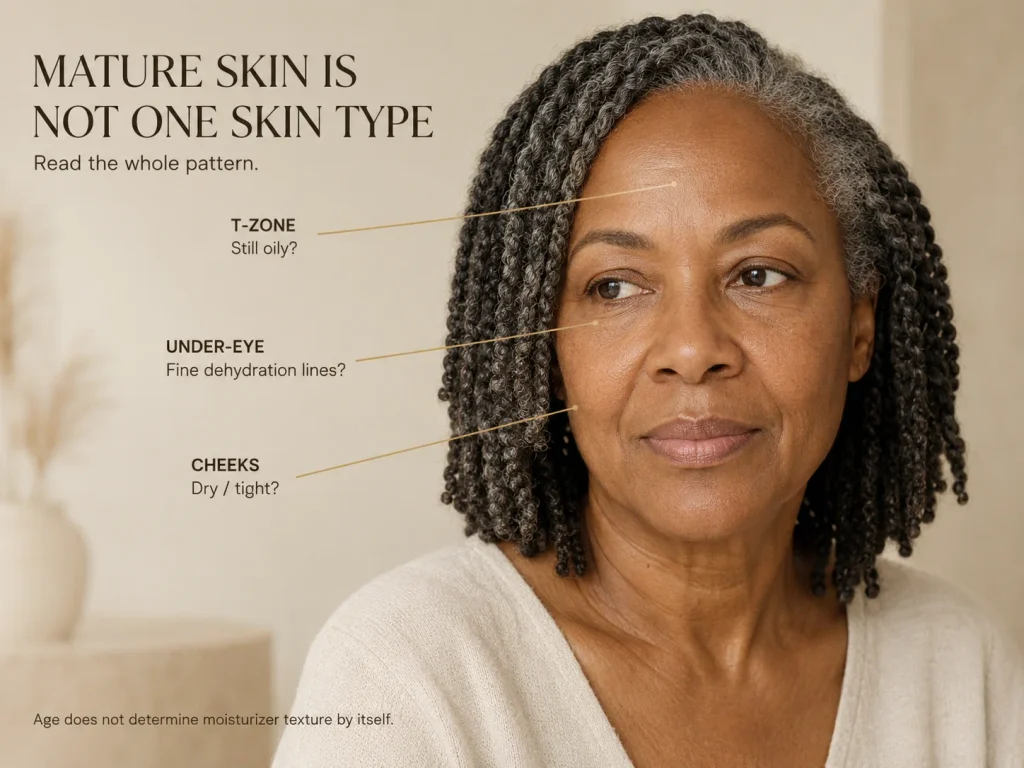
“Mature skin” describes a stage of skin change.
It does not automatically mean the skin is dry.
Mature skin may be:
This is why one universal mature-skin routine does not work for everyone.
A rich cream may feel comforting for dry mature skin.
The same cream may feel heavy for oily mature skin.
A facial oil may help one person feel more comfortable.
Another person may find it greasy or congesting.
A hydrating serum may be useful for someone whose moisturizer alone does not feel sufficient.
Another person may not need a separate serum.
The skin’s current pattern matters more than the age category alone.
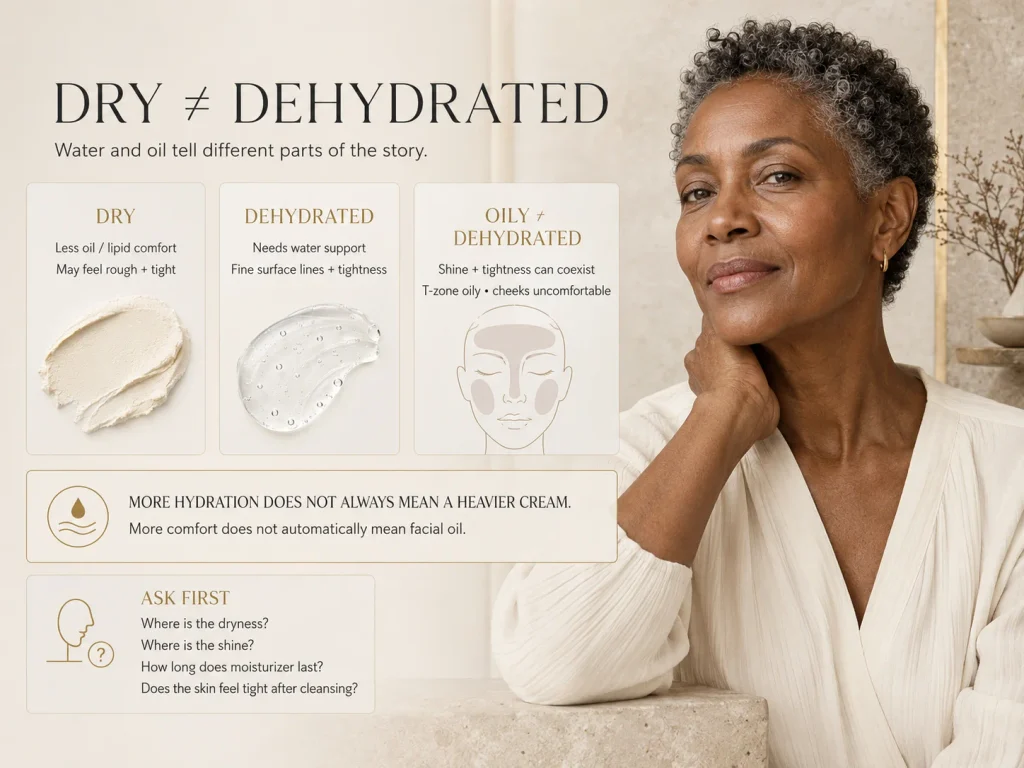
Hydration refers to the skin’s water content and water-binding support.
Oil or lipid support relates to the skin’s natural oils and the richer components that help the surface feel soft, flexible, and protected.
Mature skin may be:
This distinction matters.
A person with dehydrated, oily mature skin may not need the richest cream.
A lightweight hydrating serum and lighter moisturizer may feel more appropriate.
A person with dry, lipid-deficient mature skin may need a richer cream that supports both moisture and comfort.
More hydration does not always mean using a heavier product.
More comfort does not always mean applying facial oil.
The routine should match the actual skin pattern.
Dehydrated mature skin may feel:
Dehydration can occur in skin that is dry, oily, or combination.
Possible contributors include:
A hydrating routine should not focus only on drinking water.
Daily fluid intake is important for general well-being, but topical comfort still depends on cleanser choice, moisturizer texture, environmental exposure, and product tolerance.
Dry mature skin may experience:
Dry mature skin may need support from:
Do not respond to dryness by exfoliating more aggressively.
Roughness is not always caused by excess surface buildup.
It may be a sign that the skin needs more comfort and less product stress.
Oiliness does not prevent mature skin from feeling dehydrated.
Oily mature skin may show:
Common mistakes include:
A lightweight moisturizer may support comfort without feeling heavy.
The goal is not to remove every trace of oil.
The goal is to help the skin feel balanced, clean, and comfortable.
Combination mature skin may have:
The whole face may not need the same amount of moisturizer or the same active product.
A practical approach may include:
Do not treat dry cheeks as though they are an oily T-zone.
Zone-based care may support a more comfortable routine.
Mature skin may become more sensitive over time, or a previously comfortable routine may begin to feel too active.
Signs may include:
Sensitive mature skin may benefit from:
A strong sensation is not proof that a product is supporting mature skin effectively.
Comfort and consistency matter.
Cleansing can remove makeup, SPF, oil, sweat, and daily residue.
But a cleanser that is too strong may also leave mature skin feeling:
A cleanser that worked years ago may no longer match the skin’s current needs.
Review:
The routine should begin gently.
If cleansing creates immediate discomfort, later serums and creams may feel less comfortable too.
Hot water may make mature skin feel:
Use lukewarm water.
The skin does not need very hot water to become clean.
Very cold water is not necessary either.
Extreme temperature changes may create additional discomfort.
A person may cleanse:
Using cleanser every time may be unnecessary.
Some mature skin may prefer:
Lukewarm-water rinse or gentle cleanser
Gentle cleanser to remove makeup, SPF, and daily residue
The correct method depends on oiliness, sweat, makeup, climate, and skin comfort.
Double cleansing may be useful for:
It is not automatically required every evening.
If double cleansing causes:
review whether one effective gentle cleanser may be enough.
Two cleansing steps should not become two opportunities to strip the skin.
A cleanser for mature skin should remove daily residue while helping the skin remain comfortable.
Depending on the skin type, appropriate textures may include:
A rich cleanser is not automatically best.
Oily or blemish-prone mature skin may prefer a lighter cleansing texture.
Dry mature skin may appreciate a balm, oil, or creamy formula.
The correct cleanser should be based on how the skin feels after rinsing.
A toner or tonic may help:
However, mature skin does not require toner to have a complete routine.
Avoid or reassess toners that feel:
An acid toner is an active treatment.
It should not be treated as a neutral hydration step.
A moisturizer that once felt comfortable may begin to feel insufficient because:
Before replacing the moisturizer, review the full routine.
A stronger cleanser or overused active product may be making the moisturizer seem inadequate.
A lightweight moisturizer may suit:
A richer cream may suit:
The best texture is the one that leaves the skin comfortable without feeling excessively heavy, greasy, warm, or congested.
A rich cream may feel luxurious.
It may also create:
If the skin is oily or combination, a lighter texture may be more appropriate.
Mature skin deserves personalization, not automatic richness.
A gel or gel-cream may feel refreshing.
But dry mature skin may notice:
This does not mean every gel is unsuitable.
It means the skin’s comfort should be assessed several hours after application—not only during the first minute.
A hydrating or comfort-focused serum may help when:
A simple order may be:
Cleanser → hydrating serum → moisturizer
However, serum is optional.
If the moisturizer alone supports comfort, another layer may not be necessary.
Serums are often lightweight.
They may provide concentrated cosmetic support but may not provide the same surface comfort as a moisturizer.
Dry mature skin may still need a cream over serum.
A routine may be:
Hydrating serum → moisturizer
rather than choosing one or the other.
Oily mature skin may find that a lightweight serum plus an appropriate SPF feels sufficient during humid weather.
The correct structure depends on the formula and skin type.
A mature-skin routine may include:
Using all of them together may create:
Choose one main serum based on the most important concern.
More layers do not automatically provide more support.
Hyaluronic acid is commonly used to help support hydration and a smoother-looking surface.
It may appear in:
A separate hyaluronic-acid serum may not be needed when the moisturizer already provides enough hydration support.
Sensitive mature skin should still patch test the finished formula.
The ingredient name alone does not guarantee that every product will feel comfortable.
Ceramides are lipid components used in skincare to help support the skin’s moisture barrier and reduce the feeling of dryness.
They may be especially relevant when mature skin feels:
Ceramide products may come in:
They should be chosen according to texture and skin tolerance.
A ceramide product does not need to be layered with several other rich products automatically.
Facial oils may help some dry mature skin feel:
They may also:
Do not assume every mature-skin routine requires facial oil.
First assess whether the cleanser, serum, and moisturizer already provide enough comfort.
When a facial oil is appropriate, it may be used:
Avoid layering:
Serum → cream → balm → facial oil → sleeping mask
unless there is a clear reason and the skin tolerates the combination.
One supportive moisturizer may be enough.
A hydrating or comfort-focused mask may support skin that feels:
A mask is not a replacement for daily moisturizer.
It is also not an emergency requirement.
Avoid masks that contain:
when the skin is already irritated.
Mature skin may look rough or dull when it is dry.
This can lead to more:
But roughness may be connected to:
Exfoliating dry, uncomfortable skin may make it feel more sensitive.
Hydration and comfort should be reviewed before renewal products are increased.
Retinol may be used to support:
It may also cause:
A mature-skin retinol routine should be built around:
If the skin begins reacting to moisturizer or sunscreen, the retinol routine may be too active.
Mature skin does not need aggressive exfoliation to look smooth.
AHA or other exfoliating products may be appropriate for some skin.
But overuse may contribute to:
Begin slowly.
Use one exfoliating method.
Do not combine acid cleanser, acid toner, exfoliating serum, scrub, and retinol automatically.
When the skin feels properly moisturized, it may appear:
Hydration does not permanently remove lines.
It may help reduce the look of fine dryness lines and support a more flexible-looking surface.
Safe mature-skin care focuses on improving appearance and comfort—not promising to reverse aging.
Dryness can make surface lines more noticeable.
The skin may look:
This does not mean the skin suddenly developed many new wrinkles overnight.
The surface may simply be less hydrated and comfortable.
A gentle cleanser, appropriate moisturizer, and consistent routine may support a smoother-looking appearance.
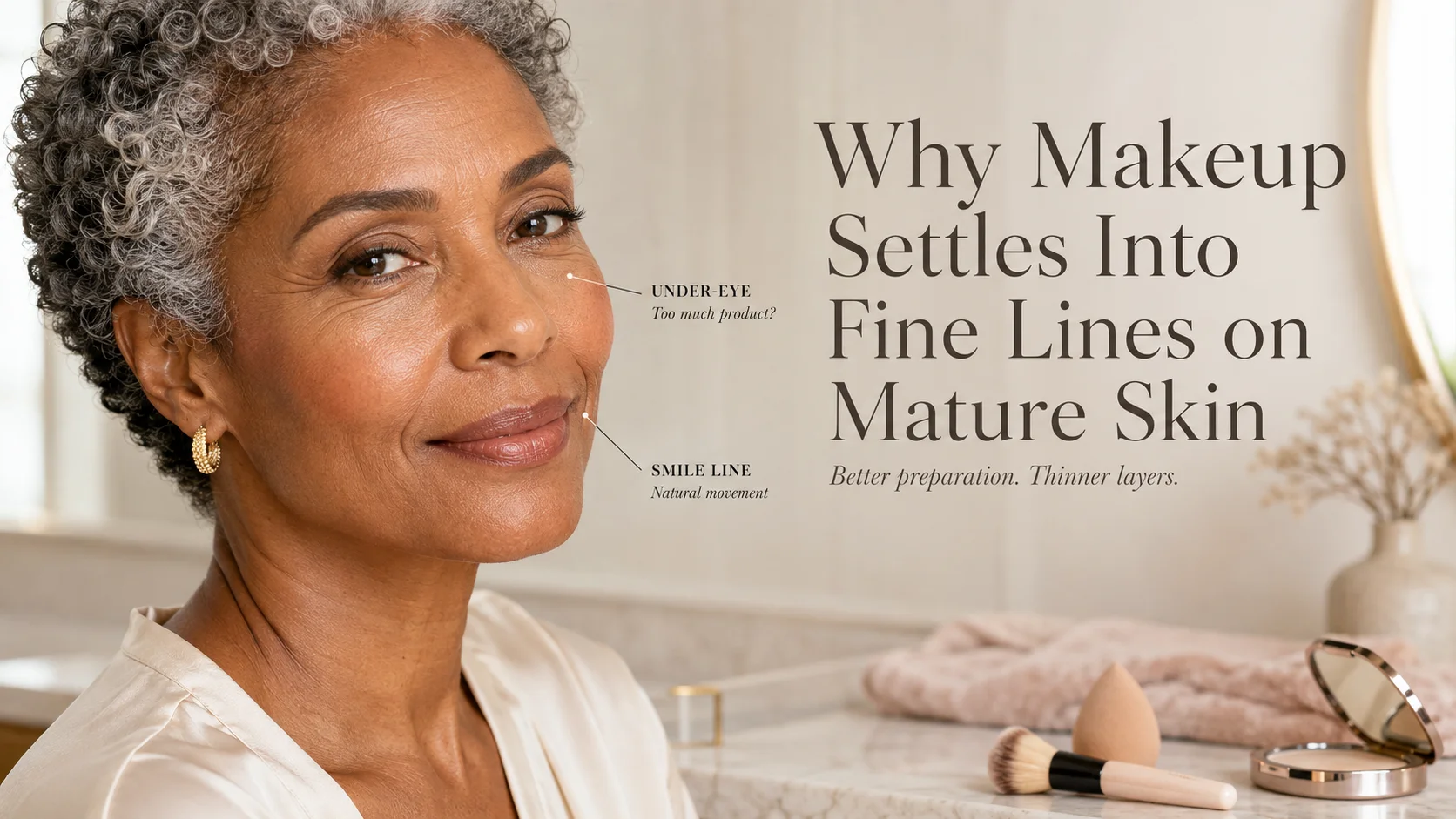
Makeup may settle into fine lines when:
Do not scrub the skin to make makeup sit more smoothly.
Improve the skincare base first.
Use lighter makeup layers.
The eye area may become:
A separate eye product may help when the facial moisturizer:
Eye care should be applied in a small amount.
More product may increase puffiness or migration.
The neck and décolleté may receive less consistent care than the face.
They may also be exposed to:
A mature-skin routine may extend gentle cleansing, moisturizer, and daytime protection to exposed neck and décolleté areas when appropriate.
Do not assume every strong facial active will be tolerated on the neck.
Introduce retinol or exfoliating products separately and cautiously.
The same routine may feel different across seasons.
Mature skin may need:
Mature skin may prefer:
Seasonal flexibility is appropriate.
A routine does not need to remain identical all year.
Indoor heating may leave mature skin feeling:
Avoid sitting directly in front of heaters.
Review whether the moisturizer remains sufficient throughout the day.
A clean, properly maintained humidifier may help some indoor environments feel more comfortable, but it does not replace an appropriate skincare routine.
Air conditioning may affect mature skin during:
The skin may look oily outside but feel tight indoors.
A lightweight moisturizer or hydrating serum may still be useful during humid weather when much of the day is spent in air conditioning.
Travel may involve:
Bring the products the skin already tolerates.
A travel routine may remain:
Morning: Gentle cleanser or rinse → moisturizer → SPF
Evening: Gentle cleanser → moisturizer
Do not introduce a new retinol, acid, mask, or fragranced product during travel.
Daytime protection remains important for mature skin.
A morning routine may include:
Gentle cleanser or rinse → serum if needed → moisturizer → SPF
SPF supports a routine focused on:
Do not use sunscreen as permission to overuse retinol or exfoliating acids.
Daytime protection and a gentle routine should work together.
Before adding:
confirm that the skin can tolerate:
If the skin cannot tolerate the foundation, adding more active products is unlikely to make the routine more comfortable.
A basic routine may be:
Gentle cleanser or lukewarm-water rinse if appropriate → moisturizer → SPF
A routine with one serum may be:
Gentle cleanser → hydrating or antioxidant serum → moisturizer → SPF
Do not add several serums automatically.
The morning routine should remain comfortable under sunscreen and makeup.
A basic evening routine may be:
Gentle cleanser → moisturizer
A routine with a comfort-focused serum may be:
Gentle cleanser → hydrating serum → moisturizer
An active-treatment evening may be:
Gentle cleanser → one active product according to directions → moisturizer
Do not use every treatment every night.
Gentle creamy, oil, or balm cleanser—or rinse if appropriate → hydrating serum if needed → supportive moisturizer → SPF
Gentle cleanser → comfort-focused serum if needed → richer moisturizer
Optional:
Avoid:
Gentle cleanser → lightweight hydrating serum if needed → lightweight moisturizer if needed → SPF
Gentle cleanser → lightweight moisturizer
A targeted active product may be added only when appropriate.
Avoid:
Gentle cleanser → lightweight hydration if needed → moisturizer according to area needs → SPF
Gentle cleanser → targeted treatment only where appropriate → moisturizer
Dry cheeks may need more support.
The T-zone may need a lighter texture.
The same amount of every product does not need to be applied everywhere.
Lukewarm-water rinse or gentle cleanser → tolerated moisturizer → tolerated SPF
Gentle cleanser → tolerated moisturizer
Once the skin is comfortable, one optional hydrating or comfort-focused serum may be introduced.
Avoid:
Gentle cleanser → hydrating or antioxidant serum if tolerated → moisturizer → SPF
Gentle cleanser → hydrating serum → moisturizer
Before adding exfoliation, review whether dullness is related to:
Dull-looking skin does not always need stronger exfoliation.
Lukewarm-water rinse or gentle cleanser if needed → tolerated moisturizer → tolerated SPF
Gentle cleanser → tolerated moisturizer
Temporarily pause:
The routine should feel simple and predictable.
Use:
Avoid massaging until the skin feels hot.
Some hydrating products may be applied to slightly damp skin.
Active products may require completely dry skin.
Follow the directions for the exact formula.
Follow the product directions and adjust within the recommended use according to:
Too little may not feel sufficient.
Too much may create:
More product does not automatically provide better results.
Many mature-skin routines include moisturizer morning and evening.
However, texture may change by time of day.
For example:
A lighter moisturizer that sits well under SPF and makeup.
A richer moisturizer that supports nighttime comfort.
Some people may use the same product for both.
The correct approach depends on skin type, season, and formula.
Fast absorption does not always mean the skin needs more product.
Observe how the skin feels after:
If tightness returns quickly, a more supportive texture or hydrating serum may be useful.
Do not keep applying layer after layer without reviewing the routine.
Possible reasons include:
Try simplifying the layers.
A lighter moisturizer may be more appropriate.
The cream may be too heavy, or the routine may contain too many occlusive layers.
Review:
A medium-weight lotion or cream may provide comfort without excessive heaviness.
This may suggest:
Do not respond by cleansing more often.
A lightweight hydrating serum or moisturizer may support comfort.
The cleanser or cleansing method may be the main issue.
Review:
Changing moisturizer alone may not solve tightness caused during cleansing.
Possible contributors include:
Review the complete morning and evening routine.
Do not rely only on repeated facial misting.
Do not scrub the skin.
Review:
Use lighter makeup layers.
Allow skincare to settle before applying foundation.
The eye area may need:
Do not apply facial acids close to the lash line.
Persistent eyelid irritation, swelling, crusting, discharge, pain, or vision changes need medical evaluation.
The neck may receive:
Apply gentle care to the neck when appropriate.
Introduce retinol or exfoliation separately.
The neck may be more sensitive than the face.
Pause or reduce retinol.
Review:
Do not continue through persistent burning or painful flaking.
Restart only when cleanser, moisturizer, and SPF feel consistently comfortable.
The visual result may be temporary while the routine is creating discomfort.
Reduce exfoliation.
Do not use tightness as proof of effectiveness.
A sustainable routine should support both appearance and comfort.
Stop using it.
A hydrating product may still contain:
Do not assume a product must be gentle because it is marketed as hydrating.
Return to the simplest routine that remains comfortable.
The moisturizer may not be the original cause.
Review:
Pause active products.
If several basic moisturizers continue to burn, seek dermatologist guidance.
Mature skin may prefer:
rather than a rich balm.
Maturity does not automatically determine texture preference.
Choose based on current skin behavior.
The skin may need:
Do not solve the problem by layering several lightweight products without reviewing whether one better moisturizer would be simpler.
Dullness may involve:
Do not immediately add a strong peel.
Review hydration, cleanser, SPF, and active-product frequency first.
Hydration may support a smoother-looking surface and soften the appearance of fine dryness lines.
It cannot permanently remove natural lines or stop the skin from maturing.
A well-aging routine should focus on:
Avoid products that promise to erase every line.
That may be enough.
A routine does not need toner, serum, oil, mask, retinol, and exfoliation to be complete.
Optional products should be added only when:
Simple routines can be effective routines.
Return to:
Gentle cleanser or rinse → moisturizer → SPF
Gentle cleanser → moisturizer
Then add one optional serum only when needed.
A shorter routine may improve consistency and make reactions easier to understand.
A product described as mature-skin care still requires careful introduction.
Once the skin feels consistently comfortable:
Do not restart retinol, acids, vitamin C, and exfoliating masks at the same time.
Seek dermatologist guidance when the skin develops:
Seek urgent medical care for:
Cosmetic skincare can support hydration and comfort.
It cannot diagnose a medical condition.
After consultation, our licensed esthetician may consider Janssen Cosmetics options based on whether mature skin is dry, oily, combination, sensitive, dehydrated, redness-prone, or concerned about texture and comfort.

Possible mature-skin options may include:
These products are possible options.
They do not belong in one automatic routine.
A simple mature-skin routine may begin with:
One appropriate cleanser → one appropriate moisturizer → daytime protection
One appropriate cleanser → one appropriate moisturizer
Once this foundation feels comfortable, a serum may be added.
For example:
Cleanser → Micellar Skin Tonic if appropriate → Age Perfecting Serum → selected moisturizer → daytime protection in its officially directed order
Cleanser → Micellar Skin Tonic if appropriate → Night Recovery Serum → selected moisturizer
Multi Action Cleansing Balm or Luxury Oil Cleanser → optional Micellar Skin Tonic → Age Perfecting Serum or Night Recovery Serum according to time of day → Rich Recovery Cream
This is only an example of possible routine logic.
It is not a universal recommendation.
Appropriate cleanser → optional tonic → selected serum if needed → Perfect Lift Cream
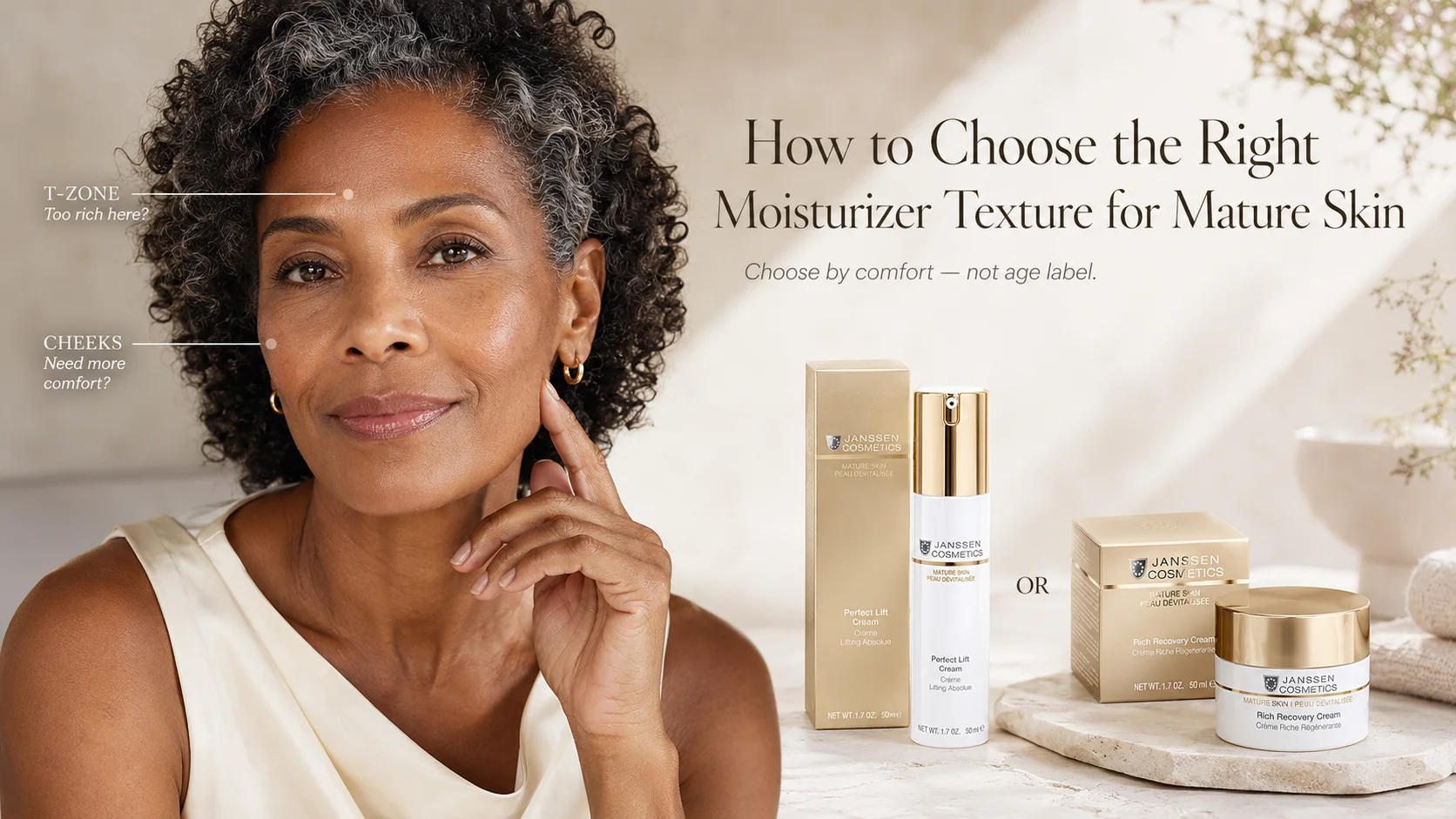
The choice between Perfect Lift Cream and Rich Recovery Cream should depend on:
Rich Recovery Cream may feel more appropriate for dry mature skin that wants richer comfort.
Perfect Lift Cream may suit mature skin that wants a supportive cream without automatically choosing the richest option.
Age Perfecting Serum and Night Recovery Serum should not automatically be layered together.
One may be selected according to the time of day and the routine’s purpose.
Ceramide Protection may be considered when mature, dry skin needs additional lipid-focused support.
It should be used according to its official directions and should not be combined blindly with several facial oils, capsules, and rich creams.
Rejuvenating Mask remains an occasional add-on.
It should not be treated as a substitute for daily moisturizer.
Tri-Care Eye Cream should be applied in a small amount around the eye contour according to its directions.
It should not be combined automatically with facial retinol near the eyes.
Face Guard Advanced has specific official layering instructions.
Its position relative to serum, capsules, and moisturizer should follow the verified product directions and personalized consultation plan rather than a generic sunscreen chart.
If mature skin is currently burning, swollen, rash-like, painfully flaky, or reacting to moisturizer or SPF, active exfoliation, retinol, strong vitamin C, and professional-style treatments should wait.
Professional peel products belong in professional treatment settings.
Do not treat mature skin as damaged or defective.
Do not promise to reverse aging.
Do not assume every mature complexion is dry.
Do not assume every mature complexion needs the richest cream.
Do not skip moisturizer because the skin looks oily.
Do not use strong cleanser to remove every trace of oil.
Do not wash the face repeatedly throughout the day.
Do not use very hot water.
Do not scrub dry or flaky skin.
Do not increase exfoliation because the skin looks dull.
Do not use acid cleanser, acid toner, exfoliating serum, scrub, and retinol together.
Do not continue retinol through persistent burning.
Do not apply facial retinol close to the eyes, mouth corners, or irritated nostril folds.
Do not use several serums without a clear purpose.
Do not assume serum always replaces cream.
Do not apply facial oil automatically.
Do not layer rich cream, balm, oil, and sleeping mask without a clear need.
Do not use a hydrating mask as a substitute for daily moisturizer.
Do not add undiluted essential oils to moisturizer or facial oil.
Do not use fragrance-heavy products on already reactive skin.
Do not exfoliate to fix makeup settling into fine lines.
Do not expect hydration to permanently remove natural lines.
Do not stop SPF while continuing retinol or exfoliating products.
Do not use professional peel products at home.
Do not continue a product simply because it is labeled for mature skin.
Do not ignore persistent burning, painful cracking, bleeding, swelling, blistering, crusting, eye symptoms, or infection-looking changes.
Mature skin may feel less able to maintain the same soft, flexible, moisturized feeling it had previously. Gentle cleansing, appropriate moisturizer, and supportive hydration may help improve comfort.
No. Mature skin may be dry, oily, combination, sensitive, blemish-prone, or dehydrated.
Yes. Oily skin may still feel tight, show fine dehydration lines, or become uncomfortable after strong cleansing and exfoliation.
Dry skin generally lacks oil or lipid comfort, while dehydrated skin lacks water. Mature skin may experience one or both.
Possible signs include tightness, fine surface lines, dullness, roughness, makeup separation, and skin that looks oily but feels uncomfortable.
Some dry mature skin may prefer a balm, oil, milk, or cream cleanser. Oily mature skin may prefer a lighter gentle cleanser. The skin should feel comfortable after rinsing.
Some mature skin benefits from gentle morning cleansing. Dry or sensitive mature skin may prefer a lukewarm-water rinse. The decision depends on oiliness, sweat, nighttime products, and comfort.
No. Toner is optional. A gentle, alcohol-free tonic may add light hydration, while an acid or astringent toner may feel too active.
Not always. A serum may provide additional hydration or targeted support, but the routine can remain complete with cleanser, moisturizer, and SPF.
Lightweight serums are generally applied before cream unless the exact product directions state otherwise.
Some oily mature skin may find a serum and moisturizing SPF sufficient in humid conditions. Dry mature skin will often still need a cream over serum.
The best texture depends on skin type. Dry mature skin may prefer a richer cream, while oily or combination mature skin may prefer a lotion, emulsion, or light cream.
The skin’s dryness, environment, active-product use, cleanser, or texture needs may have changed.
Facial oil is optional. It may support comfort for some dry mature skin but feel heavy for oily or combination mature skin.
Yes, when the formula is appropriate and tolerated. A mask is an occasional add-on, not a replacement for daily moisturizer.
Hydration may support a smoother-looking surface and reduce the appearance of fine dryness lines. It does not permanently remove natural lines.
Dryness can make the surface look less flexible and make fine lines appear more noticeable.
Dryness, product layering, retinol, over-exfoliation, too much foundation, heavy powder, or an unsuitable moisturizer may contribute.
Not automatically. Too much exfoliation may increase dryness, flaking, burning, and sensitivity.
Some mature skin may use retinol carefully. The basic cleanser, moisturizer, and SPF routine should feel comfortable first.
Why does retinol make mature skin feel drier?
Retinol may increase dryness, flaking, or sensitivity, especially when used too frequently or combined with acids.
A consistent daytime protection routine is important, especially when using retinol, exfoliating acids, vitamin C, or uneven-tone products.
A consistent daytime protection routine is important, especially when using retinol, exfoliating acids, vitamin C, or uneven-tone products.
Air-conditioned environments may reduce comfort and leave the skin feeling tight, especially around the cheeks and eyes.
Cold air, wind, indoor heating, hot water, and unchanged active-product frequency may all contribute.
Pause active products and simplify the routine. Seek dermatologist guidance if basic moisturizers, cleanser, SPF, or water continue to cause significant discomfort.
Seek guidance for persistent burning, significant swelling, severe itching, painful cracking, bleeding, blistering, crusting, infection-looking changes, eye symptoms, deep painful blemishes, or sudden changes that do not improve.
If your mature skin feels drier, tighter, less comfortable, or different from the way it felt in the past, a free virtual consultation can help you understand what may need to change.
At Zendevie, we review your cleanser, moisturizer texture, hydration level, oiliness, sensitivity, serum use, retinol schedule, exfoliation, eye-area comfort, climate, makeup, and daytime protection before discussing products.
The goal is not to give every mature complexion the richest cream or the longest routine.
The goal is to help your skin feel supported, comfortable, and cared for with products selected according to its current needs.

Zendevie is guided by Haby Diallo, a licensed esthetician with more than 20 years of professional skincare experience. Her approach is rooted in education, professional judgment, and personal care.
years of experience