



When skin feels irritated, the first reaction is often to add something.
You may reach for:
The intention is understandable.
You want the burning, tightness, warmth, flaking, or redness-looking areas to improve as quickly as possible.
But adding several new products may make the routine more difficult to understand.
If the skin reacts again, you may not know whether the problem came from:
Sensitive skin often needs fewer variables before it needs more products.
At Zendevie, our licensed esthetician first looks at what the skin already tolerates. The goal is to identify the simplest comfortable foundation and remove unnecessary product stress while the skin is reactive.
Simplifying does not mean giving up on skincare.
It means making the routine easier to evaluate.
When skin feels irritated, begin by reducing the routine to the essential steps it can tolerate.
A simple starting routine may be:
Morning: Gentle cleanser or lukewarm-water rinse if appropriate → moisturizer → SPF
Evening: Gentle cleanser → moisturizer
Temporarily pause products such as:
Do not force the skin to use a product that repeatedly causes strong burning, itching, swelling, pain, rash-like changes, or worsening discomfort.
Seek dermatologist guidance when the reaction is persistent, significantly swollen, blistering, crusting, bleeding, infection-looking, close to the eyes, severely itchy, painful, or continuing to worsen after suspected products are stopped.
Seek urgent medical care for breathing difficulty, throat tightness, faintness, or rapid swelling of the face, lips, tongue, or eyes.
Simplifying means removing steps that are not essential while the skin feels uncomfortable.
A simplified routine focuses on:
It does not mean the routine must remain minimal forever.
It means the skin is given a clearer, more predictable routine while you identify what may be contributing to the reaction.
Some people hear “simplify” and think they should stop every product immediately.
That may not always be practical.
The skin may still need:
The goal is not to abandon basic care.
The goal is to stop unnecessary or poorly tolerated steps.
If even the basic products burn or sting, the routine may need professional evaluation.

Every additional product introduces more variables.
A routine may include:
When irritation appears, it becomes difficult to know which step is responsible.
Reducing the number of products can help you observe:
A simpler routine creates clearer information.
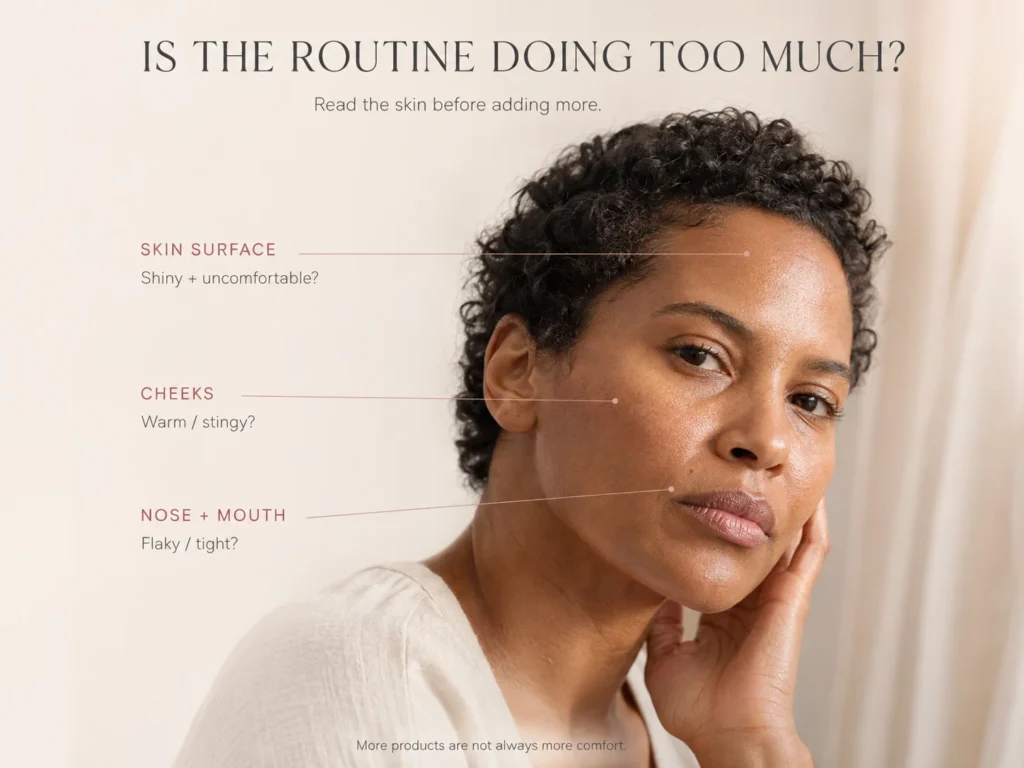
Consider simplifying when the skin:
These signs do not identify one exact cause.
They are reasons to stop adding more variables.
One product may be responsible.
However, irritation may also come from the total routine.
For example:
Acid cleanser → acid toner → vitamin C → moisturizer → SPF
may feel too active even if each product is used according to its own label.
An evening routine such as:
Exfoliating cleanser → retinol → active moisturizer
may also be too much for reactive skin.
The problem may be the combination, frequency, or timing rather than one ingredient alone.
When skin suddenly becomes uncomfortable, ask:
The newest change may provide an important clue.
Stop adding more products until the pattern is clearer.
When the skin is irritated, it is not the best time to test:
Even products marketed as calming may contain ingredients the skin has never used.
Use familiar products that remain comfortable.
Ask what each product does in the routine.
A basic routine usually needs:
Everything else is optional.
A toner, serum, mask, facial oil, eye cream, retinol, acid, or exfoliating product should have a clear purpose.
If you cannot explain why a product is being used, it may not need to remain in the routine while the skin is irritated.
Cleansing is often the first step to review because it affects the skin every day.
Ask:
If cleansing leaves the skin hot, raw, or painfully tight, the routine is not beginning comfortably.
A gentler cleansing approach may include:
The skin should feel clean without feeling stripped.
Not every sensitive complexion needs the same morning cleansing method.
Some skin may still need a mild morning cleanse because of:
Other skin may prefer a lukewarm-water rinse when it feels dry or tight.
The decision depends on:
Do not follow a rigid rule if it repeatedly leaves the skin uncomfortable.
At night, the skin may need cleansing to remove:
Simplifying the routine does not mean sleeping in makeup or heavy sunscreen.
Use the gentlest effective method.
Do not scrub the skin because the routine has fewer products.
Double cleansing may be useful when wearing:
It may be unnecessary when the skin has only light product buildup.
If double cleansing leaves the skin tight or hot, review:
Two cleansing steps should not become two opportunities to strip the skin.
A cleanser may contain:
These should be counted as active products.
When the skin feels irritated, an active cleanser may need to pause.
Use a mild cleansing foundation instead.
Toner is optional.
A toner may be:
These products do not perform the same role.
If toner causes stinging, heat, tightness, or dryness, pause it.
The routine can remain complete without toner.
An acid toner is an exfoliating step.
It may contain:
If the skin is burning, flaky, hot, or reacting to moisturizer, acid toner should wait.
Do not keep using it because toner feels like a required step.
Some toners create a clean or tight feeling.
Sensitive skin may find this uncomfortable, especially when the skin is already:
A tight feeling is not proof that pores are cleaner.
When skin feels irritated, pause:
Do not exfoliate flakes caused by irritation.
The skin may feel rough because it is dry or over-exfoliated.
More exfoliation may make the discomfort worse.
Flaking may be associated with:
Scrubbing may leave the underlying area feeling more raw.
Instead:
Persistent, painful, crusting, bleeding, or worsening flaking should be evaluated by a dermatologist.
Retinol is an optional active product.
It should wait when the skin is:
Do not continue retinol because you believe the skin must adjust.
Sensitive skin should not be forced through repeated discomfort.
Once the skin feels better, it may be tempting to restart retinol immediately.
Wait until:
Then reintroduce retinol slowly only if it still serves a clear purpose.
Vitamin C may remain comfortable for some sensitive skin.
Other formulas may feel active.
Pause vitamin C when it causes:
Do not assume every morning routine must include vitamin C.
Daily SPF and routine comfort remain important.
A routine may include several serums for:
When skin is irritated, several serums may create more uncertainty.
Temporarily remove all nonessential serums.
Once the skin feels stable, one serum may be reconsidered according to the main concern.
A product marketed as hydrating may still contain:
Do not keep using a serum simply because its purpose sounds gentle.
The skin’s response matters.
Moisturizer is often one of the most important steps in a simplified routine.
The correct texture depends on whether the skin is:
A moisturizer should help the skin feel comfortable without persistent burning, itching, heat, or heaviness.
Dry-sensitive or mature-sensitive skin may prefer a richer cream.
Oily-sensitive or combination-sensitive skin may prefer a lighter lotion.
A thick texture is not automatically more supportive.
If the cream feels:
a lighter texture may be more suitable.
A thin gel may feel pleasant but may not provide lasting comfort for dry-sensitive skin.
Signs the moisturizer may be too light include:
The correct texture should support comfort without unnecessary heaviness.
If moisturizer burns, review what was applied before it.
Possible contributors include:
The moisturizer may not be the original cause.
Pause earlier active steps.
If even a familiar moisturizer continues to burn, seek dermatologist guidance.
Facial oil is optional.
It may feel useful for some dry-sensitive skin.
It may also:
Do not add facial oil automatically because the skin is irritated.
First confirm that the basic moisturizer is appropriate.
A balm may help certain dry areas feel more protected.
However, thick occlusive products may feel uncomfortable on:
Targeted use may be more appropriate than full-face use.
Do not apply a heavy balm over skin that is hot, sweaty, or developing rash-like changes without guidance.
Daytime protection remains important, especially when the skin has recently used:
A simplified morning routine may be:
Gentle cleanser or rinse → moisturizer → SPF
However, sunscreen should feel comfortable enough to use consistently.
SPF may sting because:
Do not continue strong active products while avoiding SPF.
Review the routine first.
A different sunscreen texture or formula may be needed.
A morning routine may include:
Sensitive skin may not need every step.
Too many layers may contribute to:
Keep the morning routine purposeful.
Masks are optional.
Pause masks when the skin is irritated, especially:
Even a soothing mask may introduce new ingredients.
A cleanser and moisturizer may be enough while the skin is reactive.
When the face feels hot or red-looking, a soothing mask may sound helpful.
But the mask may contain:
Begin with the simplest comfortable routine.
Add a mask only when it is already known to be tolerated and serves a clear purpose.
Fragrance does not bother every sensitive complexion.
However, strongly fragranced skincare may be harder to tolerate when the skin is already:
Pause fragrance-heavy products if they create repeated discomfort.
Review total fragrance exposure from:
Do not apply pure essential oils directly to irritated facial skin.
Avoid:
Natural does not automatically mean gentle.
A concentrated aromatic oil may make sensitive skin more uncomfortable.
Friction may come from:
Use light pressure.
Pat rather than rub.
Do not massage products until the skin feels hot.
Makeup wipes may feel convenient.
But they can involve repeated friction.
If wipes leave the skin:
use a gentler makeup-removal method the skin tolerates.
Do not scrub waterproof makeup away.
Makeup may contribute to discomfort when it is layered over irritated skin.
Possible issues include:
Consider reducing makeup until the skin feels more comfortable.
Do not cover a painful, swollen, crusting, or infection-looking reaction with makeup.
Hair products may touch:
Possible contributors include:
If irritation appears near the hairline, facial skincare may not be the only factor.
Keep hair products away from the face when possible.
Very hot water may make sensitive skin feel:
Use lukewarm water.
Do not use freezing water or place ice directly on the face.
Extreme temperature changes may create additional discomfort.
The face may be cleansed:
Using a strong cleanser every time may create more irritation.
After light sweating, a gentle rinse may be enough for some skin.
After heavy makeup, SPF, or outdoor buildup, gentle cleansing may be needed.
Match cleansing to what is actually on the skin.
Shaving, waxing, threading, dermaplaning, and hair-removal creams may temporarily make the skin more reactive.
Avoid immediately applying:
Wait until the skin feels comfortable.
Do not apply strong active products to skin that feels:
After sun exposure, simplify.
Use products the skin already tolerates.
If the skin is blistering, significantly swollen, severely painful, or worsening, seek medical guidance.
The skin may feel more reactive after:
Follow the provider’s aftercare instructions.
Do not add home acids, retinol, scrubs, or essential oils against that guidance.
Professional exfoliation products should remain in professional settings.
Constantly changing the routine creates more uncertainty.
Once a simple routine is established, observe:
Do not add a new product every day because the skin is not immediately perfect.
Skin comfort may take time.
Once the skin feels stable, optional products may be added again carefully.
The simplified routine serves as a foundation.
It helps you identify:
The goal is not to avoid every active product forever.
The goal is to use only what the skin can tolerate and what serves a clear purpose.
There is no universal number of days.
Keep the routine simple until:
Persistent or severe symptoms should not be managed through skincare experimentation.
Seek dermatologist guidance.
Once the skin feels stable:
One product at a time creates clearer information.
The first optional product depends on the main concern.
Examples may include:
Do not reintroduce the strongest active first simply because it feels most important.
Routine comfort remains the foundation.
Avoid restarting:
all at the same time.
You will not know which step causes discomfort if the skin reacts again.
Write down:
A simple record may reveal patterns that are difficult to remember.
A basic morning routine may be:
Gentle cleanser or lukewarm-water rinse if appropriate → moisturizer → SPF
If moisturizer is unnecessary for a very oily complexion and the SPF itself provides enough comfort, this may be assessed individually.
Do not assume every person needs the same number of steps.
A basic evening routine may be:
Gentle cleanser → moisturizer
If makeup or water-resistant SPF is worn, use an appropriate removal method without aggressive rubbing.
No toner, serum, oil, mask, or active product is required while the skin feels irritated.
Gentle cleanser or rinse → supportive moisturizer → SPF
Gentle cleanser → richer moisturizer if appropriate
Avoid:
Gentle cleanser → lightweight moisturizer if needed → SPF
Gentle cleanser → lightweight moisturizer
Avoid:
Oily-sensitive skin can still feel dehydrated and uncomfortable.
Gentle cleanser → moisturizer according to area needs → SPF
Gentle cleanser → appropriate moisturizer
Do not apply acids across the whole face because the T-zone looks oily.
Dry or reactive cheeks may need a simpler approach.
Gentle cleanser or rinse → moisturizer → SPF
Gentle cleanser → moisturizer
Temporarily pause:
A well-aging routine should not make the skin feel raw, hot, or persistently tight.
Gentle cleanser or rinse → comfortable moisturizer → SPF
Gentle cleanser → moisturizer
Avoid:
Persistent or worsening redness-looking areas may need dermatologist evaluation.
A basic routine may be:
Morning: Gentle cleanser → lightweight moisturizer → SPF
Evening: Gentle cleanser → lightweight moisturizer
Pause several clarifying products at once.
Do not combine:
Painful, deep, swollen, infection-looking, crusting, bleeding, persistent, or scarring blemishes should be evaluated by a dermatologist.
Winter may increase:
A winter simplification may include:
Hot, humid weather may increase:
A hot-weather simplification may include:
Travel is not the best time to create a new routine.
Pack:
Optional products should already be tolerated.
Avoid relying on:
A familiar routine is easier to manage.
Pause:
Use only:
Morning: Gentle cleanser or rinse → moisturizer → SPF
Evening: Gentle cleanser → moisturizer
Do not exfoliate the flakes created by exfoliation.
Pause retinol.
Also pause:
Use a gentle cleanser and moisturizer.
Continue SPF when tolerated.
Do not restart retinol until the basic routine feels consistently comfortable.
Stop the suspected product.
Review other fragrance exposure from:
Do not immediately replace the product with several new fragrance-free options.
Use the familiar products the skin already tolerates.
Stop the essential-oil product.
Do not apply another essential oil to calm the area.
Avoid:
Return to the simplest tolerated routine.
The eye area may need fewer products than the rest of the face.
Avoid applying facial:
close to the lash line or eyelids unless the product is designed for that area.
Use a separate eye-area product only when appropriate and tolerated.
Seek medical guidance for significant swelling, pain, crusting, discharge, vision changes, or persistent irritation.
Products may collect around:
Avoid applying acids, retinol, fragrance, or essential oils to areas that are:
Persistent mouth- or nose-area irritation should be evaluated by a dermatologist.
Review whether the simplified products are truly tolerated.
Possible issues include:
Simplifying cannot solve every skin reaction.
If symptoms worsen, seek dermatologist guidance.
The moisturizer may not suit the skin.
It may also be applied to skin already irritated by cleansing or an earlier active product.
Pause the moisturizer if it repeatedly burns.
Do not test several new moisturizers on the same day.
Seek guidance if the skin cannot tolerate any basic moisturizer.
Stop using the cleanser.
Rinse gently with lukewarm water.
Do not follow it with toner, acid, retinol, or scrub.
If cleansing remains uncomfortable with several gentle approaches, professional evaluation may be needed.
Water stinging may suggest that the skin is highly reactive or already significantly irritated.
Avoid:
If even lukewarm water causes significant or persistent discomfort, seek dermatologist guidance.
Review:
A different formula may be needed.
Do not continue strong actives while leaving the skin unprotected during the day.
Reduce unnecessary layers.
Consider:
Do not respond by washing more often or skipping all moisture support.
The cream may be too occlusive or the routine may contain too many layers.
Review:
A different moisturizer texture may be more appropriate.
Visible redness-looking areas may take time to settle.
Do not layer several redness-focused products immediately.
Use the simplest tolerated routine.
Persistent, painful, swollen, hot, eye-related, or worsening redness should be evaluated by a dermatologist.
Pause active products.
Avoid:
Persistent heat, pain, swelling, blistering, or rash-like changes need professional evaluation.
Do not scrub.
Review:
Persistent, painful, crusting, bleeding, or worsening flaking should be evaluated by a dermatologist.
Possible contributors include:
Do not assume stronger exfoliation is needed.
Seek guidance if bumps are itchy, painful, swollen, rash-like, infection-looking, spreading, persistent, or scarring.
Stop the suspected product.
Do not scratch.
Avoid:
Persistent, severe, spreading, swollen, rash-like, or sleep-disrupting itching should be evaluated by a dermatologist.
Stop the suspected product.
Significant swelling—especially around the eyes, lips, tongue, or throat—needs prompt medical attention.
Seek urgent care for:
Do not attempt to manage a severe reaction with additional skincare.
That is useful information.
It may suggest that the previous routine contained:
Do not assume you need to rebuild the longer routine.
A simple routine can remain complete.
It is normal to worry that pausing actives will delay progress.
But continuing actives through irritation may make the routine harder to tolerate.
Temporary simplification can help you build a more sustainable plan.
Consistency matters more than forcing every ingredient into the routine.
Do not reintroduce optional products when the skin is:
The skin needs stability first.
Consider reintroducing one product when the skin is:
This does not guarantee tolerance.
It creates a clearer starting point.
Simplifying does not mean giving every sensitive complexion the same moisturizer.
Dry-sensitive skin may need richer comfort.
Oily-sensitive skin may prefer a lighter lotion.
Combination-sensitive skin may need different support in different zones.
Mature-sensitive skin may need more moisture while using fewer actives.
The routine can be simple and still personalized.
A dermatologist should evaluate the skin when irritation includes:
Seek urgent medical care for breathing difficulty, throat tightness, faintness, or rapid swelling of the face, lips, tongue, or eyes.
Cosmetic skincare can help simplify a routine.
It cannot diagnose allergy, dermatitis, rosacea, eczema, infection, or another medical condition.
After consultation, our licensed esthetician may consider Janssen Cosmetics options based on which foundational steps the skin can tolerate and whether the complexion is dry-sensitive, oily-sensitive, combination-sensitive, mature-sensitive, or redness-prone.
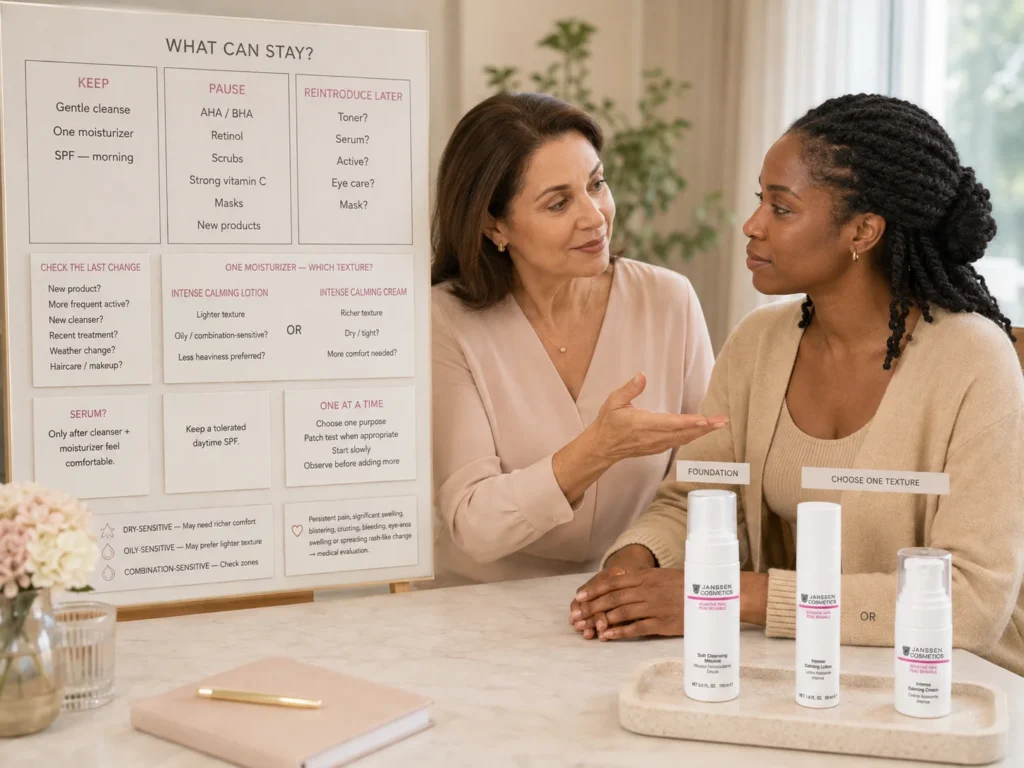
Possible sensitive-skin options may include:
These are possible options, not one automatic routine.
When the skin feels irritated, a consultation-led Janssen routine may begin with only:
Soft Cleansing Mousse → one appropriate moisturizer → Face Guard Advanced during the day
A tonic, serum, mask, and eye product should not be added automatically.
If the skin prefers a lighter texture, Intense Calming Lotion may be considered.
If the skin is dry, tight, or prefers richer comfort, Intense Calming Cream may be considered.
The choice depends on:
Soft Soothing Tonic may be considered only when the skin tolerates an additional post-cleansing step.
Intense Calming Serum may be introduced only after the basic cleanser and moisturizer routine feels comfortable.
Instant Soothing Mask remains an optional add-on, not an emergency requirement.
Active Janssen options from other lines—including AHA, BHA, enzyme exfoliation, retinol, or stronger vitamin C products—should wait while the skin is burning, hot, flaky from irritation, swollen, or reacting to moisturizer or SPF.
Professional exfoliation systems belong in professional treatment settings and should not be used as home solutions for irritated skin.
Do not add several calming products at once.
Do not start a new serum while the skin is actively reacting.
Do not continue using a cleanser that leaves the face hot, raw, or painfully tight.
Do not use acid toner because toner feels required.
Do not scrub flakes.
Do not use AHA, BHA, retinol, facial scrub, and peeling mask together.
Do not continue retinol through persistent burning.
Do not assume strong vitamin C must remain in every morning routine.
Do not use multiple serums without a clear purpose.
Do not assume every sensitive complexion needs a rich cream.
Do not skip moisturizer automatically because the skin looks oily.
Do not add facial oil simply because the skin is irritated.
Do not use a mask to cover a product reaction.
Do not apply undiluted essential oils.
Do not use fragrance-heavy products on already reactive skin.
Do not cleanse repeatedly throughout the day.
Do not use very hot or freezing water.
Do not place ice directly on the face.
Do not use rough towels, brushes, scrubs, or aggressive makeup wipes.
Do not apply facial actives close to the eyes, mouth corners, or irritated nostril folds.
Do not apply active products immediately after shaving, waxing, threading, dermaplaning, sun exposure, or professional exfoliation.
Do not use hotel soap or body lotion as facial care when traveling.
Do not reintroduce every active product at once.
Do not use professional peeling products at home.
Do not keep using a product because it was expensive or popular.
Do not diagnose persistent reactions through skincare alone.
Do not ignore significant swelling, blistering, crusting, bleeding, infection-looking changes, eye-area symptoms, breathing difficulty, or worsening reactions.
Reduce the routine to a gentle cleanser, appropriate moisturizer, and daytime SPF when tolerated. Pause active, exfoliating, fragranced, and unfamiliar products.
Consider pausing retinol, AHA, BHA, acid toners, scrubs, enzyme peels, strong vitamin C, clay masks, drying spot products, essential oils, and new products.
Not always. The skin may still need gentle cleansing, moisturizer, and daytime protection. Stop the products that are unnecessary or clearly uncomfortable.
There is no universal number. Many routines can temporarily be reduced to two evening steps and two or three morning steps.
Toner is optional. Pause it if it stings, feels drying, or contains exfoliating acids, alcohol, fragrance, or strong astringent ingredients.
Serums are optional. Pause nonessential serums until cleanser, moisturizer, and SPF feel comfortable.
A moisturizer may help the skin feel more comfortable, but the formula and texture should suit the skin. Stop and reassess if it repeatedly burns.
The skin may already be uncomfortable from cleansing, acids, retinol, shaving, sun exposure, or another product. The moisturizer formula may also not suit the skin.
No. Flaking may be a sign of dryness or over-exfoliation. Scrubbing may make the skin feel more raw.
Yes. Retinol should wait when the skin is burning, swollen, rash-like, painfully flaky, or reacting to basic products.
Pause it if it causes stinging, heat, tightness, or burning. Vitamin C is optional while the skin is reactive.
Review whether the skin is over-exfoliated or the formula is unsuitable. Do not continue strong active products while avoiding daytime protection.
Yes. A simple oily-sensitive routine may include a gentle cleanser, lightweight moisturizer, and SPF. Avoid stripping the skin.
Sometimes. Oily zones may not need the same treatment as dry, reactive cheeks. Keep targeted care simple.
A mask is optional and may contain fragrance or active ingredients. Begin with cleanser and moisturizer rather than adding an unfamiliar mask
Do not apply undiluted essential oils to irritated facial skin. Natural aromatic ingredients may still cause discomfort.
Keep it simple until cleanser, moisturizer, and SPF feel consistently comfortable and the skin is no longer burning, swollen, rash-like, or painfully flaky.
Reintroduce only one product at a time, start slowly, patch test when appropriate, and observe the skin before adding anything else.
Stop introducing new products and seek dermatologist guidance if cleanser, moisturizer, SPF, or water continues to cause significant discomfort.
See a dermatologist if irritation is persistent, painful, significantly swollen, blistering, crusting, bleeding, infection-looking, near the eyes, repeatedly returning, or not improving after suspected products are stopped.
If your routine has become complicated and your skin still burns, stings, flakes, feels hot, or reacts to basic products, a free virtual consultation can help you identify which steps may be unnecessary.
At Zendevie, we review your cleanser, toner, serums, moisturizer, SPF, retinol use, exfoliation schedule, fragrance exposure, essential oils, makeup, haircare, weather, travel, and reaction history before discussing what to keep, pause, or reintroduce.
The goal is not to remove every product forever.
The goal is to build the simplest comfortable foundation first and add only the products that serve a clear purpose for your skin.

Zendevie is guided by Haby Diallo, a licensed esthetician with more than 20 years of professional skincare experience. Her approach is rooted in education, professional judgment, and personal care.
years of experience