

Oily skin and combination skin can look similar at first.
The forehead gets shiny. The nose feels greasy. Makeup separates around the center of the face. Pores may look more noticeable in the T-zone. Blackheads or whiteheads may show up around the nose, chin, or forehead.
Because of that, many people assume they have oily skin.
But the cheeks may tell a different story.
If your cheeks feel normal, dry, tight, sensitive, or rough while your T-zone gets oily, you may not have fully oily skin. You may have combination skin.
This matters because treating combination skin like fully oily skin can make the cheeks feel stripped while the T-zone still shines.
In consultation, our licensed esthetician does not choose products from one label alone. We look at where oil appears, where the skin feels tight, where clogged-looking pores show up, and how the skin reacts after cleansing.
Oily skin usually produces visible oil across most of the face, including the forehead, nose, chin, and often the cheeks.
Combination skin usually has an oily T-zone with normal, dry, or tighter cheeks.
A simple way to tell:
If the whole face gets shiny, you may have oily skin.
If only the forehead, nose, and chin get shiny while cheeks feel different, you may have combination skin.
The routine should match the pattern. Oily skin may need more consistent oil-aware care across the face. Combination skin often needs zone-specific placement.
Oily skin and combination skin do not always need the same routine.
If you use strong oily-skin products all over a combination face, the cheeks may become dry or irritated.
If you use rich dry-skin products all over an oily face, the T-zone may become greasy or congested-looking.
The skin may need different amounts, textures, or active ingredients by area.
That is why the first step is not buying products. The first step is reading the face correctly.
Oily skin often has visible shine across most of the face.

You may notice:
Oily skin may still feel dehydrated or sensitive, but oil production is usually more widespread.
Combination skin usually has mixed zones.
The T-zone may be oily, while the cheeks behave differently.
You may notice:
Combination skin is not rare. It simply means the face has more than one behavior pattern.
The T-zone includes the forehead, nose, and chin.
This area often produces more visible oil than the cheeks. For combination skin, the T-zone is usually the main oily area.
If your T-zone gets shiny but your cheeks feel comfortable, dry, or tight, your routine should not treat the whole face like the nose.
The T-zone may need clarifying care. The cheeks may need lighter hydration, less exfoliation, or a softer moisturizer texture.
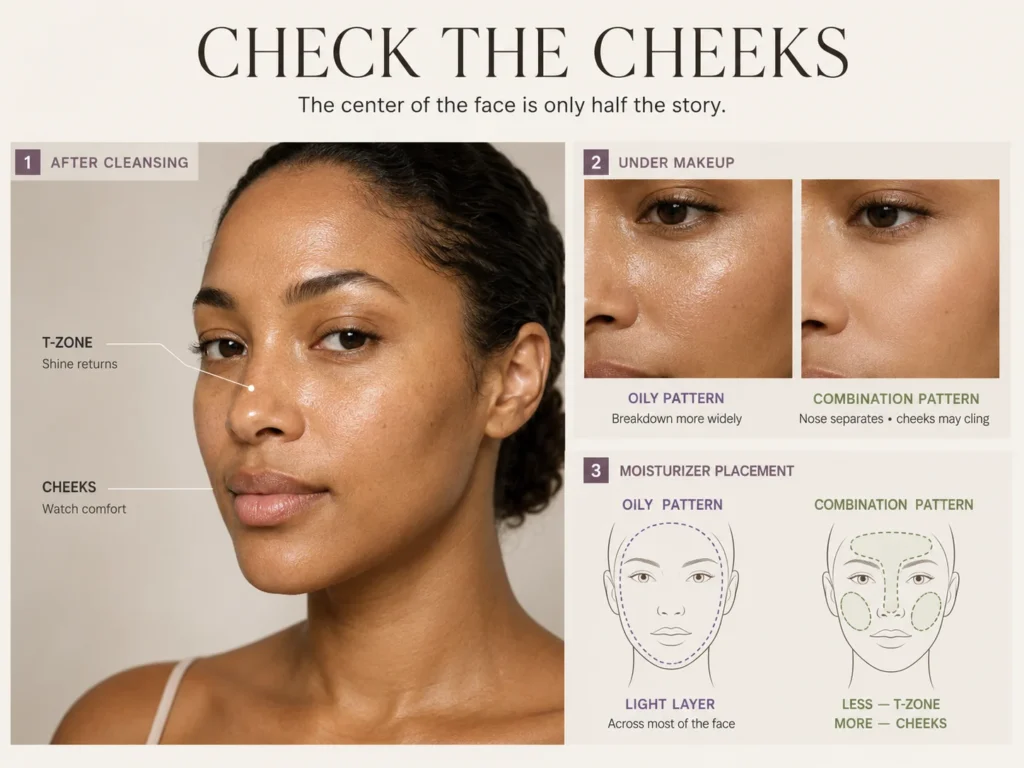
The cheeks are often the area that helps separate oily skin from combination skin.
Ask yourself:
If the cheeks behave differently from the T-zone, combination skin is more likely.
One reason people get confused is that oily skin can still feel tight.
Oily but tight skin may be dehydrated, over-cleansed, over-exfoliated, or irritated from drying products.
This means tightness alone does not always mean combination skin.
Look at the pattern.
If the entire face gets oily but feels tight after washing, you may have oily-dehydrated skin.
If only the T-zone gets oily and the cheeks feel dry or tight, you may have combination skin.
Combination skin can still be whitehead-prone or blackhead-prone.
Whiteheads may appear on the forehead, chin, or cheeks. Blackheads may appear around the nose. The T-zone may feel heavy or clogged-looking.
But that does not mean every area needs BHA, clay mask, or active cleanser.
Combination skin often needs targeted application:
This keeps the drier areas from becoming irritated.
Oily skin may develop dry patches from over-cleansing, exfoliation, weather, sun exposure, or harsh products.
Dry patches do not automatically make the skin combination.
The better question is whether the cheeks naturally behave differently or whether the dryness started after product use.
If dryness appeared after strong products, the skin may be over-stripped.
If the cheeks are consistently drier than the T-zone, combination skin may be the better description.
Makeup often reveals skin pattern clearly.
If makeup behaves differently by zone, your skincare may need to do the same.
Oily skin needs a cleanser that removes excess oil, SPF, makeup, sweat, and daily buildup.
But the cleanser should not leave the face tight or raw.
If the whole face is oily, an oily-skin cleanser may make sense more consistently.
If the skin is oily and clogged-looking, an active cleanser may be considered when the skin can tolerate it.
But if cleansing leaves the skin stretched, the product or frequency may need adjustment.
Combination skin needs cleansing that respects both zones.
The cleanser should remove oil from the T-zone without making the cheeks uncomfortable.
If the T-zone is oily but cheeks are dry, avoid choosing a cleanser only because it makes the nose feel very matte.
A cleanser that works well for combination skin should leave the whole face feeling clean, not stripped.
If the cheeks feel tight after every wash, the cleanser may be too strong for daily use.
Toner may help oily skin feel fresh after cleansing.
It may be helpful when the skin has excess shine, residue, or clogged-looking pores.
But toner should not burn, sting, or leave the skin stretched.
For fully oily skin, toner may be applied more evenly if the skin tolerates it.
Still, if certain areas sting, adjust placement or frequency.
Combination skin often benefits from selective toner use.
The T-zone may like toner more than the cheeks.
If toner feels good on the nose and forehead but sharp on the cheeks, apply it more lightly on the cheeks or avoid those areas.
The goal is not to force the whole face into a matte finish.
The goal is to support the areas that need it without drying out the rest.
BHA may be considered when oily skin has clogged-looking pores, blackheads, whiteheads, or congestion.
For fully oily skin, BHA may be useful across more areas if the skin tolerates it.
But it still should not be layered carelessly with AHA, retinol-style products, scrubs, and clay masks.
BHA works best when the skin can tolerate it.
Combination skin usually needs more targeted BHA placement.
Apply BHA where clogged-looking pores appear, such as:
Dry cheeks may not need BHA as often. If cheeks sting or flake, do not apply acids there just because the T-zone is oily.
Clay masks may help oily skin when shine or heavy surface feel is noticeable.
For fully oily skin, a mask may sometimes be used more broadly if the whole face tolerates it.
Still, it should not leave the skin tight, raw, or flaky.
A mask is an occasional tool, not a daily requirement.
Combination skin often does better with T-zone masking.
Apply clay mask mainly to:
Avoid applying it heavily to dry cheeks or the mouth area.
This helps manage the oily center without making the rest of the face uncomfortable.
Oily skin often needs lightweight moisture.
Good textures may include:
The moisturizer should not feel greasy, but it should leave the skin less bare after cleansing.
Skipping moisturizer can make oily skin feel tight and reactive.
Combination skin often needs moisturizer by zone.
You may need:
The same moisturizer may work if applied differently. In some cases, two textures may make sense.
Both oily and combination skin need SPF in the morning.
The challenge is texture.
For oily skin, SPF may feel heavy if the formula is too rich or if too much moisturizer is layered underneath.
For combination skin, SPF may feel greasy on the T-zone but dry on the cheeks.
If SPF causes makeup separation, review the whole morning routine:
Cleanser → Toner if appropriate → Moisturizer → SPF
Sometimes the SPF is not the only issue. The layers underneath may be too heavy or not allowed to settle.
Some skin behaves differently in summer and winter.
In summer, combination skin may look more oily because heat, sweat, and humidity make the T-zone shine more.
In winter, the cheeks may feel drier while the nose still gets oily.
This does not mean your skin type changes every week. It means the skin condition shifts with the environment.
Adjust texture, amount, and product placement by season.
A simple oily skin routine may look like this:
Morning:
Cleanser → Toner if appropriate → Lightweight moisturizer → SPF
Evening:
Cleanser → Toner if appropriate → Targeted serum if needed → Lightweight moisturizer
If clogged-looking pores are present, BHA may be considered.
If the whole face is oily, products may be used more evenly, as long as the skin tolerates them.
A simple combination skin routine may look like this:
Morning:
Cleanser → Toner mainly on T-zone if appropriate → Lightweight moisturizer by zone → SPF
Evening:
Cleanser → Toner if appropriate → BHA only where needed → Moisturizer by zone
For combination skin, placement matters.
The T-zone may need clarifying care. The cheeks may need less active product and slightly more moisturizer.
After cleansing with a mild cleanser, wait and observe how your skin feels before applying products.
Look for:
Do not test with a harsh cleanser, because stripping the skin can create misleading tightness.
The goal is to observe the natural pattern, not stress the skin.
Before choosing products, ask:
These answers help decide whether you need an oily-skin plan, combination-skin plan, or a more customized mix.
If you have combination skin, using oily-skin products everywhere may dry the cheeks.
This is common with:
Use clarifying products where they are needed, not automatically across the whole face.
If you have oily skin or an oily T-zone, rich cream everywhere may make the center of the face feel heavy.
This may lead to:
If cheeks need more comfort, apply more moisturizer there instead of overloading the T-zone.
Both oily and combination skin can become tight or dehydrated when moisturizer is skipped.
If you skip moisturizer because your nose is oily, your cheeks may become uncomfortable.
If you skip moisturizer because your whole face shines, active products may sting more and makeup may look rough.
The texture should be adjusted, not necessarily removed.
Blackheads on the nose do not mean the cheeks need the same exfoliation.
Whiteheads on the forehead do not mean the mouth area needs acids.
Use exfoliation based on where the concern appears.
This is especially important for combination skin and oily-dehydrated skin.
Oily and combination skin can both be blemish-prone.
Home skincare can help with cosmetic care, clogged-looking pores, shine, texture, and product selection.
But some concerns need medical evaluation.
A dermatologist should evaluate blemishes that are:
Do not keep applying stronger skincare if the skin is getting worse.
After consultation, our licensed esthetician may consider Janssen Cosmetics options depending on whether the skin is fully oily, combination, oily-dehydrated, sensitive, mature-oily, or clogged-looking.

For oily or blemish-prone patterns, possible options may include:
For combination skin patterns, possible options may include:
These options are not automatic recommendations. The right plan depends on whether the skin is oily everywhere or only oily in the T-zone, whether cheeks feel dry, and whether clogged-looking pores are localized or widespread.
Do not assume every shiny T-zone means fully oily skin.
Do not apply clay mask over dry cheeks if only the T-zone is oily.
Do not use BHA everywhere if blackheads are only on the nose.
Do not skip moisturizer because the forehead shines.
Do not use heavy cream across the T-zone if whiteheads appear there.
Do not choose products only by skin type label.
Do not ignore stinging, flaking, or tightness.
Do not keep experimenting if blemishes are painful, deep, swollen, infected-looking, scarring, rash-like, or persistent.
If most of your face gets shiny, you may have oily skin. If mainly your forehead, nose, and chin get oily while cheeks feel normal, dry, or tight, you may have combination skin.
Yes. Combination skin can have blackheads, especially around the nose, chin, or forehead. BHA may be considered in those areas if the skin can tolerate it.
Yes. Whiteheads can appear on combination skin, especially in oily or product-heavy areas. Product texture and cleansing habits should be reviewed.
Sometimes, but not always over the whole face. Oily-skin products may be used mainly on the T-zone or clogged-looking areas.
Not always. Oily skin may need more oil-focused cleansing. Combination skin needs cleansing that removes T-zone oil without drying the cheeks.
Combination skin often does well with gel-cream, light lotion, balancing cream, or lightweight cream textures. The T-zone may need less product than the cheeks.
This is a common combination pattern. The T-zone produces more visible oil, while cheeks may need more moisture or less active product.
A dermatologist should evaluate painful, deep, swollen, cystic-looking, infected-looking, scarring, rash-like, suddenly worsening, or persistent blemishes.
If you are not sure whether your skin is oily, combination, or oily-dehydrated, a free virtual consultation can help you understand the pattern before choosing products.
At Zendevie, we look at shine location, cheek comfort, clogged-looking pores, makeup behavior, SPF texture, and product tolerance before recommending next steps. The goal is to build a plan that fits your actual skin, not just a label.

Zendevie is guided by Haby Diallo, a licensed esthetician with more than 20 years of professional skincare experience. Her approach is rooted in education, professional judgment, and personal care.
years of experience