
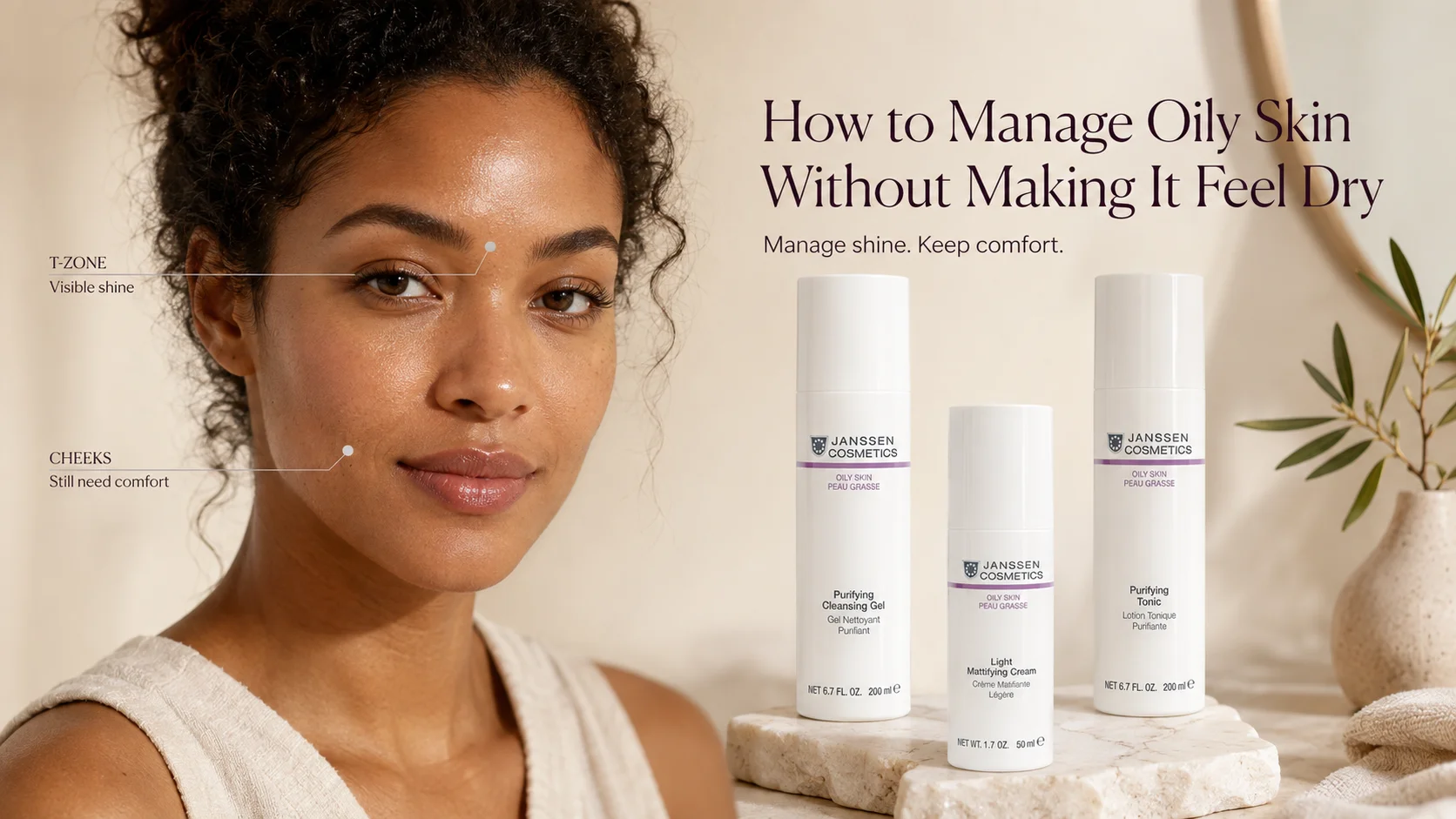
Oily skin does not need to be dried out to look better.
That is one of the biggest mistakes people make with oily skin. The face gets shiny, so they wash more. The nose looks greasy, so they use stronger toner. Pores look clogged, so they add BHA, AHA, scrub, clay mask, and drying spot products.
For a little while, the skin may look more matte.
Then the tight feeling starts.
The skin feels stretched after cleansing. Moisturizer stings. Flakes appear around the nose or mouth. Makeup clings in some areas but separates in the T-zone. The face still gets oily, but now it feels dry underneath.
This is the oily-but-dry cycle.
In consultation, our licensed esthetician looks for that pattern before recommending stronger oil-control steps. Oily skin needs clarity, but it also needs comfort. If the skin feels stripped, it becomes harder to manage.
To manage oily skin without making it feel dry, focus on a balanced routine:
Morning:
Cleanser → Toner if appropriate → Lightweight moisturizer → SPF
Evening:
Cleanser → Toner if appropriate → Targeted step if needed → Lightweight moisturizer
The most important rules are:
The goal is not to remove all oil. The goal is to reduce the look of excess shine while keeping the skin comfortable.
Oily skin can feel dry when the surface is stripped, dehydrated, irritated, or overworked.
Oil and hydration are not the same thing.
Oil is sebum. Hydration refers to water in the skin’s surface layers. A person can have visible oil on the face and still feel tight, dry, or uncomfortable.
This is why oily skin can feel confusing.
The skin may look shiny in the mirror, but it may still feel stretched after washing. That does not mean you need stronger products. It may mean the routine is removing too much or not finishing the skin properly.

Oil control focuses on reducing the look of shine.
Skin comfort focuses on how the skin feels after products.
A good oily-skin routine should do both.
If a routine controls shine but leaves the skin tight, stingy, flaky, or raw, it is not the right routine.
Good oily-skin care should leave the skin feeling:
The skin should not feel punished after every step.
Many people with oily skin like a squeaky-clean finish because it feels like the oil is gone.
But squeaky-clean skin is often too stripped.
Signs your cleanser may be too strong include:
Cleanser should remove oil, SPF, makeup, sweat, and buildup. It should not leave the face feeling raw.
Washing more often can seem logical when the skin gets shiny.
But repeated cleansing can make oily skin feel tight and irritated.
Most oily skin does well with morning and evening cleansing. After heavy sweating, exercise, or sunscreen-heavy days, another gentle cleanse may make sense.
But washing again and again throughout the day can create a stripped feeling.
If shine appears midday, blotting is often better than washing.
Hot water can make oily skin feel cleaner at first, but it can also leave the skin dry-feeling afterward.
Lukewarm water is usually better.
Avoid using very hot water to “melt” oil off the face. This can make the skin feel tight and may make the routine harder to tolerate.
Clean skin should feel refreshed, not overheated.
A cleanser for oily skin should remove excess oil and daily buildup without leaving the face uncomfortable.
For oily skin, the cleanser should be effective enough to remove:
But it should not leave the skin tight.
If a cleanser makes the face feel stretched every time, it may be too strong, used too often, or combined with too many active products.
Some oily-skin cleansers include exfoliating ingredients such as AHA or BHA.
These can be helpful when clogged-looking pores, rough buildup, blackheads, or whiteheads are present.
But active cleansers count as active products.
If you use an AHA/BHA cleanser, you may not need a leave-on BHA serum, acid toner, scrub, and clay mask on the same day.
Oily skin can become dry-feeling when every step is active.
Toner can be helpful for oily skin when it leaves the skin feeling fresh after cleansing.
But toner should not burn, sting, or make the face feel tight.
A toner that feels sharp may be too drying for the skin, or the skin may already be irritated from cleansing and exfoliation.
If toner feels good on the T-zone but drying on the cheeks, use it more selectively.
The toner step should help refine the routine, not make the skin feel stripped.
Many people associate oily skin with strong, drying toner.
But oily skin does not always need that kind of finish.
An alcohol-free toner may be a better option when the skin is oily but also tight, sensitive, mature, or combination.
The goal is to refresh and prepare the skin without creating a dry, stretched feeling.
If toner makes the skin feel bare, shiny, and tight at the same time, it may not be the right match.
Exfoliation can be helpful for oily skin when the concern is clogged-looking pores, blackheads, whiteheads, rough texture, or dull buildup.
But exfoliation should not be constant.
Too much exfoliation can make oily skin feel:
If your routine includes BHA, AHA, enzyme powder, scrub, active cleanser, clay mask, and retinol-style product, the skin may be getting too much active care.
BHA may be considered when oily skin has clogged-looking pores, blackheads, whiteheads, or congestion.
But BHA should be placed and timed carefully.
For many people, BHA may be most useful on:
Dry cheeks may not need the same frequency.
If BHA makes the skin tight, use it less often or pause it until the skin feels stable.
AHA may be considered when oily skin looks dull or has rough surface buildup.
But AHA should not be layered casually with BHA, scrubs, retinol-style products, and masks.
If the skin is already feeling dry or tight, AHA may need to wait.
Exfoliation should make the skin look smoother over time, not make it feel thinner, raw, or irritated.
Scrubs can feel satisfying because they make the skin feel smooth immediately.
But aggressive scrubbing can irritate oily skin, especially if there are whiteheads, blackheads, tender blemishes, or sensitive areas.
If the skin feels rough because it is dehydrated or over-exfoliated, scrubbing may make it worse.
Use physical exfoliation carefully, and avoid friction on irritated areas.
Clay masks can help reduce the look of shine, especially in the T-zone.
But clay masks can also make oily skin feel tight if they are used too often, left on too long, or applied over the entire face when only the nose and forehead are oily.
A better approach may be:
The mask should leave oily zones feeling refreshed, not the whole face feeling stretched.
Skipping moisturizer is one of the fastest ways to make oily skin feel dry.
Oily skin may not need a heavy cream, but it still needs a finishing step after cleansing and active products.
A lightweight moisturizer can help the skin feel comfortable without making it greasy.
Good textures may include:
The right texture should feel light, not heavy.
If your whole face is oily, one light moisturizer may work across the face.
If your T-zone is oily but your cheeks are dry, apply moisturizer differently.
You may need:
The face does not always need the same amount everywhere.
If your skin looks oily but feels tight, be careful with oil-control products.
The skin may need lightweight hydration and a gentler routine.
A simple reset may look like:
Morning:
Cleanser → Lightweight moisturizer → SPF
Evening:
Cleanser → Lightweight moisturizer
Pause BHA, AHA, scrubs, retinol-style products, and clay masks until the tight feeling improves.
Once the skin feels stable, active steps can be reintroduced slowly.
Oily skin still needs SPF in the morning.
Some people skip SPF because it feels greasy, but that can create a different problem, especially when exfoliation is part of the routine.
If SPF feels too heavy, review the layers underneath.
You may need:
The answer is not to skip SPF. The answer is to make SPF wearable.
Makeup separation can make people over-dry the skin.
They use strong cleanser, mattifying toner, clay mask, powder, and oil-control primer — all before makeup.
This may make the skin look matte for a short time, but makeup can later cling, crack, or separate.
For makeup to sit well, oily skin needs a smooth, comfortable base.
That usually means thin layers, light moisturizer, SPF that works with makeup, and blotting instead of repeated powdering.
If shine appears during the day, blot gently.
Blotting can reduce visible oil without disturbing the skin barrier or removing all skincare.
Use blotting paper or a soft tissue and press lightly.
Do not rub aggressively.
If you apply powder, blot first. Powder applied directly over oil can cake and make pores look more obvious.
Oily skin can become dry-feeling from too many products, even if each product seems appropriate.
A routine may become too much if it includes:
The skin may not need stronger oil control. It may need fewer overlapping steps.
A simple morning routine for oily skin may be:
Cleanser → Toner if appropriate → Lightweight moisturizer → SPF
This keeps the routine wearable during the day.
If the skin gets greasy quickly, reduce moisturizer amount on the T-zone.
If the skin feels tight, make sure the cleanser is not stripping and the moisturizer texture is not too matte.
If makeup follows, allow SPF to settle.
A simple evening routine may be:
Cleanser → Toner if appropriate → Targeted serum if needed → Lightweight moisturizer
Evening is a good time to use targeted products if the skin needs them.
For example, BHA may be considered for clogged-looking pores.
But do not use every active product every night.
If the skin feels tight or stingy, keep the evening routine simple.
A balanced weekly plan may look like:
Daily morning:
Cleanser → Lightweight moisturizer → SPF
Daily evening:
Cleanser → Lightweight moisturizer
Selected nights if needed:
BHA on clogged-looking areas
Occasionally if tolerated:
Clay mask on oily zones
Pause actives:
When the skin feels tight, flaky, stingy, or irritated
This structure manages oily skin without turning the routine into constant removal.
If shine returns quickly, do not assume your skin needs stronger cleansing.
Ask:
Fast shine can happen for different reasons.
The answer depends on the pattern.
If oily skin feels dry after cleansing, adjust the cleansing step first.
Try reviewing:
Do not immediately add a rich cream if the cleanser is the real issue.
If moisturizer makes oily skin greasy, the texture may be wrong.
Try:
Do not skip moisturizer completely if the skin feels tight. Adjust texture and amount first.
If SPF feels greasy, review the morning layers.
The issue may be:
SPF should remain part of the morning routine, but the layers around it may need adjustment.
If clay mask leaves your skin tight, change how you use it.
Try:
A clay mask should not make the whole face feel dry.
If BHA makes oily skin flaky, the frequency may be too high or the routine may include too many active products.
Reduce or pause BHA.
Review whether you are also using:
Once the skin feels stable again, BHA can be reconsidered more carefully.
This often happens when oily skin is dehydrated or overworked.
Makeup may slide on the nose but cling around the mouth, cheeks, or flaky areas.
Focus on the skin underneath.
You may need:
Makeup usually looks better when the skin feels comfortable.
If your T-zone is oily but your cheeks feel dry, you may have combination skin.
Do not treat the entire face like the nose.
Use:
Combination skin often needs placement, not stronger products.
Mature oily skin may still have shine, clogged-looking pores, blackheads, or whiteheads.
But it may also feel drier or less tolerant of strong products.
Avoid using teenage-style oil-control routines on mature skin.
Mature oily skin may need:
The goal is clearer-looking skin without making texture look rough.
Sensitive oily skin can still get shiny, but it does not tolerate aggressive routines well.
If the skin stings, burns, or becomes red-prone, simplify.
A calm basic routine may be:
Morning: Cleanser → Lightweight moisturizer → SPF
Evening: Cleanser → Lightweight moisturizer
Once the skin feels better, targeted steps can be added one at a time.
If irritation is painful, swollen, rash-like, or persistent, seek professional evaluation.
Your routine may be working if:
This is a better goal than trying to keep the face matte all day.

Your routine may be too drying if:
If these signs appear, reduce active products and rebuild comfort.
Pause:
Keep the routine simple until the skin feels less tight.
Then reintroduce one product at a time.
Keep:
This helps the skin feel easier to read before adding clarifying care again.
After consultation, our licensed esthetician may consider Janssen Cosmetics options depending on whether oily skin is shiny, clogged-looking, dehydrated, sensitive, mature, or combination.
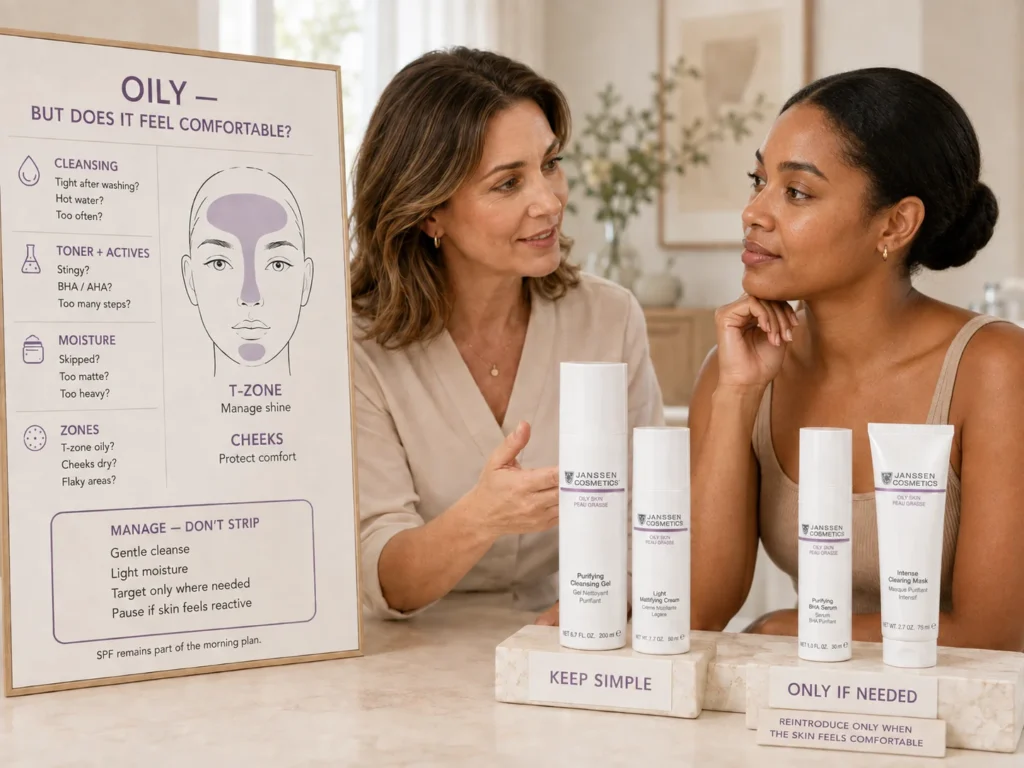
Possible options may include:
These options are not automatic recommendations. If oily skin already feels dry, tight, stingy, or flaky, the first step may be simplifying the routine before adding stronger clarifying care.
Do not try to dry out oily skin completely.
Do not wash repeatedly all day.
Do not use very hot water to remove oil.
Do not use toner that burns.
Do not layer BHA, AHA, retinol-style products, scrubs, and clay masks all at once.
Do not apply clay mask over dry cheeks.
Do not skip moisturizer because the skin is oily.
Do not skip SPF because it feels heavy.
Do not keep using a product that makes the skin sting, burn, swell, or worsen.
Do not ignore painful, deep, swollen, infected-looking, scarring, rash-like, or persistent blemishes.
Use a gentle but effective cleanser, avoid harsh toner, exfoliate carefully, moisturize with a lightweight texture, and use SPF in the morning. Do not layer too many active products at once.
Oily skin can feel dry when it is dehydrated, over-cleansed, over-exfoliated, or irritated. Oil and hydration are not the same thing.
Yes. Oily skin can still need moisturizer. Choose a light texture such as gel, gel-cream, light lotion, mattifying cream, or lightweight cream.
Not usually. Most oily skin does well with morning and evening cleansing. Repeated washing can make the skin feel tight or stripped.
Yes, especially if it is used too often or layered with other active products. Use BHA carefully and moisturize afterward.
Clay masks may help oily zones feel less heavy, but they should not be used too often or applied over dry areas. Moisturize afterward.
This may be oily-dehydrated skin, over-cleansing, over-exfoliation, or product imbalance. Simplify the routine and focus on lightweight comfort.
A dermatologist should evaluate painful, deep, swollen, cystic-looking, infected-looking, scarring, rash-like, suddenly worsening, or persistent blemishes.
If your oily skin keeps getting shiny but also feels dry, tight, stingy, or uncomfortable, a free virtual consultation can help you understand what your routine may be doing.
At Zendevie, we look at cleanser strength, toner feel, moisturizer texture, SPF heaviness, active product use, clogged-looking pores, and skin comfort before recommending products. The goal is to help oily skin look more balanced without making it feel stripped.

Zendevie is guided by Haby Diallo, a licensed esthetician with more than 20 years of professional skincare experience. Her approach is rooted in education, professional judgment, and personal care.
years of experience