


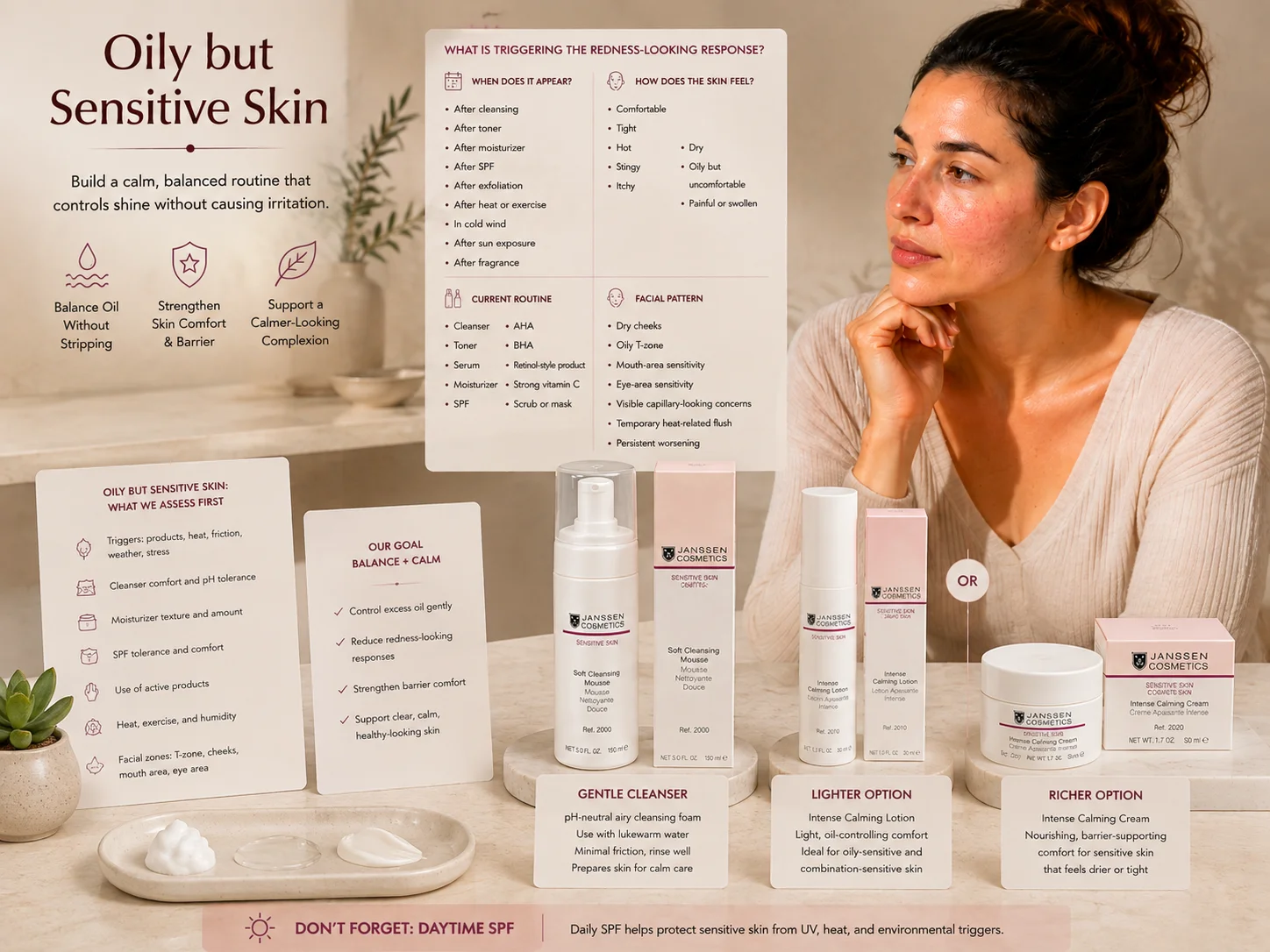
Oily but sensitive skin can feel frustrating because the skin seems to send mixed signals.
The forehead gets shiny. The nose feels greasy. Pores may look more visible. Blackheads or whiteheads may appear. Makeup may separate in the T-zone.
But at the same time, the skin may sting after toner, burn after moisturizer, feel tight after cleansing, or look redness-prone after exfoliation.
This creates a difficult cycle.
You try to control the oil, then the skin becomes irritated. You try to calm the irritation, then the skin feels too shiny or heavy. You use stronger oily-skin products, then the skin feels tight and reactive again.
At Zendevie, we do not treat oily sensitive skin as a simple oily-skin problem. We first look at what the skin is showing: where the shine appears, where sensitivity happens, whether the skin feels tight, and whether the current products are too strong.
In consultation, our licensed esthetician studies both sides of the pattern before recommending products. Oily sensitive skin needs clarity, but it also needs restraint.
Oily but sensitive skin needs a routine that manages shine without stripping the skin.
A simple starting point may look like:
Morning:
Mild cleanser → lightweight moisturizer → SPF
Evening:
Mild cleanser → lightweight moisturizer
Once the skin feels stable, targeted oily-skin steps may be considered only where needed, such as the T-zone, blackhead-prone areas, or clogged-looking zones.
Avoid starting with strong toner, daily acids, frequent clay masks, scrubs, and multiple active products at once.
If your oily skin stings, burns, feels hot, becomes swollen, develops rash-like irritation, or has painful persistent blemishes, seek dermatologist guidance.
Many people think oily skin is strong skin.
That is not always true.
Oily skin may produce visible sebum, but the surface can still be reactive. The skin may look shiny but feel tight. It may have clogged-looking pores but still sting after active products. It may need oil-aware care, but not harsh oil removal.
This is why oily sensitive skin needs a different approach than oily resilient skin.
The goal is not to dry the face out. The goal is to make the skin easier to manage without creating irritation.
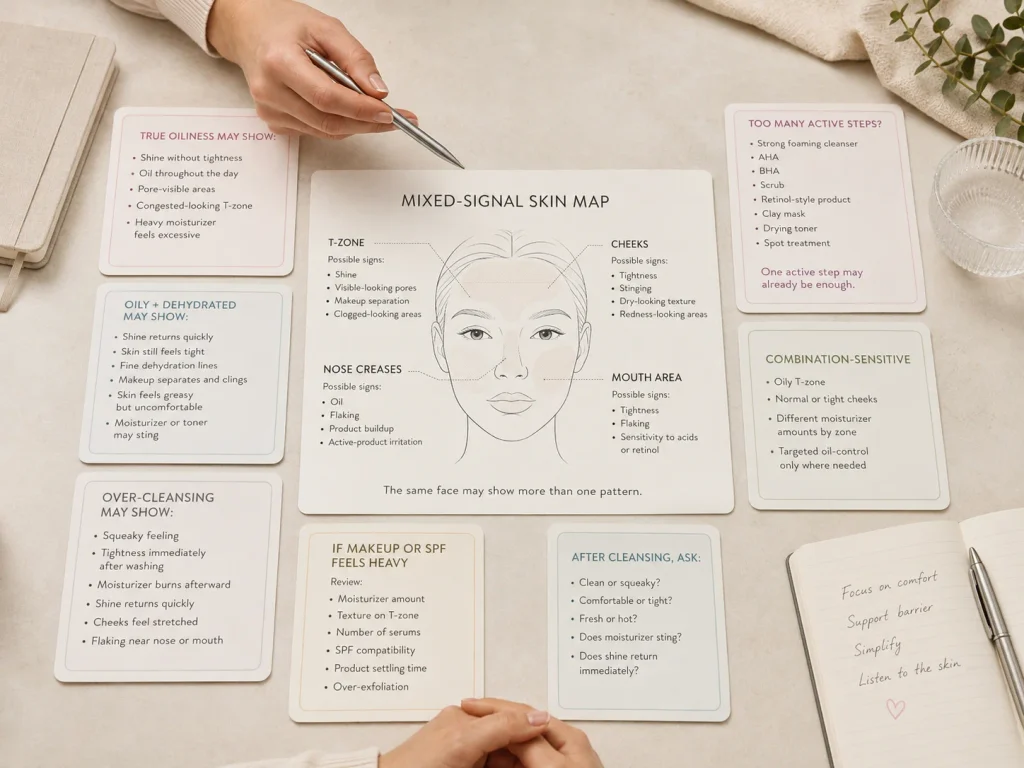
Oily sensitive skin often has opposite-looking symptoms at the same time.
You may notice:
This does not mean your skin is impossible. It means your routine has to respect more than one concern.
When the skin looks shiny, many people reach for stronger oil-control products.
That may include:
For oily sensitive skin, this can quickly become too much.
The skin may look less shiny for a few hours, but then it may feel tight, stingy, flaky, or hot. That reaction can make the routine harder to continue.
Shine should be managed carefully, not attacked.
Oily sensitive skin often overlaps with dehydration.
Oil and hydration are not the same thing.
Your skin may produce oil on the surface but still feel tight underneath. This can happen when the skin lacks water, has been over-cleansed, or is reacting to too many active products.
Signs of oily-dehydrated sensitive skin include:
In this case, stronger oil control may make the tightness worse.
Oily sensitive skin often gets over-cleansed.
The skin feels greasy, so you wash more often. But frequent washing can leave the skin tight and reactive.
A cleanser may be too much if:
A cleanser should remove oil, SPF, makeup, sweat, and buildup without leaving the face raw.
Hot water can make oily skin feel cleaner, but it can also make sensitive skin more reactive.
If your skin stings after washing, check the water temperature.
Use lukewarm water.
Avoid steam, very hot showers, rough towels, cleansing brushes, and scrubbing motions when the skin already feels sensitive.
Oily sensitive skin usually responds better to soft application and consistency.
The first step for oily sensitive skin is choosing a cleanser that respects both concerns.
The cleanser should remove oil and daily buildup, but it should not make the face feel stripped.
A good cleansing result feels:
If the cleanser leaves the skin tight, the rest of the routine will be harder to tolerate.
Some oily-skin cleansers include AHA, BHA, enzymes, or exfoliating ingredients.
These may be useful for clogged-looking pores or blackheads when the skin can tolerate them.
But for oily sensitive skin, an active cleanser may be too much as a daily step.
If you use an active cleanser, you may need to avoid using acid toner, leave-on BHA, scrub, retinol-style product, and clay mask on the same day.
One active step may be enough.
Toner is often used for oily skin, but sensitive skin may not tolerate every toner.
A toner should not burn, sting, or leave the face feeling stretched.
If toner feels good on the T-zone but stings on the cheeks, use it only where tolerated or pause it.
If toner stings every time, it may not belong in your routine right now.
Oily sensitive skin does not need a toner just because the skin is shiny.
Alcohol-free toners are often better tolerated by sensitive skin than drying toners.
But even alcohol-free products can sting if the skin is already irritated or over-exfoliated.
The question is not only what the label says. The question is how your skin responds.
If your skin feels calmer without toner, keep the routine simple until the skin feels stable.
Oily sensitive skin still needs moisturizer.
Skipping moisturizer may make the skin feel tighter and more reactive. It can also make active products sting more.
The key is texture.
Oily sensitive skin often does better with:
The moisturizer should not feel heavy, but it should help the skin feel less bare.
Some sensitive skin needs richer care, but oily sensitive skin may become congested-looking if a heavy cream is used everywhere.
If the T-zone is shiny and the cheeks are tight, use placement.
Apply less product on the forehead, nose, and chin.
Apply more where the skin feels dry or tight.
The whole face does not always need the same amount.
BHA is often discussed for clogged-looking pores, blackheads, whiteheads, and oily T-zone congestion.
But oily sensitive skin should not start with daily BHA if the skin is already stinging or burning.
Before BHA, the skin should tolerate:
If the skin burns from moisturizer or toner, BHA should wait.
When BHA is introduced, it may be better to apply it only where clogged-looking pores appear, not across the entire face.
AHA may be useful for dullness or rough surface texture, but oily sensitive skin needs caution.
If the skin is already tight, red-looking, flaky, or reactive, AHA may make the skin feel worse.
Do not layer AHA with BHA, scrubs, retinol-style products, and clay masks without a clear professional plan.
If the skin stings easily, start with fewer active steps.
Retinol-style products may be considered for certain mature, textured, or blemish-prone concerns, but oily sensitive skin can react if they are introduced too quickly.
Do not begin retinol-style care while also using acids, active cleansers, scrubs, strong toner, and clay masks.
If retinol-style products cause burning, peeling, or ongoing tightness, pause and simplify.
The skin should feel stable before retinol-style care is reconsidered.
Clay masks can help oily areas feel less heavy.
But oily sensitive skin may become dry or irritated if clay masks are used too often or applied over the whole face.
Use clay only where it makes sense:
Avoid dry cheeks, around the mouth, and areas that sting or flake.
A mask should not leave the skin feeling stretched.
Scrubs can make oily sensitive skin worse, especially when the skin already has bumps, whiteheads, blackheads, redness-looking areas, or stinging.
Friction may increase irritation.
Do not scrub blackheads aggressively.
Do not scrub flakes caused by dryness or over-exfoliation.
If exfoliation is needed, it should be selected carefully and used with restraint.
Oily sensitive skin may struggle with makeup.
Foundation may separate on the nose and cling to tight cheeks. Powder may cake. Primer may pill. SPF may feel heavy or sting.
Before blaming the makeup, review the skincare underneath.
Makeup may separate because:
A calmer skin prep often improves makeup wear.
Oily sensitive skin still needs SPF during the day.
Some people skip SPF because it feels greasy or stings. But skipping SPF is not the right answer, especially if exfoliation, brightening products, or retinol-style care are part of the routine.
If SPF stings, review:
The solution may be better layering, not removing SPF completely.
A simple morning routine may look like:
Mild cleanser → lightweight moisturizer → SPF
If the skin tolerates toner, it may be added after cleansing.
If the skin is very reactive, keep the morning routine simple.
Morning care should leave the skin feeling clean, not bare.
If makeup follows, keep layers thin and let SPF settle.

A simple evening routine may look like:
Mild cleanser → lightweight moisturizer
If the skin is stable and clogged-looking pores are present, a targeted step may be added on selected nights.
For example:
Mild cleanser → BHA only where needed → lightweight moisturizer
But do not add BHA, AHA, retinol-style product, scrub, and clay mask all together.
Evening care should help the skin recover from the day, not create more irritation.
If oily sensitive skin is stinging, burning, flaky, or hot, simplify.
Use:
Morning: Mild cleanser or rinse if appropriate → moisturizer → SPF
Evening: Mild cleanser → moisturizer
Pause:
Once the skin feels stable, targeted care can be discussed.
Oily sensitive skin often needs different care in different areas.
The T-zone may be oily.
The cheeks may be dry or reactive.
The mouth area may sting.
The nose may have blackheads.
The chin may have whiteheads.
This does not mean every product goes everywhere.
Use product placement:
Placement can make the routine more tolerable.
Your skin may not be ready for active products if:
In this case, reduce active products and rebuild a basic routine first.
When oily sensitive skin feels stable, introduce one active product at a time.
A careful approach:
The goal is to understand tolerance before increasing frequency.
There is no universal number.
Some oily sensitive skin may tolerate occasional exfoliation. Some may need to avoid it for a while.
Frequency depends on:
If the skin is stinging, do not exfoliate.
Blackheads may appear on oily sensitive skin, especially around the nose.
Do not scrub them aggressively.
Do not squeeze them repeatedly.
BHA may be considered when the skin is stable, but it should be introduced carefully.
For sensitive skin, it may make sense to apply BHA only to the nose or chin rather than the whole face.
If blackheads are severe, painful, inflamed-looking, or persistent, seek professional guidance.
Whiteheads or closed comedones may appear when oily sensitive skin is overloaded with heavy products or not cleansing well enough.
Review:
Do not respond to whiteheads by using every clarifying product at once.
Whitehead-prone sensitive skin needs a careful plan.
If oily sensitive skin also looks redness-prone, avoid aggressive routines.
Be careful with:
If redness-looking areas are persistent, painful, swollen, rash-like, or worsening, a dermatologist should evaluate the skin.
A hot feeling after products can mean the skin is irritated.
Pause active products.
Avoid heat, steam, hot water, scrubs, and exfoliating products until the skin feels calmer.
If the hot feeling is severe, persistent, swollen, painful, or rash-like, seek dermatologist guidance.
Oily but flaky skin often means the surface is dry, irritated, or over-exfoliated while oil is still present.
Do not scrub the flakes.
Do not add more acids immediately.
Focus on:
Once flaking improves, clogged-looking pores can be addressed more carefully.
Fast shine does not always mean you need stronger products.
Ask:
Fast shine can come from oil, but it can also happen when the skin is not comfortable.
If toner burns, pause it.
Oil control should not come at the cost of irritation.
You may need to manage oil through:
A toner is optional if the skin does not tolerate it.
If moisturizer makes oily sensitive skin greasy, the texture or amount may be wrong.
Try reviewing:
Do not skip moisturizer completely if the skin feels tight.
Use a lighter texture and adjust placement.
If SPF feels heavy, review the whole morning routine.
The issue may be:
SPF still matters. The goal is to find a wearable way to use it.
Oily sensitive skin should be cautious with combinations like:
The more reactive the skin feels, the fewer active combinations it should use.
Simplify immediately if you notice:
A simple routine helps reduce variables and makes the skin easier to read.
A dermatologist should evaluate oily sensitive skin if there is:
Cosmetic skincare can help with product selection and routine structure, but medical-looking concerns need medical evaluation.
After consultation, our licensed esthetician may consider Janssen Cosmetics options depending on whether the skin is more sensitive, more oily, clogged-looking, dehydrated, redness-prone, or over-exfoliated.
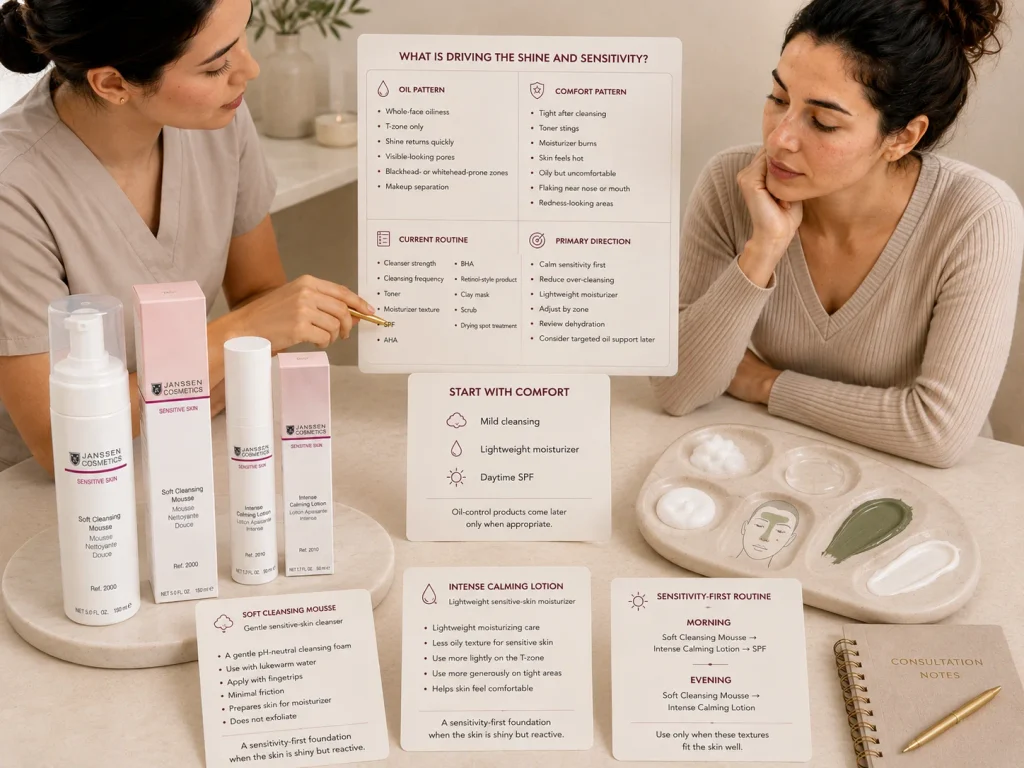
For sensitive behavior, possible options may include:
For oily or clogged-looking behavior, possible options may include:
These options should not be combined automatically. Oily sensitive skin needs product selection by tolerance, placement, and skin response.
Do not treat oily sensitive skin like fully resilient oily skin.
Do not wash repeatedly all day.
Do not use hot water to remove oil.
Do not keep using toner that burns.
Do not skip moisturizer because the skin is shiny.
Do not apply clay mask over the entire face if only the T-zone is oily.
Do not layer AHA, BHA, retinol-style products, scrubs, and masks all at once.
Do not scrub blackheads aggressively.
Do not ignore burning, swelling, rash-like irritation, pain, deep blemishes, or persistent worsening.
Yes. Oily skin can still sting, burn, feel tight, become redness-prone, or react to products. Oiliness does not mean the skin barrier feels comfortable.
Your cleanser may be too strong, the water may be too hot, or the skin may be dehydrated or over-cleansed. Oily skin can still feel stripped.
Yes. Oily sensitive skin usually needs a lightweight moisturizer. Skipping moisturizer can make tightness and stinging worse.
Sometimes, but only when the skin is stable. BHA may be useful for clogged-looking pores, blackheads, or whiteheads, but it should be introduced carefully and often only where needed.
Only if the toner does not sting. If toner burns or leaves the skin tight, pause it.
Clay masks may help oily zones, but they should be used carefully. Apply only where needed and avoid dry, flaky, or irritated areas.
The skin may be oily and dehydrated, over-exfoliated, or irritated. Shine does not mean the skin can tolerate strong products.
See a dermatologist if there is persistent burning, swelling, rash-like irritation, painful deep blemishes, scarring, crusting, bleeding, infection-looking changes, eye-area irritation, or symptoms that do not improve after stopping products.
If your skin is oily but also stings, burns, feels tight, or reacts easily, a free virtual consultation can help you understand what your skin is showing before choosing more products.
At Zendevie, we review your shine pattern, cleanser, toner, moisturizer, SPF, exfoliation habits, clogged-looking pores, and sensitivity signs before recommending next steps. The goal is to help oily sensitive skin feel clearer and less irritated with a routine that fits both concerns.

Zendevie is guided by Haby Diallo, a licensed esthetician with more than 20 years of professional skincare experience. Her approach is rooted in education, professional judgment, and personal care.
years of experience