
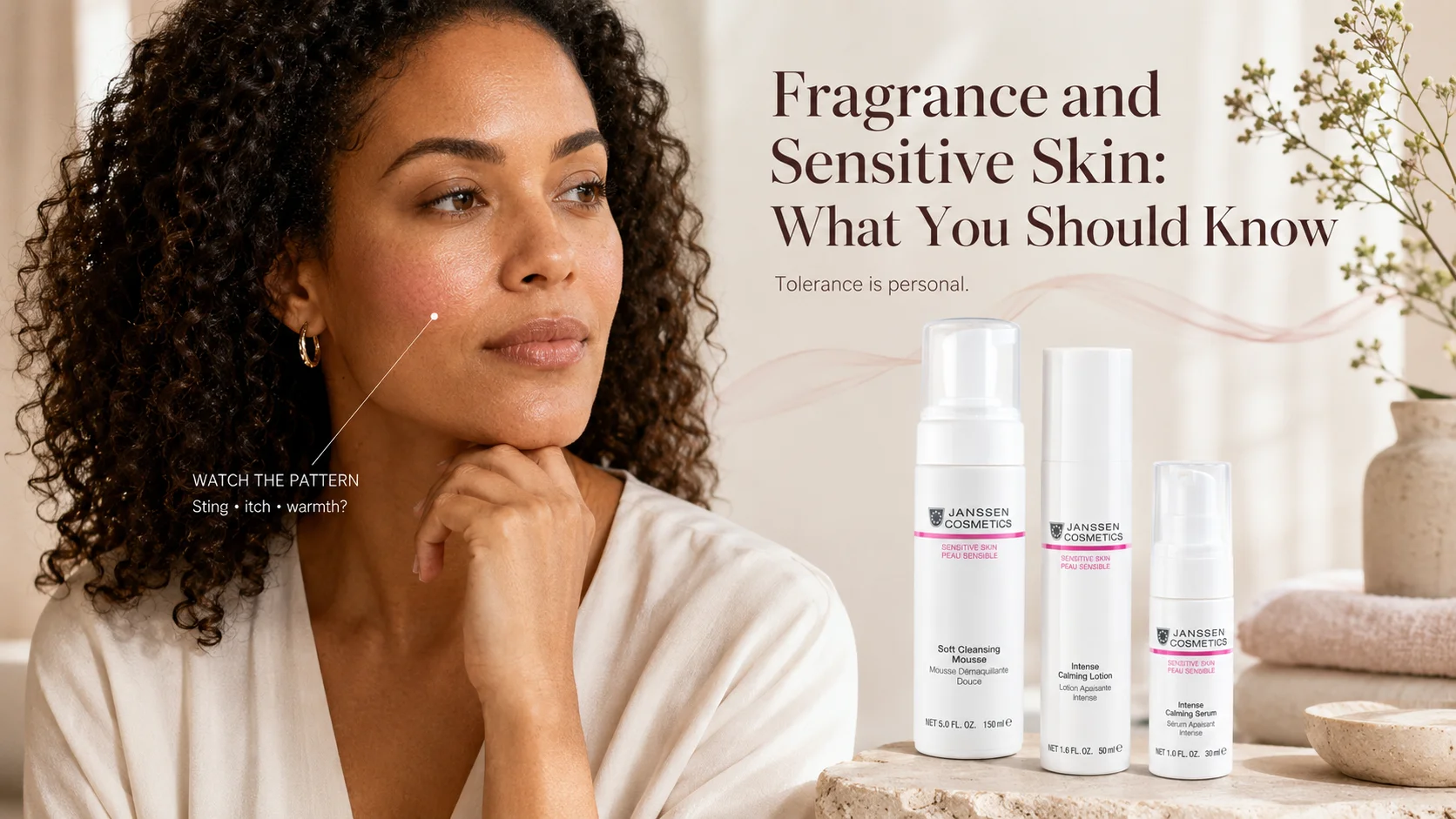
Fragrance can make a skincare product feel pleasant, luxurious, clean, fresh, or relaxing.
But when skin reacts easily, fragrance may also become one of the ingredients people question first.
Some sensitive skin can use lightly fragranced products without discomfort. Other sensitive skin may sting, itch, feel warm, become dry, or develop redness-looking areas after using scented skincare.
The answer is not that every fragranced product is bad.
The answer is also not that a product is automatically gentle because the scent comes from flowers, herbs, fruits, or essential oils.
Sensitive skin needs a more individual approach.
At Zendevie, our licensed esthetician looks at the complete formula, the skin’s current condition, the type of reaction, the location of the reaction, and the number of fragranced products being used.
Fragrance may be one part of the problem.
But the cleanser, acids, retinol, alcohol content, exfoliation frequency, weather, makeup, haircare, or product layering may also be contributing.
The first step is understanding what the skin is actually reacting to.
Fragrance may cause discomfort for some sensitive skin, but not everyone with sensitive skin reacts to every fragranced product.
A fragrance-free option may be worth considering when the skin repeatedly:
Sensitive skin should be especially careful when fragrance is combined with:
A simple starting routine may be:
Morning: Gentle cleanser → moisturizer → SPF
Evening: Gentle cleanser → moisturizer
Introduce one product at a time and observe the skin.
If a product causes persistent burning, swelling, painful irritation, blistering, crusting, bleeding, infection-looking changes, eye-area swelling, or a worsening rash-like reaction, stop using it and seek dermatologist guidance.
Fragrance is added to skincare to create or improve a product’s scent.
It may be used to:
Fragrance may come from synthetic fragrance materials, naturally derived aromatic materials, essential oils, botanical extracts, or a combination of sources.
On an ingredient list, fragrance may appear under terms such as:
The exact wording may vary by product and market.
A product can also have a noticeable smell even when no added fragrance is listed because some ingredients naturally have an aroma.
Skincare is not only about how a product performs.
Texture, application, packaging, and scent can influence how someone experiences the routine.
A soft scent may make a moisturizer feel more enjoyable.
A fresh aroma may make a cleanser feel cleaner.
A botanical scent may make a mask feel relaxing.
This sensory experience can help some people enjoy using skincare consistently.
However, sensitive skin should not choose a product based on scent alone.
A product can smell pleasant and still be too active.
A product can have no noticeable scent and still contain ingredients that cause discomfort.
The complete formula and skin response matter more than whether the product smells good.
No.
Not every person with sensitive skin reacts to fragrance.
Some people tolerate certain lightly fragranced formulas but react to strongly scented products.
Some tolerate fragrance in rinse-off products but not in leave-on serums or creams.
Some react only when the skin is already dry, over-exfoliated, or irritated.
Others may experience repeated discomfort from even small amounts of fragrance.
Skin tolerance may also change.
A product that felt comfortable in summer may sting in winter.
A moisturizer that felt fine before exfoliation may burn after an acid treatment.
A fragranced product may feel comfortable on the body but not around the eyes.
Sensitive skin should be evaluated through patterns, not assumptions.
Sensitive skin may react more easily when its protective barrier feels stressed.
When the skin is dry, over-cleansed, over-exfoliated, or already uncomfortable, more ingredients may begin to sting.
Fragrance may feel more noticeable when the skin is:
The reaction may not come from fragrance alone.
For example, a fragranced acid toner may sting because of the exfoliating acids, the fragrance, the alcohol content, frequent use, or the combination of all of these factors.
This is why the entire formula and routine need to be reviewed.
Two people with sensitive skin may respond differently to the same product.
One person may use it comfortably.
Another may experience:
Personal tolerance matters.
The amount used, application area, frequency, other products, and condition of the skin can change the response.
A product should not be considered safe for your skin simply because someone else with sensitive skin likes it.
It should also not be rejected automatically because another person reacted to it.
“Fragrance-free” and “unscented” do not always mean the same thing.
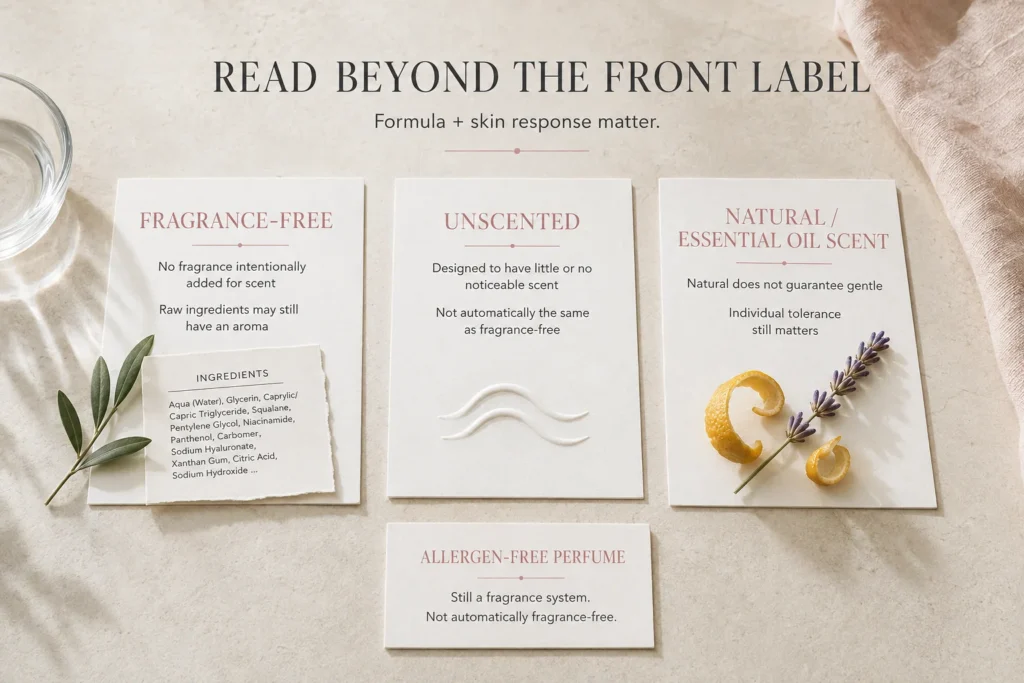
A fragrance-free product is generally formulated without ingredients added specifically to create or mask a scent.
However, the product may still have a natural smell from its raw ingredients.
Fragrance-free does not mean the product is completely odorless.
It also does not guarantee that sensitive skin will tolerate the formula.
Acids, retinol, preservatives, plant extracts, or other ingredients may still cause discomfort.
An unscented product is designed not to have a noticeable scent.
In some formulas, ingredients may be used to neutralize or mask the natural smell of the product.
This means an unscented product is not always the same as a fragrance-free product.
When fragrance is a concern, look beyond the front label and review the full ingredient list.
Not necessarily.
The word “natural” may sound soft, pure, or safe, but natural fragrance can still contain aromatic compounds that some sensitive skin does not tolerate.
Natural scents may come from:
These ingredients may feel comfortable for one person and irritating for another.
Natural does not automatically mean non-irritating.
Synthetic does not automatically mean harsh.
Sensitive skin should focus on the actual formula and the skin’s response rather than marketing language alone.
Fragrance and essential oils can overlap, but they are not always the same.
A fragrance blend may contain synthetic or naturally derived aromatic materials.
An essential oil is a concentrated aromatic material obtained from a plant source.
Essential oils may be included for scent, sensory appeal, or other cosmetic reasons.
Some essential oils have strong aromas even when the product is not marketed as fragranced.
Sensitive skin may react to:
This does not mean every essential oil causes a reaction for every person.
It means essential oils should not automatically be treated as gentler than fragrance.
When a product stings, fragrance may be blamed immediately.
But other ingredients or routine habits may be involved.
Possible contributors include:
Removing fragrance may help some people.
But if the rest of the routine remains too active, the skin may continue to feel uncomfortable.

A fragranced product may not be a good match when the same pattern happens repeatedly after use.
Watch for:
One brief sensation does not always identify the cause.
But repeated discomfort after the same product is important information.
Stop and review the product rather than continuing because it is expensive, popular, or marketed for sensitive skin.
Dry-sensitive skin may react more easily when it lacks enough moisture or lipid comfort.
Fragranced products may feel more noticeable when dry-sensitive skin is:
Before blaming fragrance alone, review the entire routine.
A simple routine may be:
Morning: Gentle cleanser → moisturizer → SPF
Evening: Gentle cleanser → moisturizer
If the skin becomes more comfortable after scented products are removed, fragrance may be one factor.
If discomfort continues, cleanser strength, moisturizer texture, active products, and weather exposure may also need review.
Oily-sensitive skin may be shiny while still feeling irritated.
People with oily skin often use:
When several of these products are layered, the skin may become tight, hot, or stingy.
The reaction may be blamed on fragrance, but the complete routine may be too aggressive.
For oily-sensitive skin, ask:
Removing one strongly fragranced product may help, but routine balance still matters.
Combination-sensitive skin may react differently across the face.
The T-zone may be oily and more tolerant.
The cheeks may be dry, redness-prone, or easily irritated.
A fragranced product may feel comfortable on the forehead but sting around the cheeks, eyes, or mouth.
This does not always mean the product needs to be applied everywhere.
However, creating different routines for every area can become complicated.
Start with a simple full-face routine that feels comfortable.
Then consider targeted products only when there is a clear need.
Redness-prone skin may feel warm or look flushed after certain products.
Strongly fragranced formulas may increase discomfort for some people.
If the skin becomes red-looking after application, review:
Do not assume redness-looking skin needs stronger soothing products layered on top of the reaction.
First stop the product that appears to be causing discomfort.
Return to a simple routine.
If redness is persistent, painful, swollen, rash-like, or worsening, seek dermatologist guidance.
Mature sensitive skin may be drier, more comfort-focused, or less tolerant of strong formulas.
Luxury skincare is often fragranced to create a sensory experience.
But a premium scent does not determine whether the product is right for mature sensitive skin.
Before choosing a fragranced mature-skin product, review:
Mature sensitive skin may tolerate one lightly fragranced cream but react when a fragranced cleanser, toner, serum, cream, mask, and makeup product are layered together.
More products can mean more exposure.
A simple routine may be more comfortable.
Blemish-prone sensitive skin may use active products that already feel intense.
These may include:
Adding fragrance-heavy products may make it harder to identify what is causing discomfort.
If the skin develops painful, deep, swollen, cystic-looking, infection-looking, crusting, bleeding, or scarring blemishes, dermatologist guidance should come first.
Cosmetic skincare can help organize the routine, but medical-looking blemishes should not be managed by adding more active or fragranced products.
The eye area is thinner and often more reactive than the rest of the face.
Fragrance from skincare, makeup, hair products, perfume, or sprays may contribute to:
Facial products should not be applied too close to the eyes unless they are designed for that area.
Spray fragrance away from the face.
Be careful with scented eye creams, makeup removers, setting sprays, and hair sprays.
If the eye area becomes swollen, painful, crusting, severely itchy, or persistently irritated, seek medical guidance.
The mouth area may react to:
If the corners of the mouth are already dry, cracked-looking, or rash-like, avoid applying fragranced or active products to the area.
Do not exfoliate the irritation.
If mouth-area discomfort is persistent or worsening, dermatologist evaluation may be needed.
A fragranced cleanser has short contact with the skin because it is rinsed away.
However, rinse-off does not automatically mean non-irritating.
A fragranced cleanser may still feel uncomfortable when:
After cleansing, the skin should not feel:
If it does, review the complete cleanser formula and cleansing method.
Toner can be a gentle preparation step or an active exfoliating step.
A fragranced toner may be more uncomfortable if it also contains:
If toner stings, do not keep applying it because toner is considered a required step.
Sensitive skin does not need a toner that creates discomfort.
A gentle, alcohol-free tonic may be more appropriate when the skin can tolerate it.
Serums are usually leave-on products.
They remain on the skin under moisturizer and SPF.
A fragranced serum may be more noticeable because it has longer contact with the skin.
The serum may also contain:
If a serum stings, fragrance may be one factor, but the active ingredients may also contribute.
Introduce one serum at a time.
Do not begin several fragranced active serums during the same week.
Moisturizers are expected to make the skin feel more comfortable.
If a moisturizer repeatedly burns, stings, itches, or makes the skin feel hot, it may not be the right match.
Possible reasons include:
Do not assume the moisturizer is the only problem.
Sometimes moisturizer stings because the skin was already irritated by an earlier step.
Sunscreen is an important daytime step.
However, some sensitive skin reacts to fragranced SPF formulas.
Possible signs include:
SPF may also sting when the skin is already irritated from acids, retinol, shaving, or over-cleansing.
Do not stop daytime protection without reviewing alternatives.
A consultation can help identify a more comfortable formula and determine whether the issue is fragrance, filters, texture, other ingredients, or an already stressed skin surface.
Masks may contain noticeable fragrance because they are designed to create a spa-like experience.
Sensitive skin should be cautious with masks that combine fragrance with:
A mask should not cause strong burning or painful heat.
Do not leave a mask on longer than directed because you want stronger results.
If the skin becomes swollen, rash-like, painful, or persistently irritated, remove the product and seek guidance when needed.
Makeup may contain fragrance, especially complexion products, setting sprays, lip products, and some powders.
Sensitive skin may react when makeup is applied over:
If makeup causes discomfort, review both the makeup and the skincare underneath.
The reaction may result from the combined layers rather than one product alone.
Haircare can affect facial skin.
Shampoo, conditioner, leave-in products, hair oils, edge products, styling creams, and hair sprays may touch:
Strongly fragranced hair products may contribute to discomfort around these areas.
If reactions appear mainly around the hairline or sides of the face, review haircare as well as facial skincare.
Keep hair products away from the face when possible.
Rinse the hairline thoroughly.
Sensitive facial skin may coexist with sensitive body skin.
Fragranced body lotions, shower gels, scrubs, deodorants, and perfumes may contribute to discomfort on:
A facial routine may be fragrance-free while the neck continues reacting to perfume or scented body lotion.
Review where each product is sprayed or applied.
Perfume is not facial skincare.
Avoid spraying perfume directly onto the face.
Perfume applied to the neck, chest, hair, scarf, or clothing may still come into contact with facial skin.
This may be more noticeable during:
If facial or neck sensitivity appears after perfume use, change the placement and reduce exposure.
One lightly fragranced product may feel comfortable.
But several scented products layered together may create more exposure.
A routine may include:
When the skin reacts, it becomes difficult to identify which product is contributing.
Simplify.
Remove unnecessary layers.
Reintroduce products one at a time.
A product that was previously comfortable may suddenly sting.
Possible reasons include:
Do not assume the skin must continue tolerating a product because it worked before.
Skin condition can change.
Exfoliation can make sensitive skin feel more reactive.
After using AHA, BHA, enzymes, scrubs, or peeling products, a fragranced serum or moisturizer may sting more than usual.
This does not always prove the fragrance is the only problem.
The skin may be temporarily less tolerant because the routine is too active.
After exfoliation, keep the routine simple.
Avoid adding several fragranced or active products.
Use moisturizer and daytime SPF when tolerated.
Retinol may cause dryness, flaking, or increased sensitivity.
A fragranced product applied after retinol may feel uncomfortable, even if it was previously tolerated.
Sensitive skin should avoid starting:
at the same time.
Introduce one active change at a time.
If the skin burns, pause retinol and review the entire routine.
Some vitamin C formulas may feel active on sensitive skin.
If a vitamin C serum is also strongly fragranced, it can be difficult to know whether the sensation comes from:
Patch test carefully.
Introduce the product when the rest of the routine is stable.
Do not layer several active products simply because they target different concerns.
AHA and BHA can already feel active.
Adding fragrance does not automatically make an acid product unsuitable, but the combination may be uncomfortable for some sensitive skin.
If an acid toner or exfoliating serum stings, review:
Do not continue through repeated burning.
Cold air, wind, and indoor heating can leave sensitive skin drier and less tolerant.
A fragranced product that felt comfortable in summer may sting in winter.
During colder weather, sensitive skin may need:
If the skin begins reacting, simplify before adding more soothing products.
Heat, sweat, sun exposure, and frequent cleansing may make fragrance feel more noticeable.
Perfume and scented products may also move across the skin with sweat.
During summer:
If the skin is blistered, severely painful, or visibly burned, seek medical guidance.
Travel may change skin tolerance because of:
Do not introduce several new fragranced products during travel.
Bring products the skin already tolerates.
Keep the routine simple.
Recently waxed, threaded, shaved, dermaplaned, or epilated skin may be more sensitive.
Avoid strongly fragranced skincare on freshly treated areas.
Fragrance may not be the only concern.
Alcohol, acids, retinol, and essential oils may also sting.
Wait until the skin feels comfortable before reintroducing active or fragranced products.
Do not apply strongly fragranced or active skincare to skin that feels:
After sun exposure, use a simple routine that the skin already tolerates.
If the skin is blistering, severely painful, swollen, or worsening, seek medical guidance.
Patch testing can be helpful when skin reacts easily.
Apply a small amount to a limited area according to the product directions.
Watch for:
Do not patch test on skin that is already scratched, recently shaved, or irritated.
A patch test does not guarantee that the entire face will respond the same way.
It may still help identify an immediate or delayed reaction.
A careful introduction may look like this:
Sensitive skin needs enough time to show whether a product feels comfortable.
When skin reacts easily, write down:
This can make patterns easier to recognize.
It can also make a consultation more useful.
A brief mild sensation may occur with some active formulas.
But monitor carefully.
Stop the product if the sensation becomes:
Sensitive skin should not be forced through repeated discomfort.
If a product burns every time, stop using it.
The fragrance may be one factor, but the complete formula may not suit the skin.
Return to a simple routine:
Morning: Gentle cleanser → moisturizer → SPF
Evening: Gentle cleanser → moisturizer
Once the skin feels stable, review the product before using it again.
The skin may do better without it.
Itching may be associated with irritation, dryness, product sensitivity, or another concern.
Stop the new product.
Avoid scratching or rubbing.
Do not apply acids or scrubs to the area.
If itching is severe, persistent, spreading, rash-like, swollen, affecting the eyes, or disturbing sleep, seek medical guidance.
If a fragranced product makes the skin look red, warm, or flushed, pause it.
Review whether the product also contains:
If redness-looking changes are persistent, painful, swollen, rash-like, or worsening, seek dermatologist guidance.
If moisturizer burns, the skin may already be irritated.
The moisturizer may contain fragrance or another ingredient the skin does not tolerate.
However, a product applied earlier may have stressed the skin.
Review:
Pause active products.
Use only products that remain comfortable.
SPF may sting because of fragrance, filters, texture, other ingredients, or an already irritated skin surface.
Do not simply stop using daytime protection.
Review:
A more comfortable SPF formula may be needed.
Watery eyes may occur when fragrance, sunscreen, makeup, hair spray, or skincare moves into the eye area.
Avoid applying products too close to the eyes.
Keep spray products away from the face.
Use products designed for the eye area when appropriate.
If the eyes or eyelids become swollen, painful, crusting, severely red, or persistently irritated, seek medical guidance.
Fragrance-free does not guarantee that a formula will suit every sensitive complexion.
A fragrance-free product may still contain:
The skin may also already be over-exfoliated or irritated.
Review the entire routine.
Do not keep switching between products every few days.
If the skin tolerates one fragranced product consistently, it may not need to be removed automatically.
Consider:
Sensitive skin does not always need a completely fragrance-free routine.
It needs a routine it can tolerate consistently.
If the skin seems to react to nearly everything, stop adding new products.
Return to the simplest routine that remains comfortable.
Avoid:
If the skin also reacts to water, cleanser, moisturizer, or SPF, or the discomfort is persistent, painful, rash-like, swollen, or worsening, seek dermatologist guidance.
Avoid or pause fragranced skincare when the skin is:
Fragranced products can wait while the skin becomes more comfortable.
A fragranced product may be considered when sensitive skin is:
This does not guarantee tolerance.
It creates a clearer starting point.
A simple morning routine may look like:
Gentle cleanser or rinse if appropriate → moisturizer → SPF
If an additional serum is needed:
Gentle cleanser → one tolerated serum → moisturizer → SPF
Avoid starting several scented products at once.
The morning routine should not leave the skin feeling hot, tight, itchy, or uncomfortable.
A simple evening routine may look like:
Gentle cleanser → moisturizer
If the skin tolerates an additional serum:
Gentle cleanser → one tolerated serum → moisturizer
Do not add acids, retinol, scrubs, masks, and several fragranced products in the same routine.
The evening routine should help the skin feel more comfortable, not more stimulated.
A product does not need fragrance to work.
Fragrance mainly affects the sensory experience of the formula.
A fragrance-free routine can still support:
At the same time, a lightly fragranced product is not automatically ineffective or unsuitable.
Effectiveness and fragrance tolerance are separate questions.
Some sensitive skin may benefit from an entirely fragrance-free routine.
Other sensitive skin may tolerate selected products that contain a carefully designed fragrance.
The goal is not to create fear around every scented formula.
The goal is to identify what the individual skin can use comfortably.
A consultation should look at:
A dermatologist should evaluate the skin if product use is followed by:
Cosmetic skincare can help organize a routine.
It cannot diagnose a fragrance allergy or another medical skin condition.
After consultation, our licensed esthetician may consider Janssen Cosmetics options based on the skin’s sensitivity pattern, current comfort, texture preference, redness-looking areas, dryness, oiliness, and reaction history.
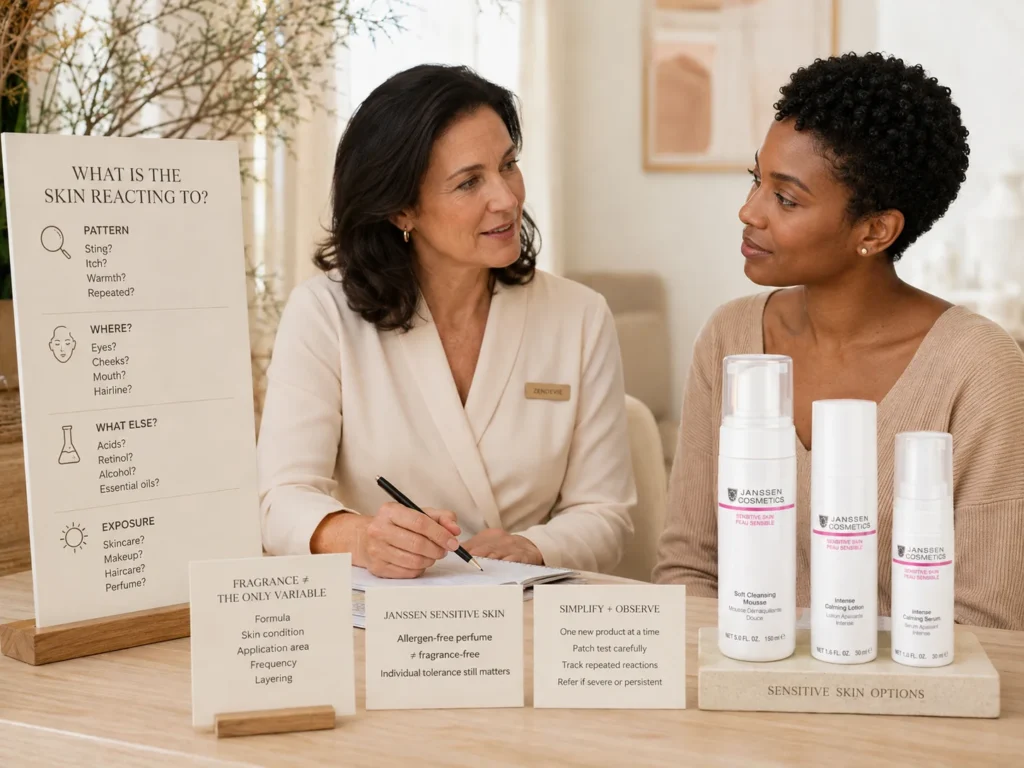
For sensitive skin, possible options may include:
These products are examples, not automatic recommendations.
Janssen Cosmetics describes its Sensitive Skin family as being developed for sensitive and extra-sensitive skin. Its product information also states that the range contains an allergen-free perfume.
This does not mean every person with sensitive skin is guaranteed to tolerate every product in the range.
“Allergen-free perfume” should not be interpreted as fragrance-free, odorless, or impossible to react to.
The complete formula, the person’s sensitivity history, application area, and current skin condition still matter.
Someone who knows they react to fragranced products should mention that during the consultation.
If the skin is currently burning, itching, swollen, rash-like, flaky from irritation, or reacting to basic products, the first step may be simplifying the routine rather than adding several new products.
Do not assume every fragranced product is bad for every sensitive complexion.
Do not assume fragrance-free guarantees that the skin will not react.
Do not confuse unscented with fragrance-free automatically.
Do not assume natural fragrance or essential oils are always gentle.
Do not choose skincare only because it smells luxurious, clean, floral, or botanical.
Do not apply perfume directly to the face.
Do not spray fragrance near irritated eyes.
Do not layer a scented cleanser, toner, serum, cream, SPF, makeup product, hair spray, and perfume without considering the combined exposure.
Do not introduce several fragranced products at once.
Do not start fragrance, retinol, acids, and vitamin C during the same week when the skin reacts easily.
Do not apply fragranced products to recently waxed, shaved, sun-stressed, or over-exfoliated skin.
Do not apply strong fragrance around the eyes or mouth corners.
Do not keep using a product that repeatedly burns, itches, or causes visible discomfort.
Do not scratch or scrub rash-like or flaky areas.
Do not try to diagnose a fragrance allergy through skincare alone.
Do not ignore persistent swelling, blistering, crusting, bleeding, severe itching, eye-area reactions, or worsening symptoms.
Fragrance is not automatically bad for every person with sensitive skin. However, it may cause stinging, itching, warmth, dryness, or redness-looking areas for some people.
Fragrance-free products may be a helpful choice when skin repeatedly reacts to fragranced formulas. However, fragrance-free does not guarantee that every ingredient will be tolerated.
Fragrance-free generally means fragrance was not intentionally added for scent. Unscented means the product is designed not to have a noticeable smell and may sometimes contain ingredients that mask odor.
Yes. Raw ingredients may have a natural aroma even when no fragrance is added.
Yes. Natural fragrance, botanical scents, and essential oils may still cause discomfort for some sensitive skin.
Some sensitive skin may tolerate certain essential oils, while other skin may react. Essential oils should not automatically be considered gentle because they are natural.
Look for terms such as fragrance, parfum, perfume, aroma, and the names of essential oils or aromatic plant extracts.
Parfum is commonly used on ingredient lists to indicate a fragrance mixture.
Some sensitive skin may tolerate a lightly fragranced formula. Tolerance depends on the complete formula, frequency, application area, and current condition of the skin.
Fragrance may be one reason a moisturizer burns, but the skin may also be irritated from acids, retinol, over-cleansing, weather exposure, or another product underneath.
Yes. Fragrance from skincare, makeup, hair products, sprays, or perfume may contribute to eye-area stinging or watering in some people.
A strong scent does not automatically mean a product will cause a reaction. However, skin that reacts easily may benefit from caution, patch testing, and a simpler routine.
Fragrance may contribute to itching for some people. Persistent, severe, spreading, swollen, or rash-like itching should be evaluated by a dermatologist.
Yes. Patch testing may help identify an immediate or delayed reaction, although it cannot guarantee how the entire face will respond.
The skin may be drier, over-exfoliated, recently exposed to sun or wind, using retinol, or reacting to another product. Skin tolerance can change over time.
When the skin is actively irritated, simplifying the routine can be useful. Once the skin feels comfortable, products may be reviewed and reintroduced one at a time.
Yes. Perfume applied to the neck, hair, scarf, or clothing may still come into contact with facial skin.
No. An allergen-free perfume is still a fragrance system. It should not automatically be interpreted as fragrance-free or guaranteed not to cause a reaction.
See a dermatologist if a product causes persistent burning, severe itching, swelling, blistering, crusting, bleeding, infection-looking changes, eye-area swelling, a worsening rash-like reaction, or symptoms that do not improve after stopping the product.
If your skincare smells pleasant but your skin repeatedly stings, itches, becomes warm, or develops redness-looking areas, a free virtual consultation can help you review the complete routine.
At Zendevie, we look at more than one ingredient.
We review your cleanser, toner, serums, moisturizer, SPF, makeup, active products, fragrance exposure, essential oils, exfoliation habits, and reaction history before discussing product options.
The goal is not to create fear around fragrance.
The goal is to understand whether your skin is reacting to fragrance, another active ingredient, the combined routine, or a skin condition that needs dermatologist evaluation.

Zendevie is guided by Haby Diallo, a licensed esthetician with more than 20 years of professional skincare experience. Her approach is rooted in education, professional judgment, and personal care.
years of experience