


Sensitive skin can sometimes use exfoliating acids, but that does not mean every sensitive skin routine needs one.
Exfoliating acids can help improve the appearance of surface dullness, rough texture, clogged-looking pores, blackheads, or whiteheads. However, these products can also increase stinging, dryness, tightness, and redness-looking areas when the skin is already uncomfortable.
Before choosing an acid, it is important to understand what your skin is currently experiencing.
Skin that feels calm, hydrated, and consistent may respond differently from skin that feels hot, flaky, tight, itchy, or irritated. This is why the condition of the skin matters more than simply choosing an ingredient labeled “gentle.”
Sensitive skin may be able to use an AHA or BHA carefully, but exfoliating acids should not be introduced while the skin is burning, stinging, unusually warm, swollen, flaky, rash-like, or reacting to basic products such as moisturizer or SPF.
Start by making sure your skin tolerates a simple routine:
Once the skin feels stable, one exfoliating product may be introduced slowly and cautiously.
Do not begin with several acids, exfoliating cleansers, acid toners, scrubs, retinol products, and clarifying masks at the same time.

It is easy to believe that every skincare routine needs an exfoliating acid. In reality, exfoliation is an optional step.
Some people with sensitive skin may have a smoother-looking complexion simply by using a gentle cleanser, an appropriate moisturizer, and consistent sun protection. Others may benefit from limited exfoliation when roughness, dull-looking skin, or clogged-looking pores remain visible despite a stable basic routine.
More exfoliation does not automatically mean better skin.
For sensitive skin, the goal is not to remove as much surface buildup as possible. The goal is to support a comfortable complexion without creating unnecessary routine stress.
Exfoliating acids loosen the bonds between surface skin cells or help clear buildup inside pores, depending on the type of acid being used.
This action can be helpful, but it can also feel uncomfortable when the skin is already reactive.
An acid may sting more when:
A slight awareness of a new product is not the same as persistent burning. Burning, worsening redness-looking areas, swelling, or pain should not be treated as a sign that the product is “working.”
AHA and BHA are both exfoliating acids, but they are commonly used for different concerns.
AHA stands for alpha hydroxy acid.
Common AHAs include glycolic acid, lactic acid, mandelic acid, and citric acid.
AHAs mainly work at the surface of the skin. They may help support the appearance of:
Some AHAs can feel intense on reactive skin, especially when used in high percentages or applied too frequently.
A product containing lactic acid or mandelic acid is sometimes described as gentler than glycolic acid, but the complete formula, concentration, pH, frequency, and condition of the skin still matter.
The ingredient name alone cannot predict whether sensitive skin will tolerate a product.

BHA stands for beta hydroxy acid. In skincare, this usually refers to salicylic acid.
BHA is oil-soluble, which allows it to work within oily or clogged-looking pores. It may be considered when the primary concerns include:
Sensitive skin that is also oily or prone to clogged-looking pores may sometimes benefit from a carefully selected BHA product.
However, oily skin can still become dehydrated and irritated. A BHA should not be used simply because the face looks shiny.
There is no universal answer.
The better option depends on the concern being addressed.
An AHA may make more sense when the main concern is surface roughness or dull-looking skin.
A BHA may make more sense when the main concern is clogged-looking pores, blackheads, whiteheads, or an oily T-zone.
Our licensed esthetician’s approach begins by identifying why exfoliation is being considered. Sensitive skin should not be exposed to an acid without a clear purpose.
For some people, neither AHA nor BHA is appropriate at the moment. A comfort-focused routine may need to come first.
Pause exfoliating acids when the skin is:
Exfoliating an already irritated complexion can make it more difficult to identify what is causing the reaction.
During this period, simplify the routine rather than adding another active product.
Before adding an exfoliating acid, the skin should generally tolerate:
The cleanser should remove daily residue without leaving the skin feeling squeaky, tight, hot, or stripped.
The moisturizer should help skin feel comfortable without persistent burning or itching.
The sunscreen should be comfortable enough to use consistently.
Acids can increase the importance of sun protection because freshly exfoliated skin may be more vulnerable to visible sun-related changes and irritation.
When these three steps are not yet comfortable, exfoliation is not the next priority.
When the skin is stable and an exfoliating acid has a clear purpose, introduce it slowly.
Do not begin an acid cleanser, acid toner, exfoliating serum, exfoliating mask, and scrub together.
Choose one product so you can observe how the skin responds.
Apply a small amount to a limited area according to the product directions.
A patch test cannot guarantee that the entire face will respond the same way, but it may help identify an immediate reaction before broader use.
Do not patch test on skin that is already irritated, scratched, recently shaved, or visibly inflamed.
Sensitive skin may only need occasional exfoliation.
Starting once a week may be more appropriate than immediately using an acid every night. Some people may need even more time between applications.
Frequency should be based on the skin’s response, not on how often the label suggests the product can be used.
Avoid:
For combination or oily-sensitive skin, an exfoliating product may only be needed on the T-zone rather than the entire face.
A moisturizer can help reduce the tight or dry feeling that may follow exfoliation.
Avoid layering several additional active products afterward.
Daily broad-spectrum SPF is an essential part of any routine that includes exfoliating acids.
It is also important on cloudy days and during colder seasons.
There is no ideal schedule that applies to everyone.
Sensitive skin may tolerate an exfoliating acid once a week, once every 10 days, or less often. Some people may not tolerate acid exfoliation at all.
Watch for changes in:
These signs may suggest that exfoliation is happening too frequently.
Do not increase frequency simply because visible peeling is absent. An exfoliating acid can still be active without causing flakes.
An acid cleanser has shorter contact with the skin than a leave-on serum or toner, but it is not automatically gentle.
A cleanser containing AHA or BHA may still feel too active when:
For some sensitive complexions, a non-acid cleanser is a more appropriate daily foundation. An acid cleanser may be reserved for occasional use or may not be needed at all.
Acid toners are leave-on exfoliating products, even when they are marketed as toners.
They should not be confused with a gentle, comfort-focused tonic used after cleansing.
Using an acid toner every day can be too frequent for reactive skin, particularly when other actives are already part of the routine.
Read the ingredient list and product directions carefully. The word “toner” does not mean the formula is mild.
Sensitive skin with blackheads, whiteheads, or clogged-looking pores may sometimes use BHA carefully.
A targeted approach may be more appropriate than applying the product across the entire face.
For example, BHA may only be needed around the nose, chin, or another oily area.
However, what looks like a blackhead or whitehead is not always something that should be managed with stronger home exfoliation. Persistent, painful, swollen, or worsening blemish-like areas should be discussed with a dermatologist.
AHA may help improve the appearance of surface dullness or roughness, but dull-looking skin does not always mean the skin needs exfoliation.
Dullness may also become more noticeable when the skin is:
Before introducing an AHA, check whether a more consistent moisturizing and SPF routine improves the appearance of the skin.
Sensitive skin should not begin several active ingredients at once.
Avoid automatically combining:
Using multiple active steps can make it difficult to identify which product is causing stinging or discomfort.
It may also create a cycle in which the skin feels rough, more exfoliation is added, and the skin becomes increasingly reactive.
One active step at a time is usually easier to evaluate.
Do not automatically add retinol, another acid, a scrub, or a strong clarifying mask on the same evening.
If an exfoliating product causes burning:
Seek guidance from a dermatologist when burning is persistent, painful, swollen, rash-like, crusting, bleeding, infection-looking, close to the eyes, or continuing to worsen.
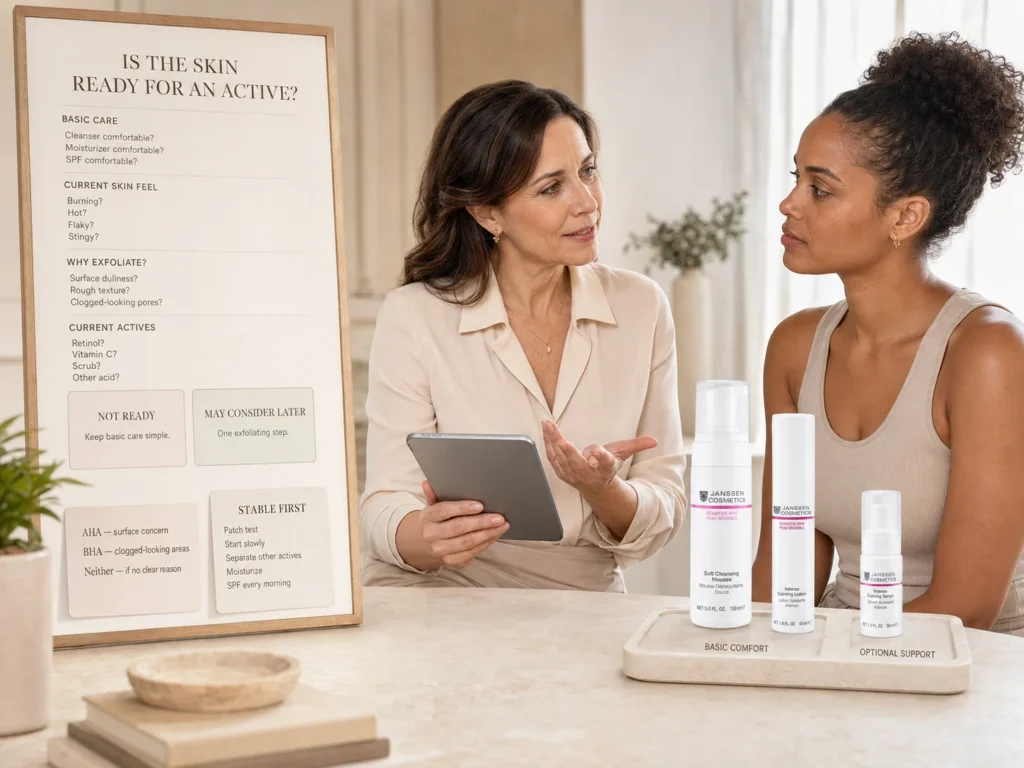
Janssen Cosmetics products should only be considered after the skin concern, tolerance level, routine comfort, and purpose of exfoliation have been assessed.
For sensitive skin that currently needs a simple, comfort-focused routine, possible consultation-led options may include:
A mild cleansing option that may be considered when the skin needs daily cleansing without an exfoliating step.
A non-acid tonic that may be considered after cleansing when the skin benefits from a gentle, refreshing step.
A possible serum step for skin that feels reactive or uncomfortable and needs a simple routine before stronger active products are considered.
A lighter moisturizer option that may suit sensitive skin that prefers a less rich texture.
A richer comfort-focused moisturizer option for skin that feels dry, tight, or reactive.
A possible add-on for skin that needs occasional comfort-focused care rather than additional exfoliation.
A daytime SPF option that may be included when acids are part of the routine or when sensitive skin needs consistent daily protection.
These products are not automatically recommended as one complete routine. Product selection should reflect skin type, current sensitivity, preferred texture, and routine comfort.
AHA + BHA Cleanser is an active cleanser intended for oily and blemish-prone skin concerns.
It may be too active for highly reactive sensitive skin, especially when the skin is dry, burning, flaky, or already using another exfoliating product.
It should not be presented as a default sensitive-skin cleanser.
Purifying BHA Serum may be considered only when clogged-looking pores, blackheads, whiteheads, or oily-zone concerns are present and the skin can tolerate salicylic acid.
For sensitive skin, targeted application may be more appropriate than full-face use. It should not be layered blindly with another acid product or retinol.
Enzyme or peeling products may be considered only after the skin has been assessed and is stable.
Some enzyme options may feel more comfortable than a strong acid formula for certain skin types, but “enzyme” does not automatically mean irritation-free.
Professional exfoliation systems and high-strength peels belong in professional settings and should not be presented as home-use routines.
Do not:
Some sensitive skin may tolerate a carefully formulated glycolic acid product, but glycolic acid can feel intense because of how efficiently it exfoliates the skin’s surface.
It should not be introduced while the skin is irritated, and frequent use may not be appropriate.
Lactic acid is often considered a more comfortable AHA option, but it can still cause stinging or irritation.
Concentration, product formula, frequency, and the condition of the skin all matter.
Mandelic acid is sometimes chosen for sensitive or blemish-prone skin because of its larger molecular size, but it is still an exfoliating acid.
Patch testing and slow introduction remain important.
Sensitive skin may sometimes use salicylic acid when blackheads, whiteheads, clogged-looking pores, or oily areas are present.
It may be better used only on the areas that need it rather than across the entire face.
Daily acid exfoliation is often unnecessary for sensitive skin.
Less frequent use may provide enough support while reducing the chance of discomfort.
Brief mild tingling may occur with some formulas, but persistent burning, pain, swelling, or worsening redness-looking areas should not be ignored.
Stop using the product when the skin feels increasingly uncomfortable.
Some people eventually alternate acids and retinol, but sensitive skin should first show that it can tolerate each product separately.
Do not introduce both products during the same week when neither has been used before.
Some acids may help improve the appearance of surface dullness and uneven-looking tone. However, daily SPF and a stable, comfortable routine remain essential.
A simple moisturizer that the skin already tolerates is often appropriate.
Consult a dermatologist when the skin reaction is persistent, painful, swollen, rash-like, infection-looking, crusting, bleeding, near the eyes, or continuing to worsen.
A dermatologist should also evaluate recurring reactions when it is unclear whether the issue is sensitivity, an allergy, or another skin concern.
Sensitive skin does not always need more products. It often needs a clearer understanding of what the skin is reacting to, which steps are necessary, and whether exfoliation has a useful purpose in the routine.
At Shop Zendevie, our free virtual skincare consultation begins with your skin type, current concerns, product history, routine comfort, and visible signs of sensitivity.
A personalized consultation can help determine whether an AHA, BHA, enzyme product, or no exfoliating product at all is the more appropriate next step.

Zendevie is guided by Haby Diallo, a licensed esthetician with more than 20 years of professional skincare experience. Her approach is rooted in education, professional judgment, and personal care.
years of experience