

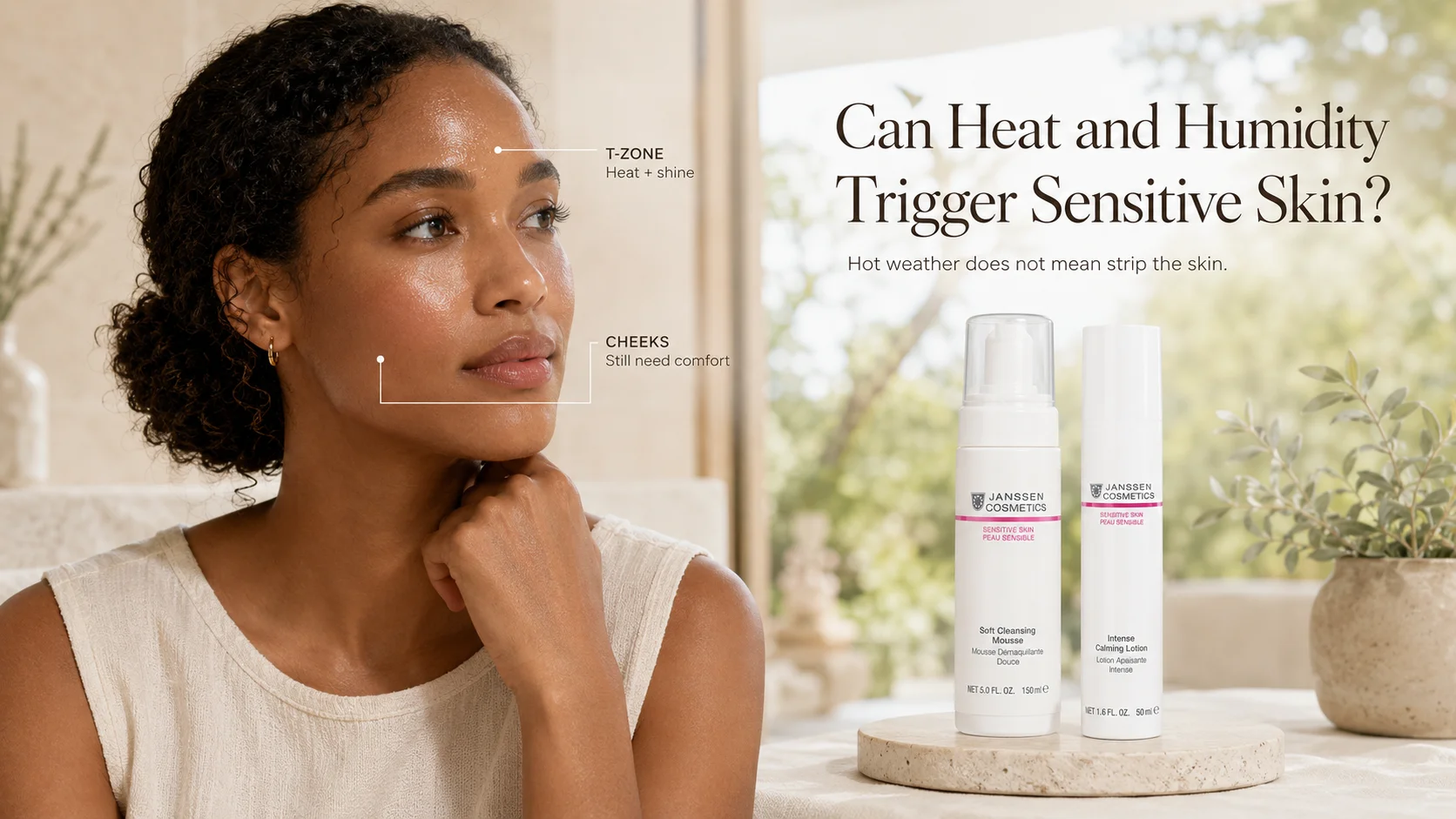
Sensitive skin may feel very different when the weather becomes hot and humid.
The face may feel warmer.
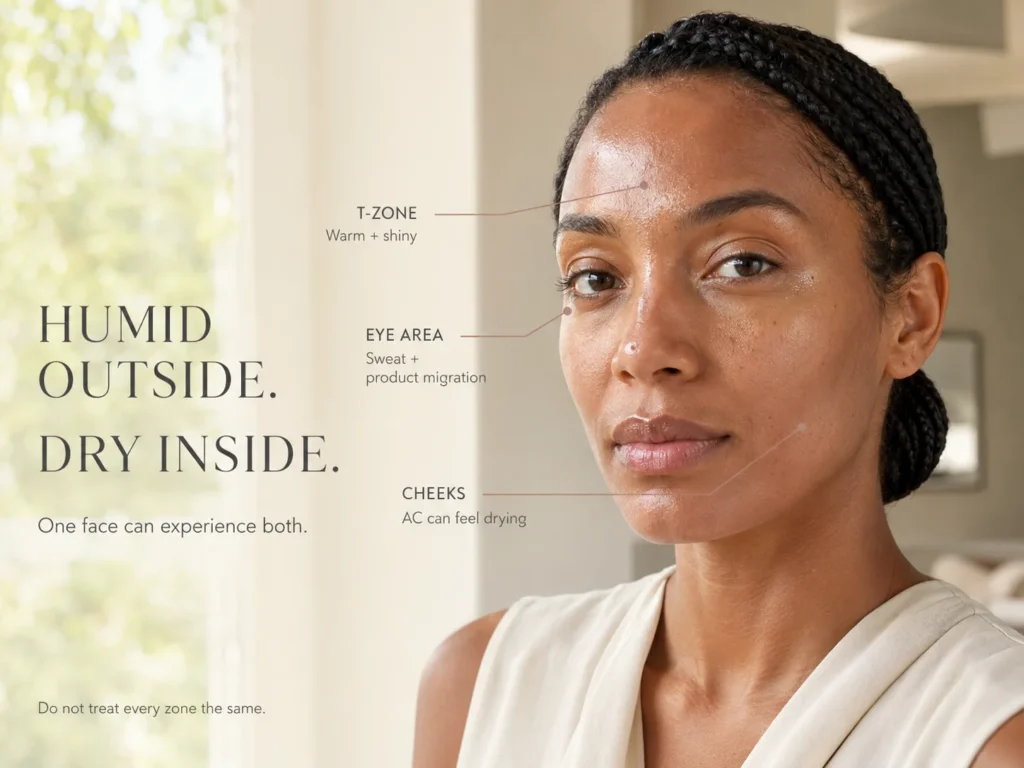
The T-zone may look shinier.
Sweat may collect around the nose, mouth, hairline, and eyes.
A moisturizer that felt comfortable in winter may suddenly feel heavy.
SPF may move toward the eyes.
Makeup may separate.
Cleansing may happen more frequently because the face feels sticky.
At the same time, air conditioning may leave the cheeks feeling dry or tight.
This can create a confusing pattern:
The skin looks oily but feels uncomfortable.
The face feels hot but also dehydrated.
The T-zone looks congested while the cheeks feel sensitive.
A product may not burn indoors but may sting after sweating outdoors.
Heat and humidity do not affect every sensitive complexion in the same way.
For some people, humidity helps the skin feel less dry.
For others, heat, sweat, friction, heavy layers, and frequent cleansing make the skin feel more reactive.
At Zendevie, our licensed esthetician looks at the full seasonal pattern before recommending stronger cleansing, lighter moisturizer, or more exfoliation.
The goal is to understand whether the skin is reacting to heat itself, sweat, product buildup, friction, active ingredients, sunscreen migration, air conditioning, or the combination of several factors.
Yes, heat and humidity may make sensitive skin feel more reactive.
Common hot-weather concerns include:
A simple hot-weather routine may be:
Morning: Gentle cleanser or rinse if appropriate → lightweight moisturizer if needed → SPF
Evening: Gentle cleanser → appropriate moisturizer
Temporarily reduce or pause active products when the skin feels persistently hot, burns, becomes rash-like, or begins reacting to basic skincare.
Seek dermatologist guidance when the skin is persistently painful, significantly swollen, blistering, crusting, bleeding, infection-looking, severely itchy, close to the eyes, or continues worsening after suspected products are stopped.
Seek urgent medical care for rapid facial swelling, breathing difficulty, throat tightness, faintness, or another severe reaction.
Heat raises the temperature of the environment and may increase facial warmth and sweating.
Sensitive skin may feel:
The skin may also be exposed to:
Heat may not be the only factor.
The products being worn during the heat also matter.
Humidity refers to the amount of moisture in the air.
Humid air may make some dry-sensitive skin feel less tight.
However, high humidity may also make skincare feel:
Humidity may also encourage people to wash more often or skip moisturizer completely.
Both habits can create problems for sensitive skin.
The goal is not to eliminate every trace of shine.
The goal is to keep the routine comfortable without stripping the skin.

Heat and humidity often happen together, but they are different.
A hot, dry climate may leave the skin feeling:
A hot, humid climate may leave the skin feeling:
Air conditioning may then create a second environment that feels cool but dry.
Sensitive skin may move between all three conditions during one day:
This is why one product texture may not feel ideal in every setting.
Sweat is part of the body’s natural cooling process.
But sensitive skin may notice more discomfort when sweat remains on the skin or mixes with:
Sweat may collect around:
The skin may begin to feel itchy, stingy, or sticky.
Avoid rubbing sweat away aggressively.
Blot gently with a clean, soft material when needed.
When the face feels sweaty or dirty, people may use:
This can make sensitive skin more uncomfortable.
Sweat does not need to be scrubbed out of the skin.
Use gentle cleansing based on:
More friction does not create a cleaner complexion.
Hot weather may lead to more washing.
A person may cleanse:
If a strong cleanser is used every time, the skin may become:
After light sweating, some skin may only need a lukewarm-water rinse.
After heavy sweating, makeup, or sunscreen buildup, gentle cleansing may be appropriate.
The correct approach depends on what is on the skin and how it feels.
In humid weather, oily or sweaty skin may feel as though it needs a very strong cleanser.
But sensitive skin should not feel:
A cleanser can remove daily residue without stripping the skin.
If the face feels tight every time it is washed, review:
Hot showers and hot facial rinsing may make sensitive skin feel more flushed or uncomfortable.
Use lukewarm water.
The water does not need to feel cold.
It should not leave the face hot after cleansing.
Long hot showers may affect facial skin even when the face is not directly under the water.
Very cold water may feel refreshing after heat exposure.
However, extreme temperature changes may also feel uncomfortable.
Sensitive skin does not need ice-cold water.
Use cool or lukewarm water rather than very hot or freezing temperatures.
Do not place ice directly on facial skin.
Air conditioning may reduce indoor humidity and expose the face to cool, dry airflow.
Sensitive skin may feel:
This creates a common summer pattern:
The skin feels oily outdoors but dry indoors.
Do not choose skincare based only on the morning weather.
Consider how much time is spent in:
A lightweight moisturizer may still be useful even in humid weather.
Air-conditioning vents, fans, and car vents may blow directly onto the face.
This may contribute to:
Redirect airflow away from the face when possible.
Hot weather may increase visible shine.
At the same time, frequent cleansing, air conditioning, acids, and lack of moisturizer may leave the skin dehydrated.
Signs may include:
Do not automatically treat shine with more cleansing or stronger toner.
The skin may need a lighter moisturizer rather than no moisturizer.
Some people can reduce moisturizer use during very humid weather.
Others still need a lightweight layer.
Moisturizer may support comfort after:
The texture may need to change.
A heavy winter cream may feel too rich.
A lighter lotion may be more comfortable.
Sensitive skin should not skip moisturizer only because the face looks shiny.
A rich cream may trap heat or feel uncomfortable in humid weather.
Possible signs include:
This does not make rich creams bad.
It means the texture may not match the current climate or skin type.
Dry-sensitive skin may still need richer comfort.
Oily-sensitive or combination-sensitive skin may prefer a lighter lotion.
A hot-weather routine may include:
Sensitive skin may not need every layer.
Too many layers may contribute to:
Use only the steps that serve a clear purpose.
Facial oils may feel comfortable in winter but heavy during humid weather.
They may also:
Facial oils are optional.
Do not assume dry-sensitive skin needs oil in every season.
Sunscreen is an important daytime step.
However, heat and humidity may make some SPF formulas feel:
The solution is not to stop SPF while continuing acids or retinol.
Instead, review:
A more comfortable texture may be needed.
Sweat can move sunscreen toward the eyes.
Possible signs include:
Avoid applying facial products too close to the lash line.
Use an appropriate eye-area approach.
Blot sweat gently rather than rubbing the eyes.
If the eyes or eyelids become significantly swollen, painful, crusting, or persistently irritated, seek medical guidance.
Daytime SPF may need reapplication depending on exposure and product instructions.
However, repeated layers over:
may feel uncomfortable.
Consider the practical context.
Do not rub aggressively.
Use products and methods appropriate for the skin, activity, and amount of sun exposure.
A consultation can help simplify the morning base so reapplication feels more manageable.
Foundation, concealer, primer, and setting spray may:
Sensitive skin may be tempted to use more powder, more setting spray, or stronger cleansing at night.
Review the full makeup and skincare structure.
Sometimes fewer layers improve both comfort and wear.
Some setting sprays contain:
If the face becomes hot, itchy, or stingy after setting spray, stop and review the formula.
Do not spray directly into open eyes.
Allow mist products to settle without inhaling heavily or saturating the face.
Fragrance may become more noticeable during hot weather because of:
Sensitive skin may notice more itching, warmth, or eye-area discomfort.
Review total fragrance exposure from:
The cause may not be facial skincare alone.
Peppermint, eucalyptus, citrus, tea tree, cinnamon, clove, and other essential oils may create cooling, tingling, or warming sensations.
These sensations may feel stronger when the skin is already hot or sweaty.
Do not apply undiluted essential oils to the face.
Avoid homemade essential-oil facial sprays.
A product does not need to create a strong cooling sensation to support the skin.
A product may feel cooling because of:
Cooling may feel refreshing.
It does not automatically mean the skin is being calmed.
If cooling becomes burning, eye watering, intense tingling, or persistent discomfort, stop using the product.
A warming mask may feel overly stimulating when the skin is already hot.
Sensitive skin should avoid masks that create:
Do not leave a mask on longer than directed.
More sensation does not mean better results.
Oily-sensitive skin may use clay masks more often during humid weather.
Clay may feel helpful for oily-looking areas.
But frequent use may leave the skin:
For combination-sensitive skin, clay may only be appropriate on the T-zone.
Do not apply a drying mask automatically across dry or redness-prone cheeks.
Humidity may make the skin feel rough, clogged, or sticky.
This may lead to more:
But sensitive skin may be reacting to sweat, buildup, heavy layers, or frequent cleansing rather than needing stronger exfoliation.
Exfoliation should have a clear purpose.
It should not be used simply because the face feels sticky.
BHA may be considered for:
However, oily-sensitive skin should avoid layering:
A targeted BHA approach may be more appropriate than full-face daily use.
The cheeks may not need the same treatment as the nose or chin.
AHA may be used for surface dullness or roughness.
But rough texture in humid weather may also be related to:
Do not increase AHA automatically.
Review the routine first.
Retinol is generally used at night, but daytime heat and sun exposure may affect how comfortable the skin feels later.
Retinol may sting more when the skin is:
Do not apply retinol to skin that still feels hot, painful, or sun-stressed.
Wait until the skin feels comfortable.
A vitamin C serum may sting more when:
If vitamin C repeatedly creates heat or burning, pause and review the routine.
Sensitive skin does not need to push through pain for antioxidant support.
Before applying:
allow the skin to cool and cleanse or rinse appropriately.
Do not apply strong actives while the face is still hot, sweaty, or irritated.
Exercise naturally raises body temperature and increases sweating.
The face may become:
This does not automatically mean skincare caused the reaction.
However, makeup, sunscreen, hair products, and friction may contribute.
After exercise:
Do not scrub the face after exercise.
During hot weather, the face may be wiped frequently.
Rough towels or repeated rubbing may make sensitive skin:
Blot rather than rub.
Use a clean, soft material.
Hair oils, edge control, leave-in products, sprays, and conditioners may move toward the face when sweating.
This can affect:
If bumps, itching, or redness-looking areas appear mainly near the hairline, review haircare as well as facial skincare.
Hats, headbands, helmets, scarves, and workout accessories may trap:
This may contribute to discomfort around the forehead and hairline.
Clean wearable items regularly according to their care instructions.
Avoid tight friction when the skin is already irritated.
Some work, travel, health, or environmental situations may require face coverings.
Heat and moisture may collect around:
Possible concerns include:
Use a simple routine under the covering.
Avoid unnecessary heavy layers.
Change or clean reusable coverings appropriately.
The mouth area may be affected by:
Avoid applying strong active products to areas that are:
Persistent mouth-area irritation should be evaluated by a dermatologist.
Sweat, tissues, rubbing, sunscreen, and product buildup may collect around the nose.
Avoid applying acids or retinol directly into irritated nostril folds.
Cleanse gently.
Do not scrub blackheads or roughness aggressively.
Heat and sweat can move products toward the eyes.
Possible contributors include:
Keep strong facial products away from the lash line.
Use eye-area products only as directed.
Seek medical guidance for significant swelling, pain, crusting, discharge, vision changes, or persistent irritation.
Dry-sensitive skin may feel less flaky outdoors but still become dehydrated through:
A lightweight but supportive moisturizer may feel more comfortable than a heavy cream.
The correct texture depends on:
Oily-sensitive skin may become:
Common mistakes include:
The goal is not to remove every trace of oil.
A lightweight moisturizer and gentle cleansing may support a more comfortable balance.
Combination-sensitive skin may have:
The whole face may not need the same products.
A BHA product may be considered only on oily, clogged-looking areas.
A lighter moisturizer may be used broadly, with additional support only where needed.
Do not treat the dry cheeks as though they are an oily T-zone.
Heat may make redness-looking areas more visible.
Possible triggers may include:
Skincare cannot diagnose the cause of persistent flushing or facial heat.
A comfort-focused routine may help reduce unnecessary product stress.
Persistent, painful, swollen, eye-related, or worsening redness should be evaluated by a dermatologist.
Mature sensitive skin may need hydration but dislike heavy summer layers.
A routine may become uncomfortable when it includes:
A well-aging routine should not feel heavy, hot, or sticky.
The focus may include:
Heat and sweat may make blemish-prone skin feel more congested-looking.
But aggressive treatment may worsen sensitivity.
Avoid combining:
Painful, deep, swollen, cystic-looking, infection-looking, crusting, bleeding, persistent, or scarring blemishes should be evaluated by a dermatologist.
Do not apply strong active products to skin that feels:
After sun exposure, use products the skin already tolerates.
Pause:
If the skin is blistering, significantly swollen, severely painful, or worsening, seek medical guidance.
After professional exfoliation, dermaplaning, microdermabrasion, microneedling, laser procedures, or another intensive service, follow the provider’s aftercare instructions.
Heat, sweating, exercise, and sun exposure may need to be limited depending on the procedure.
Do not add home acids, retinol, scrubs, or essential oils against professional aftercare guidance.
Professional exfoliation systems should remain in professional settings.
Shaving may leave the skin more reactive.
Avoid immediately applying:
Allow the skin to cool and feel comfortable.
If the area becomes painful, significantly swollen, blistering, rash-like, or infection-looking, seek guidance.
Waxing and threading may temporarily increase sensitivity.
Avoid:
until the skin feels comfortable again.
Follow the provider’s aftercare instructions.
Travel may combine:
Do not introduce several new products during travel.
Bring the cleanser, moisturizer, and SPF the skin already tolerates.
A simple routine is easier to adjust between outdoor heat and indoor dryness.
A parked car may become very hot.
Heat may affect both skin comfort and product storage.
Do not store skincare or sunscreen in a hot car unless the product instructions specifically allow it.
Products exposed to extreme heat may change in:
Store products according to their directions.
Bathrooms may become warm and humid.
This environment may not be ideal for every product.
Follow storage instructions.
Keep containers closed.
Avoid introducing water into jars or products.
Do not continue using products that have changed significantly in smell, color, or texture without assessing whether they remain suitable.
Sensation and appearance do not always match.
The skin may feel hot without a visible color change.
Review:
Persistent or painful heat should not be ignored simply because the skin looks normal.
Redness-looking areas may appear after:
Allow the skin to cool naturally.
Avoid applying several active or heavily fragranced products.
Persistent or recurring redness may need dermatologist evaluation.
Review:
Use the gentlest tolerated approach.
Do not follow hot-feeling skin with an acid toner or retinol.
The routine may contain too many layers or textures that are too rich for the climate.
Review:
Remove unnecessary steps.
A sticky feeling does not always mean the skin needs stronger cleansing.
The skin may be oily and dehydrated.
Review:
Do not cleanse more often automatically.
A lightweight moisturizer may support comfort.
Blot sweat gently.
Rinse or cleanse appropriately.
Review products mixed with the sweat, including:
Persistent, severe, spreading, swollen, or rash-like itching should be evaluated by a dermatologist.
Sweat may carry sunscreen, makeup, or hair products toward the eyes.
Rinse gently with appropriate water if needed.
Avoid rubbing.
Review eye-area application and product migration.
Seek medical guidance for significant swelling, pain, crusting, discharge, vision changes, or persistent irritation.
Consider whether:
A lighter lotion may feel more comfortable.
Do not stop moisturizer automatically if the skin becomes tight after cleansing.
The skin may already be irritated by:
The moisturizer formula may also not suit the skin.
Pause active products.
Use only products that remain comfortable.
If burning persists, seek dermatologist guidance.
Reduce unnecessary layers underneath.
Review:
Do not stop daytime protection while continuing active products.
A consultation may help identify a more comfortable structure.
Keep SPF away from the immediate lash line unless the product is intended for that area.
Review whether sweat or product migration is involved.
Avoid rubbing the eyes.
Seek guidance if symptoms are persistent or severe.
Small bumps may be associated with:
Do not assume stronger exfoliation is always needed.
Simplify the routine.
If bumps are itchy, painful, swollen, rash-like, spreading, infection-looking, or persistent, seek dermatologist guidance.
Humidity, oil, makeup, SPF layers, and buildup may make pores look more noticeable.
Review:
Do not squeeze or scrub blackheads aggressively.
A targeted BHA approach may be discussed after the skin is stable.
Review:
Do not begin several clarifying products at once.
Painful, inflamed-looking, persistent, or scarring blemishes should be evaluated by a dermatologist.
A lightweight moisturizer may still be needed.
Consider:
Do not treat dry cheeks with stronger exfoliation.
Use a zone-based approach.
The T-zone may need lighter textures or carefully selected BHA.
The cheeks may need only gentle cleansing and moisturizer.
Do not apply every active product across the entire face automatically.
Stop introducing new products.
Return to the simplest routine that remains comfortable.
Avoid:
If cleanser, moisturizer, SPF, or water continues to create significant discomfort, seek dermatologist guidance.
The pattern may involve:
Review the outdoor routine and what is worn on the face.
Do not assume the skincare formula is the only factor.
That is useful information.
The previous routine may have contained:
Do not add everything back immediately.
Reintroduce one product at a time only when it serves a clear purpose.
Gentle cleanser or lukewarm-water rinse if appropriate → lightweight moisturizer if needed → SPF
Gentle cleanser → appropriate moisturizer
Optional products should be added only when they serve a clear purpose and the skin remains comfortable.
Gentle cleanser or rinse → lightweight but supportive moisturizer → SPF
Gentle cleanser → comfort-focused serum if appropriate → moisturizer
Air-conditioning exposure may influence how much moisturizer is needed.
Gentle cleanser → lightweight moisturizer → SPF
Gentle cleanser → lightweight moisturizer
If clogged-looking pores are present, one targeted BHA step may be considered after consultation.
Do not use several clarifying products together.
Gentle cleanser → lightweight moisturizer according to area needs → SPF
Gentle cleanser → moisturizer with targeted care only where needed
Avoid applying heavy cream to oily zones or strong acids to dry cheeks automatically.
Do not exfoliate simply because the face was sweaty.
Lukewarm-water rinse or gentle cleanser if needed → tolerated moisturizer → tolerated SPF
Gentle cleanser → tolerated moisturizer
Temporarily avoid:
The routine should feel simple and predictable.
Once the skin feels stable:
Hot weather may require a different schedule from colder months.
Seasonal adjustment may involve only a few changes:
Do not replace every product at once.
Changing too many products creates more uncertainty.
A dermatologist should evaluate the skin when heat-related or product-related discomfort includes:
Seek urgent medical care for breathing difficulty, throat tightness, faintness, or rapid swelling of the face, lips, tongue, or eyes.
Cosmetic skincare can help organize a hot-weather routine.
It cannot diagnose the cause of persistent facial heat, itching, swelling, or rash-like changes.
After consultation, our licensed esthetician may consider Janssen Cosmetics options based on whether the skin is dry-sensitive, oily-sensitive, combination-sensitive, mature-sensitive, redness-prone, congested-looking, or currently uncomfortable.

Possible sensitive-skin options may include:
These products are possible options, not one automatic hot-weather routine.
In heat and humidity, Intense Calming Lotion may be considered when the skin wants a lighter moisturizer texture.
Intense Calming Cream may still be considered when the skin remains dry, tight, or exposed to strong air conditioning.
The correct choice depends on:
A toner, serum, mask, and eye product should not be added automatically.
The basic cleanser, moisturizer, and SPF foundation should feel comfortable first.
For oily-sensitive or combination-sensitive skin with clogged-looking pores, Purifying BHA Serum may be discussed only when blackheads, whiteheads, or oily-zone buildup are present and the skin can tolerate BHA.
It should not be combined blindly with:
AHA + BHA Cleanser may be too active for skin that is already hot, irritated, over-cleansed, or reacting to SPF.
Active cleanser use should be assessed carefully.
Professional exfoliation systems belong in professional treatment settings and should not be used as home solutions for summer congestion or shine.
If the skin is persistently hot, burning, swollen, rash-like, or reacting to moisturizer, active products should wait.
Do not wash the face every time it feels slightly sweaty.
Do not use a strong foaming cleanser several times a day.
Do not scrub sweat away.
Do not use very hot or freezing water.
Do not place ice directly on the face.
Do not assume humidity means moisturizer is unnecessary.
Do not apply a heavy winter cream automatically in humid weather.
Do not layer toner, several serums, facial oil, moisturizer, SPF, primer, and makeup without reviewing whether every step is needed.
Do not stop SPF because it feels heavy while continuing acids or retinol.
Do not apply retinol, AHA, BHA, or strong vitamin C to hot, sweaty, sun-stressed, or freshly shaved skin.
Do not use acid toner, BHA serum, clay mask, facial scrub, and retinol together.
Do not treat every summer bump with stronger exfoliation.
Do not apply undiluted essential oils for a cooling effect.
Do not assume tingling or cooling proves effectiveness.
Do not use warming masks on already hot skin.
Do not rub the eyes when sweat or SPF stings.
Do not apply strong facial products close to the lash line.
Do not apply active products over irritated mouth or nostril folds.
Do not ignore hair products, makeup, perfume, hats, headbands, and face coverings that touch the skin.
Do not store skincare or SPF in a hot car.
Yes. Heat, exercise, hot water, sun exposure, friction, and temperature changes may make redness-looking areas more noticeable.
Humidity itself does not automatically clog pores, but sweat, heavy product layers, makeup, hair products, and incomplete cleansing may contribute to clogged-looking texture.
Not automatically. BHA may help with clogged-looking pores, but frequent use may irritate sensitive skin. Targeted and less frequent use may be more appropriate.
Retinol may feel more uncomfortable when the skin is sun-stressed, sweaty, over-cleansed, dehydrated, or using acids.
A clay mask may suit some oily zones, but frequent full-face use may leave sensitive areas tight or irritated.
Sweat, heavy moisturizer, facial oil, multiple serums, SPF, primer, and makeup texture may all contribute.
Some essential oils create a cooling sensation, but that does not mean they are gentle. Undiluted essential oils should not be applied to sensitive facial skin.
Stop introducing new products, pause active ingredients, and return to the simplest tolerated cleanser, moisturizer, and SPF routine.
See a dermatologist if the reaction is persistent, painful, significantly swollen, blistering, crusting, bleeding, infection-looking, close to the eyes, repeatedly returning, or not improving after suspected products are stopped.
If your skin becomes hot, sticky, oily, itchy, or more reactive during humid weather, a free virtual consultation can help you adjust the routine without stripping the skin or adding unnecessary clarifying products.
At Zendevie, we review your cleanser, moisturizer texture, SPF, makeup, exfoliation schedule, retinol use, sweating, exercise, air-conditioning exposure, fragrance, hair products, and seasonal reaction history before discussing product options.
The goal is not to remove every trace of shine.
The goal is to help your skin feel comfortable in both outdoor heat and indoor air conditioning while keeping the routine simple, purposeful, and appropriate for your skin type.

Zendevie is guided by Haby Diallo, a licensed esthetician with more than 20 years of professional skincare experience. Her approach is rooted in education, professional judgment, and personal care.
years of experience