

Over-exfoliation can make sensitive skin feel like every product is suddenly a problem.
Your cleanser may sting. Moisturizer may burn. SPF may feel uncomfortable. Makeup may cling to rough patches. The skin may look shiny but feel dry underneath. It may feel hot, tight, flaky, or raw.
This often happens when the skin has been pushed too hard.
Maybe you used AHA, BHA, a scrub, an exfoliating cleanser, a peeling mask, and a retinol-style product too close together. Maybe one product was too strong. Maybe the skin was already dry, sensitive, or sun-stressed before exfoliation.
At Zendevie, we do not treat over-exfoliation as a reason to add more active products. We treat it as a reason to pause, simplify, and understand what the skin is showing.
In consultation, our licensed esthetician first looks at what was used, how often it was used, where the skin feels irritated, and whether there are signs that need dermatologist evaluation.
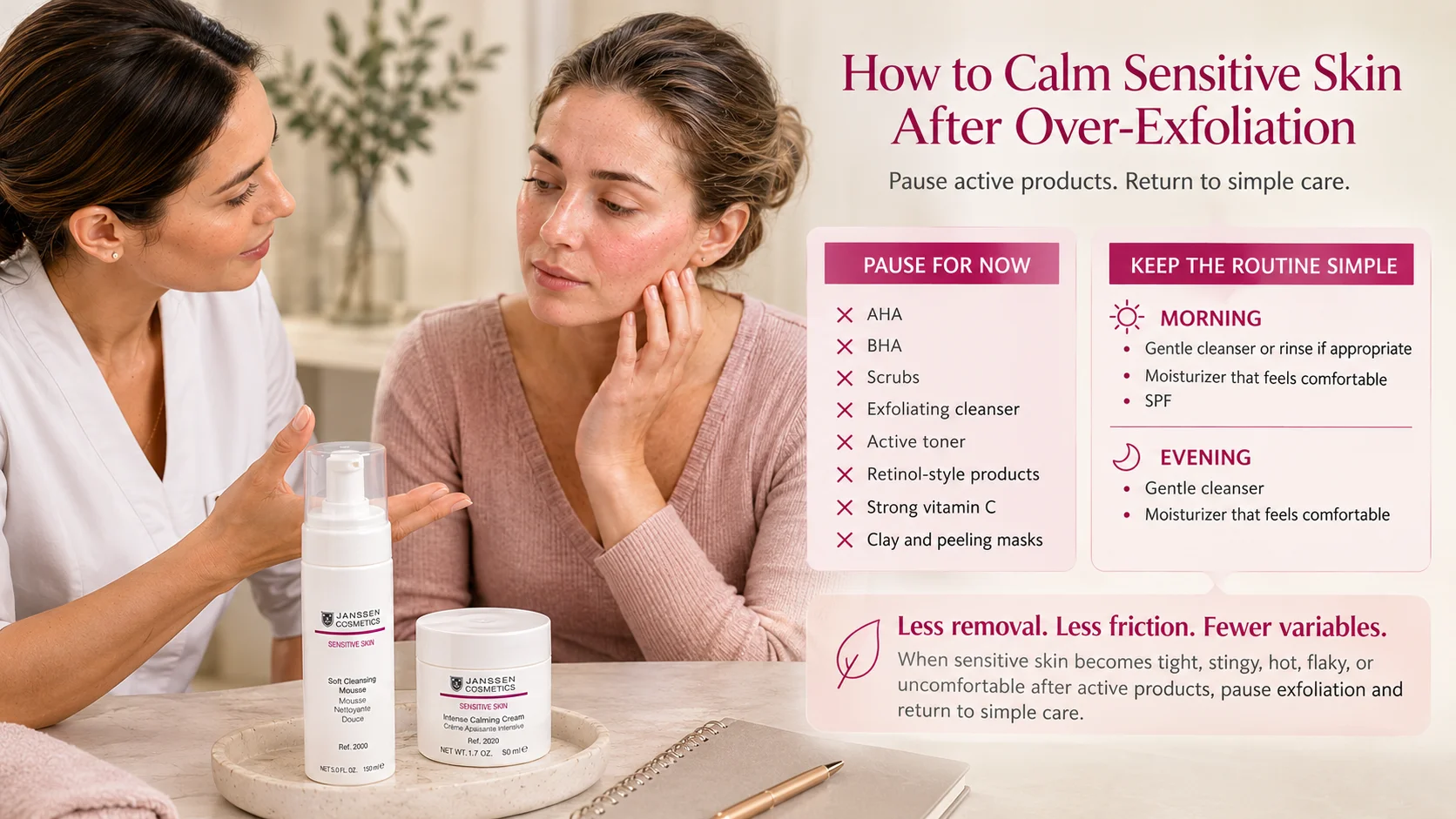
To calm sensitive skin after over-exfoliation, stop exfoliating products first.
Pause:
Use a simple routine instead:
Morning: Gentle cleanser or rinse if appropriate → moisturizer that does not sting → SPF
Evening: Gentle cleanser → moisturizer that does not sting
Avoid hot water, scrubbing, strong actives, and testing new products until the skin feels calm again.
If there is swelling, severe burning, rash-like irritation, pain, crusting, bleeding, eye-area irritation, or symptoms that do not improve, seek dermatologist guidance.

Over-exfoliation happens when the skin is exfoliated more than it can comfortably tolerate.
Exfoliation removes surface buildup. When used appropriately, it may help the skin look smoother or less dull. But too much exfoliation can leave sensitive skin feeling exposed, tight, stingy, or irritated.
Over-exfoliation can happen from one strong product or from too many mild products used together.
For example, the routine may include:
AHA cleanser → exfoliating toner → BHA serum → scrub → clay mask → retinol-style cream
Even if each product has a purpose, the total routine may be too much.
Sensitive skin may show over-exfoliation in several ways.
Common signs include:
If your skin suddenly reacts to basic products, over-exfoliation may be part of the reason.
Sensitive skin often reacts faster because the surface may be more easily disturbed.
If the skin already feels dry, tight, redness-prone, or reactive, exfoliation needs extra caution.
Sensitive skin may become over-exfoliated from:
Sensitive skin usually needs a slower plan, not a stronger one.
Moisturizer can burn after over-exfoliation because the skin is already irritated.
The moisturizer may not be the only problem. It may simply be touching skin that is too reactive at that moment.
This is why switching moisturizers repeatedly does not always solve the issue.
First, pause the active products that created the stress. Then keep only the products the skin can tolerate.
If every moisturizer burns, the skin may need professional evaluation.
Over-exfoliated skin can still look shiny.
This confuses many people.
The face may look oily, but the surface may feel dry, tight, or stripped. This can happen when the skin produces visible oil while the surface lacks comfort.
That does not mean you should exfoliate more.
It means the skin may need a calmer routine.
Oily but over-exfoliated skin should avoid stronger oil-control steps until the tightness, burning, and flaking improve.
The first step is to stop exfoliating.
Do not try to “smooth” the irritation with more acid or another scrub.
Pause:
The skin needs a break from removal-focused products.
Retinol-style products can make over-exfoliated skin feel worse if the skin is already tight, burning, or flaky.
Pause retinol-style care until the skin feels stable.
This does not mean retinol-style products can never be used again. It means the skin is not ready for them right now.
When reintroduced later, they should be spaced carefully and not layered with multiple exfoliating products.
Vitamin C may sting on sensitive or over-exfoliated skin, depending on the formula and skin condition.
If your skin is burning, hot, or flaky, strong vitamin C should wait.
A brightening routine should not come before skin comfort.
Once the skin feels calmer, vitamin C-style products can be considered more carefully if appropriate.
Clay masks can be helpful for oily areas, but they may feel too drying on over-exfoliated skin.
If your skin is tight, hot, or flaky, pause clay masks.
Do not apply a clay mask to “pull out” irritation or control shine while the skin is overworked.
Once the skin feels stable, clay may be used only where needed and not too often.
Scrubs can make over-exfoliated skin feel more irritated.
Even gentle scrubs can be too much when the skin is already raw or sensitive.
Do not scrub away flakes.
Flaking after over-exfoliation is not a sign that the skin needs more exfoliation. It is a sign that the skin needs less.
Hot water can make over-exfoliated skin feel worse.
Use lukewarm water when cleansing.
Avoid steam, very hot showers, and rough towels.
Pat the skin gently instead of rubbing.
The way you apply products matters as much as the products themselves.
A simple morning routine may look like:
Gentle cleanser or rinse if appropriate → Moisturizer that does not sting → SPF
If cleanser stings, use the mildest cleansing approach that still fits your needs.
If moisturizer stings, stop and seek guidance before trying many new products.
If SPF stings, the skin may be very reactive, or the SPF formula may not be a good match. Daytime protection still matters, but the product choice may need careful review.

A simple evening routine may look like:
Gentle cleanser → Moisturizer that does not sting
At night, avoid active serums, exfoliating acids, retinol-style products, peels, scrubs, and masks until the skin feels more comfortable.
Evening care should help the skin feel settled, not more reactive.
Over-exfoliated skin needs fewer variables.
Do not introduce several new products while the skin is burning.
A basic routine is easier to judge.
If you keep switching cleansers, moisturizers, toners, serums, masks, and SPF products, it becomes difficult to identify what the skin tolerates.
Sensitive skin usually responds better to calm consistency.
Fragrance may be a trigger for some sensitive skin, especially when the skin is already over-exfoliated.
Avoid fragrance-heavy products while the skin is reactive.
This may include:
A product does not have to be harsh to be irritating for sensitive skin.
Essential oils may sound gentle, but they can be too stimulating for reactive skin.
When the skin is over-exfoliated, even small triggers may feel stronger.
Pause essential oil products until the skin feels stable.
Natural does not always mean calming for sensitive skin.
If your toner contains exfoliating ingredients or leaves the skin tight, pause it.
Even a toner that usually feels fine may sting when the skin is over-exfoliated.
A toner should not be forced into a routine that is already causing burning.
If the skin feels reactive, toner may not be necessary for a short reset period.
Flakes can be tempting to remove, but picking or peeling them can make irritation worse.
Do not scrub, peel, or pull flaking skin.
Keep the routine simple and let the skin become more comfortable.
If flaking is severe, painful, cracking, or persistent, seek professional guidance.
Over-exfoliated skin is not the right time to test a new acid, retinol-style product, vitamin C, peel, or mask.
Wait until the skin is calm.
Then introduce one product at a time.
If you add too much too quickly, the same cycle may happen again.
Over-exfoliated skin can be more sensitive to sun exposure.
SPF is still important during the day.
The challenge is choosing a formula that does not sting and layering it over a moisturizer the skin tolerates.
If SPF burns strongly, do not keep forcing the same product. Seek guidance and avoid unnecessary sun exposure while the skin is reactive.
Makeup may look patchy when the skin is over-exfoliated.
Foundation may cling to flakes, settle into rough texture, or separate around the T-zone.
Avoid using more exfoliation before makeup to smooth the surface.
Instead:
Makeup will usually sit better once the skin feels less irritated.
There is no exact timeline for everyone.
Some skin feels better after a few days of simple care. Other skin needs longer, especially if the routine has been aggressive for weeks.
The skin may be ready for a careful next step when:
Do not rush the process.
Reintroduce products only when the skin feels stable.
Start with one product at a time.
For example:
This helps you understand what your skin can tolerate.
When the skin is calm, exfoliation may be reconsidered if there is a clear reason.
Possible reasons include:
Start slowly.
Do not exfoliate because the skin feels “not perfect.” Exfoliate only when the skin shows a concern that exfoliation may appropriately address.
AHA and BHA do different things, but both can be too much for sensitive skin if layered carelessly.
If you need BHA for clogged-looking pores, you may not need AHA at the same time.
If you need AHA for dull texture, you may not need BHA that same night.
Sensitive skin often does better with spacing, not stacking.
To prevent over-exfoliation from coming back, look at your routine.
Ask:
The answer may show where the routine became too much.
Once the skin feels calm, a gentle weekly plan may look like:
Daily morning:
Gentle cleanser → Moisturizer → SPF
Daily evening:
Gentle cleanser → Moisturizer
Selected night if needed:
One exfoliating product only, if the skin can tolerate it
Avoid:
Using acids, scrubs, retinol-style products, and masks on the same night
The plan should be adjusted based on skin tolerance.
Dry sensitive skin over-exfoliates easily.
If your skin is dry, tight, flaky, and burning, exfoliation should pause.
Focus on:
Once the skin feels comfortable, exfoliation can be discussed carefully.
Oily sensitive skin can become over-exfoliated when you try too hard to control shine.
If your skin is shiny but tight, stop drying it out.
Focus on:
Oily sensitive skin needs balance, not aggressive oil removal.
Redness-prone skin needs extra caution after over-exfoliation.
Avoid heat, steam, hot water, scrubs, acids, retinol-style products, and fragrance-heavy products while the skin feels reactive.
If redness-looking changes are persistent, painful, swelling, rash-like, or worsening, seek dermatologist guidance.
A hot feeling after skincare can happen when the skin is irritated.
Stop active products and simplify.
Avoid:
If the hot feeling is severe, persistent, or comes with swelling, rash-like changes, or pain, seek medical advice.
If moisturizer still burns after you pause active products, the skin may need more careful evaluation.
The moisturizer formula may not suit your skin, or the skin may be more irritated than it seems.
Do not keep trying many moisturizers quickly.
Seek guidance, especially if burning is strong or persistent.
If SPF burns after over-exfoliation, review whether the skin is still too reactive, whether the moisturizer underneath is enough, and whether the SPF formula is appropriate.
Do not replace SPF with acids, oils, or makeup.
Daytime protection still matters, especially after exfoliation.
If SPF cannot be tolerated, seek professional guidance and limit unnecessary sun exposure while the skin is reactive.
Over-exfoliated skin may develop bumps or blemish-looking irritation.
Do not assume every bump needs more exfoliation.
If blemishes are painful, deep, swollen, infected-looking, rash-like, scarring, or persistent, a dermatologist should evaluate them.
If bumps are mild and the skin is simply irritated, simplify first before adding clarifying products.
A dermatologist should evaluate the skin if over-exfoliation is followed by:
Do not try to solve severe reactions with more skincare.

After consultation, our licensed esthetician may consider Janssen Cosmetics options depending on whether the skin is sensitive, dry-sensitive, oily-sensitive, redness-prone, or reactive after product overload.
Possible sensitive-skin options may include:
These options are not automatic recommendations. If the skin is swollen, painful, rash-like, crusting, bleeding, infection-looking, or persistently worsening, dermatologist evaluation should come first.
Do not exfoliate more to remove flakes.
Do not use AHA, BHA, scrub, retinol-style product, and mask together.
Do not apply clay mask over burning skin.
Do not use hot water or steam.
Do not keep using toner that stings.
Do not test new active products while the skin is reactive.
Do not pick or peel flaking skin.
Do not assume burning means the product is working.
Do not ignore swelling, pain, rash-like irritation, crusting, bleeding, or persistent worsening.
Stop exfoliating products, simplify your routine, use gentle cleansing, apply a moisturizer that does not sting, and use SPF in the morning. Avoid acids, scrubs, retinol-style products, and masks until the skin feels stable.
It may feel tight, stingy, burning, hot, flaky, raw, or rough. Products that normally feel fine may suddenly burn.
Yes, if the moisturizer does not sting. Moisturizer can help the skin feel more comfortable, but if every moisturizer burns, seek guidance.
Yes. SPF is important during the day, especially when the skin has been exfoliated. Choose a formula the skin can tolerate and avoid unnecessary sun exposure while the skin is reactive.
Pause BHA until the skin feels calm. Once the skin is stable, BHA may be reconsidered if clogged-looking pores, blackheads, or whiteheads are present.
Pause retinol-style products until the skin feels comfortable again. Reintroduce only carefully and avoid layering with exfoliating acids.
Your skin may be irritated or barrier-stressed from too much exfoliation. Even a normally comfortable moisturizer can burn when applied to overworked skin.
See a dermatologist if there is severe burning, swelling, rash-like irritation, pain, crusting, bleeding, infection-looking changes, eye-area irritation, or symptoms that do not improve after stopping active products.
If your skin feels tight, stingy, burning, flaky, or reactive after exfoliation, a free virtual consultation can help you simplify before choosing more products.
At Zendevie, we review your cleanser, toner, acids, scrubs, masks, retinol-style products, moisturizer, SPF, and skin response before recommending next steps. The goal is to help sensitive skin feel calmer and less overwhelmed.

Zendevie is guided by Haby Diallo, a licensed esthetician with more than 20 years of professional skincare experience. Her approach is rooted in education, professional judgment, and personal care.
years of experience