


Sensitive skin often reveals itself at the cleansing step.
Your face may feel fine before washing, then tight afterward. Moisturizer may sting right after cleansing. Toner may burn. The cheeks may look red-looking or feel warm. The skin may feel clean, but not comfortable.
That is an important clue.
A cleanser is not supposed to leave sensitive skin feeling stripped. It should remove daily buildup, SPF, makeup, sweat, oil, and residue without making the skin feel raw, stretched, or reactive.
The best cleanser for sensitive skin is not always the strongest cleanser, the most foamy cleanser, or the cleanser that gives a squeaky-clean finish. For sensitive skin, the best cleanser is usually the one that leaves the skin clean and calm enough for the next steps.
At Zendevie, we do not choose a cleanser only by skin type label. In consultation, our licensed esthetician asks how the skin feels after cleansing, how often the person washes, whether moisturizer stings afterward, whether SPF or makeup is worn, and whether active products are already in the routine.
The cleanser sets the tone for the entire routine.
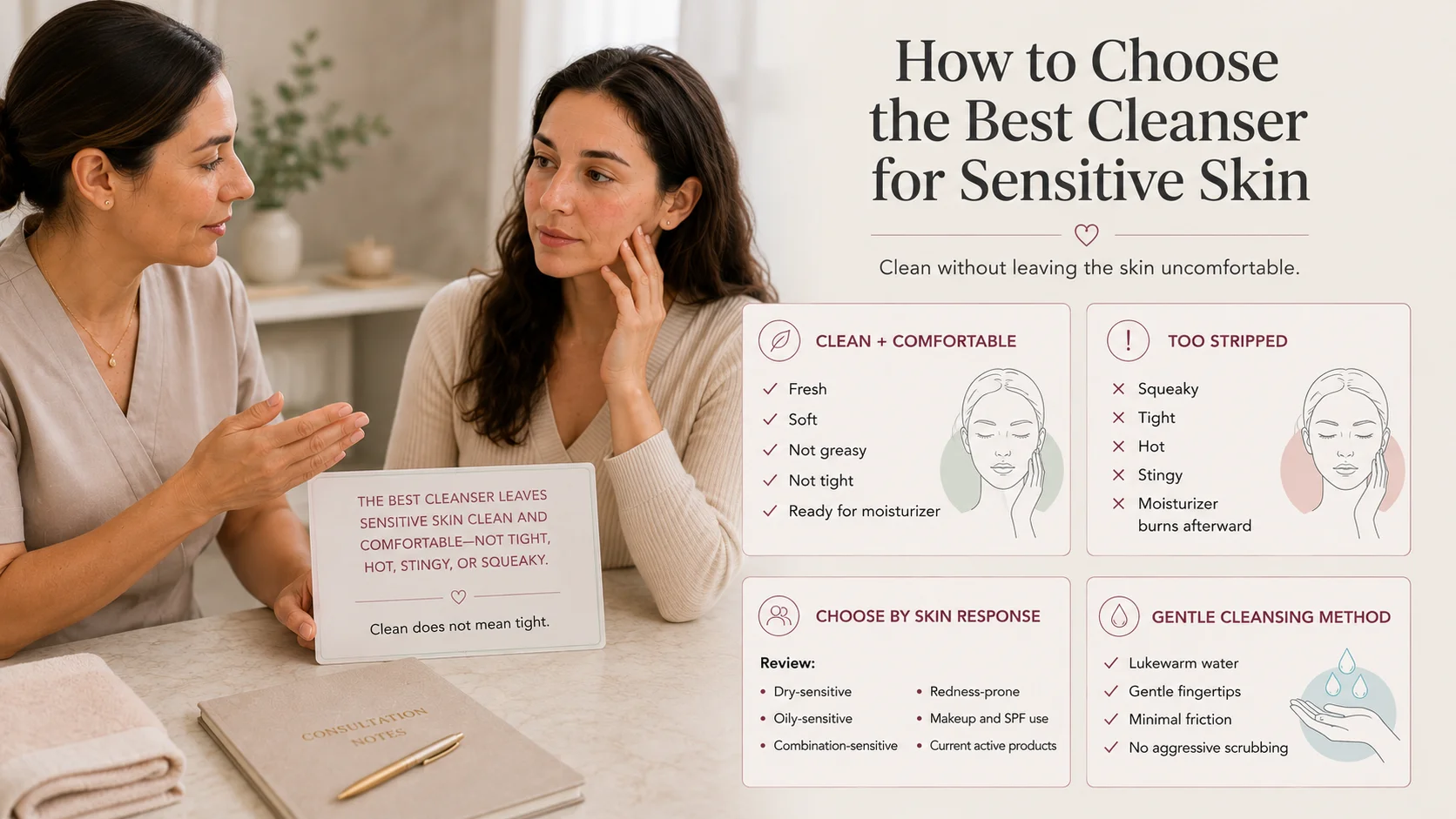
The best cleanser for sensitive skin should clean the skin without leaving it tight, hot, stingy, dry, or squeaky.
Look for a cleanser that:
A simple routine may look like:
Morning: Gentle cleanser or light rinse if appropriate → moisturizer → SPF
Evening: Gentle cleanser → moisturizer
If skin burns, swells, develops rash-like irritation, or keeps reacting to basic products, dermatologist guidance may be needed.
Cleanser is the first step in most routines.
If the cleanser is too strong, every product afterward may feel worse. Moisturizer may sting. Toner may feel sharp. SPF may burn. Makeup may cling. The skin may look more redness-prone or feel hot.
This does not always mean the moisturizer or SPF is the problem.
The problem may have started with cleansing.
Sensitive skin needs cleansing that respects the surface of the skin. The goal is to remove what does not belong without disturbing the skin more than necessary.
After cleansing, sensitive skin should feel:
If your skin feels stretched or uncomfortable after every wash, the cleanser or cleansing method may need to change.
Clean does not mean tight.
Many people think a cleanser is working well when the skin feels squeaky clean.
For sensitive skin, that feeling can be a warning sign.
Squeaky-clean skin may mean the cleanser removed too much from the surface or was paired with hot water, over-washing, or scrubbing.
Sensitive skin should not feel like it needs moisturizer immediately because it feels uncomfortable.
It should feel clean enough to continue the routine calmly.
Your cleanser may be too strong if you notice:
If these signs happen often, do not ignore them.
The cleanser may be making the routine harder to tolerate.
Some people love foam because it feels clean.
But not every foam is right for sensitive skin.
A foaming cleanser can be mild or harsh depending on the formula. The problem is not foam itself. The problem is whether the cleanser leaves the skin tight, dry, or irritated.
For sensitive skin, a cleanser should have a mild feel and should not require aggressive rubbing.
If a foaming cleanser leaves the face comfortable, it may work. If it leaves the face tight, it may not be the right match.

Texture matters, but response matters more.
Common cleanser textures include:
Dry-sensitive skin may prefer creamier or milkier textures.
Oily-sensitive skin may prefer a light gel, soft foam, or mousse that does not strip.
Redness-prone skin may need the mildest option that removes daily buildup without heat or friction.
The best texture depends on how your skin feels after rinsing.
Dry-sensitive skin often feels tight quickly after washing.
It may also look rough, flaky, dull, or redness-prone.
A cleanser for dry-sensitive skin should not leave the skin feeling bare.
Avoid cleansing habits that make dryness worse:
Dry-sensitive skin usually needs mild cleansing and a moisturizer soon after.
Oily-sensitive skin can be tricky.
The skin may get shiny, but still sting after cleansing. It may have blackheads or whiteheads but also feel tight. It may need oil-aware care, but not aggressive oil removal.
A cleanser for oily-sensitive skin should remove oil and buildup without leaving the face stripped.
If the cleanser makes the skin feel squeaky, shiny, and tight all at once, it may be too strong.
Oily-sensitive skin often needs balance, not harsh cleansing.
Redness-prone skin may look flushed or feel warm after cleansing.
If that happens, review:
Redness-prone skin often does best with mild cleansing, lukewarm water, and very little friction.
Combination-sensitive skin may have an oily T-zone but dry or reactive cheeks.
A cleanser should be chosen for the whole face, not only the nose.
If a cleanser makes the nose feel matte but leaves the cheeks tight, it may not be the best daily cleanser.
Combination-sensitive skin may need a cleanser that removes T-zone oil without making the cheeks uncomfortable.
The T-zone can receive targeted care later if needed.
Hot water can leave sensitive skin more reactive.
Even a mild cleanser may feel drying when used with hot water.
Use lukewarm water instead.
Avoid:
Sensitive skin should be cleansed calmly, not shocked.
Cleansing should not feel like polishing the skin.
Scrubbing can increase sensitivity, especially when the skin is already dry, red-looking, flaky, or irritated.
Avoid:
Sensitive skin needs soft contact.
Use your fingertips and gentle pressure.
Most sensitive skin needs evening cleansing.
Evening cleansing removes:
Morning cleansing depends on the skin.
Some sensitive skin does well with a gentle morning cleanse. Some very dry or reactive skin may only need a light rinse in the morning, depending on the person.
If your skin feels tight every morning after cleansing, the morning cleanse may need to be softer.
If you wear SPF, makeup, or spend the day outside, evening cleansing matters.
Leaving SPF, makeup, oil, and residue on the skin may make sensitive skin feel more congested, dull, or reactive.
But evening cleansing should still be mild.
The goal is to remove the day without leaving the face uncomfortable.
If you need to cleanse twice to remove makeup or SPF, both steps should be gentle and appropriate for the skin.
Double cleansing may be useful for some people who wear makeup, heavy SPF, or long-wear products.
But sensitive skin should double cleanse carefully.
The first step should loosen makeup or SPF without harsh rubbing.
The second step should cleanse the skin without stripping.
If double cleansing leaves your face tight, burning, or red-looking, it may be too much or the products may not be right.
Sensitive skin does not need double cleansing if one mild cleanser removes the day properly.
Micellar-style products may be helpful for some people, but they are not automatically perfect for sensitive skin.
Some formulas may leave residue. Some may sting. Some may require rubbing with cotton pads, which can irritate sensitive skin.
If using micellar water, avoid rubbing aggressively.
If the skin feels sticky, tight, or stingy afterward, review whether it should be rinsed or whether a different cleanser is needed.
Cleansing balms may help remove makeup and SPF, but the formula matters.
Some balms contain fragrance, essential oils, or rich textures that may not suit every sensitive skin type.
If a balm causes burning, bumps, eye-area irritation, or residue that feels heavy, it may not be the right match.
Sensitive skin should not choose a balm only because it feels soft at first.
It should also leave the skin comfortable afterward.
Some cleansers include exfoliating ingredients such as AHA, BHA, enzymes, or scrubbing particles.
These can be useful for certain concerns, but sensitive skin needs caution.
An active cleanser may be too much if the skin already feels:
A cleanser should not feel like a treatment every time unless the skin can truly tolerate that.
Fragrance may be a trigger for some sensitive skin.
A cleanser is rinsed off, but fragrance can still bother reactive skin, especially if the skin is dry, over-exfoliated, or redness-prone.
If your skin burns or looks red after scented cleansers, fragrance should be reviewed.
Fragrance-free or low-fragrance options may be better for some sensitive skin types.
Essential oils are not always gentle for sensitive skin.
A cleanser may be marketed as natural or spa-like, but sensitive skin may still react to essential oils.
If your cleanser smells strongly botanical and your skin feels hot, stingy, or uncomfortable afterward, essential oils may be part of the concern.
The skin’s reaction matters more than natural-sounding language.
Some soap-based cleansers can leave the skin feeling squeaky, tight, or dry.
Sensitive skin often does better with a cleanser designed for the face rather than a traditional soap bar.
If your cleanser leaves the skin stretched after every wash, it may be disturbing the skin’s comfort.
Cleanser choice should support the skin, not simply remove everything from the surface.
Blemish-prone sensitive skin needs care.
If the skin has clogged-looking pores, blackheads, whiteheads, or oily areas, it may be tempting to use a strong acne-style cleanser.
But if the skin is also sensitive, strong cleansers may worsen tightness or stinging.
A better plan may be:
The cleanser should not be the only solution for every concern.
Mature sensitive skin may feel thinner, drier, or less tolerant of strong products.
It may need a cleanser that removes makeup, SPF, and daily buildup without making fine lines look drier or texture look rough.
Avoid cleansers that leave mature sensitive skin feeling squeaky or tight.
A mild cleanser can help the rest of the routine feel more comfortable.
The eye area is delicate.
If cleanser stings your eyes, causes watering, or leaves the eye area dry-looking, review how you remove makeup and SPF.
Avoid rubbing.
Avoid strong acids, fragrance-heavy cleansers, and harsh cleansing near the eyes.
If there is swelling, pain, persistent burning, or eye-area irritation, seek medical guidance.
Sensitive skin may sting after shaving, waxing, threading, or facial hair removal.
Use mild cleansing and avoid active cleansers immediately after hair removal.
Avoid:
If irritation, bumps, swelling, or burning persist, seek professional guidance.
Sweat can make sensitive skin feel itchy, hot, or uncomfortable.
After exercise, cleanse gently or rinse if appropriate.
Do not scrub the face because it is sweaty.
Let the skin cool before applying active products.
If redness-prone skin flushes after exercise, avoid applying strong skincare while the skin is still hot.
Winter can make sensitive skin drier.
Cold air, wind, and indoor heating can make cleansing feel harsher.
In winter, sensitive skin may need:
If the cleanser that worked in summer feels drying in winter, the routine may need adjustment.
Summer sensitive skin may need cleansing that removes sweat, SPF, and oil without over-cleansing.
Heat and humidity can make people wash more often, but repeated cleansing can make the skin reactive.
Use gentle cleansing after heavy sweating or SPF wear, but avoid washing aggressively throughout the day.
If the skin is oily and sensitive in summer, choose a cleanser that removes buildup without leaving tightness.
Travel can make sensitive skin unpredictable.
Hotel products, airplane dryness, climate changes, different water, more sun exposure, and inconsistent routines can all affect the skin.
Do not rely on random hotel cleansers if your skin reacts easily.
Bring a cleanser your skin already tolerates.
Travel is not the best time to test a new active cleanser.
Sensitive skin may need to avoid:
This does not mean every ingredient is bad. It means the formula and skin response matter.
A sensitive-skin cleanser should feel:
The cleanser should prepare the skin for care, not make the skin defensive.
One way to evaluate your cleanser is to notice what happens when you apply moisturizer afterward.
If moisturizer burns every time after cleansing, ask:
If moisturizer feels better when you change the cleansing step, the cleanser may have been part of the problem.
After cleansing, wait a few minutes before applying products and notice how your skin feels.
If the skin becomes tight, stretched, hot, or uncomfortable quickly, the cleansing step may be too strong or the skin may be dry, dehydrated, or barrier-stressed.
This test is not about leaving skin bare for long.
It is simply a way to observe whether the cleanser is leaving the skin comfortable.

Use a simple method:
The goal is to cleanse with the least unnecessary irritation.
Yes, the neck may need cleansing too, especially if SPF, perfume, makeup, or sweat touches the area.
But the neck can be sensitive.
Use gentle pressure and avoid harsh scrubbing.
If the neck stings or becomes red-looking after products, treat it as sensitive skin and simplify.
Some sensitive skin can cleanse twice a day.
Some dry-sensitive skin may prefer a gentler morning approach.
A practical structure is:
Morning: Gentle cleanse or light rinse if appropriate → moisturizer → SPF
Evening: Gentle cleanse → moisturizer
If you wear makeup or SPF, evening cleansing is especially important.
If twice-daily cleansing makes the skin tight, adjust the morning step first.
If your cleanser burns, stop using it and simplify.
A cleanser should not strongly burn sensitive skin.
Burning may happen because:
If burning is persistent, rash-like, swollen, painful, or worsening, seek dermatologist guidance.
If skin looks red after cleansing, review the method and formula.
Ask:
Persistent or worsening redness-looking changes need professional evaluation.
If a mild cleanser does not remove makeup, do not scrub harder.
Instead, consider a gentle makeup-removal step before cleansing.
The removal step should dissolve makeup or SPF with minimal rubbing.
Then cleanse gently.
If the skin is sensitive, the makeup-removal method matters as much as the cleanser.
Some SPF formulas are more resistant and may need careful removal.
If one cleanse does not remove SPF, do not use a harsh cleanser automatically.
Consider:
The goal is thorough removal without stripping the skin.
Some people worry that mild cleansers do not clean enough.
If the skin still feels oily, consider:
Do not jump immediately to the strongest cleanser.
A cleanser should be effective, but not aggressive.
If every cleanser leaves your skin tight, the skin may be dry, dehydrated, over-exfoliated, or barrier-stressed.
Review the full routine:
The cleanser may not be the only issue.
If basic products continue to burn or sting, seek professional guidance.
Pause active products if cleansing is followed by:
Active products can be useful later, but sensitive skin should first tolerate cleansing and moisturizer.
A dermatologist should evaluate sensitive skin if cleansing causes or is followed by:
Cosmetic skincare can help with cleanser selection and routine structure, but medical-looking concerns need medical evaluation.

After consultation, our licensed esthetician may consider Janssen Cosmetics options depending on whether the skin is sensitive, dry-sensitive, oily-sensitive, redness-prone, barrier-stressed, or reactive after over-cleansing.
Possible sensitive-skin options may include:
If the skin is dry-sensitive rather than purely sensitive, dry-skin cleansing options may also be reviewed after consultation. The first step is understanding whether the skin needs mild sensitive care, moisture-focused dry care, or a simplified reset.
These options are not automatic recommendations. The right cleanser depends on how your skin feels after cleansing and what the rest of your routine looks like.
Do not choose a cleanser only because it foams strongly.
Do not chase a squeaky-clean feeling.
Do not wash with hot water.
Do not scrub sensitive skin.
Do not use active cleansers daily if your skin feels tight or reactive.
Do not keep using a cleanser that makes moisturizer burn.
Do not rely on harsh cleansing to remove makeup or SPF.
Do not use hotel cleansers or random products if your skin reacts easily.
Do not layer active products onto skin that already feels irritated after washing.
Do not ignore swelling, rash-like irritation, pain, crusting, bleeding, eye-area irritation, or persistent worsening.
The best cleanser for sensitive skin is one that removes daily buildup without leaving the skin tight, hot, stingy, dry, or stripped. The right cleanser depends on whether your skin is dry-sensitive, oily-sensitive, redness-prone, or combination-sensitive.
Some sensitive skin can use a mild foam or mousse if it does not leave tightness. Foam itself is not always the issue. The formula and how your skin feels afterward matter most.
Your cleanser may be too strong, the water may be too hot, you may be cleansing too often, or your skin may be dry, dehydrated, or barrier-stressed.
Some sensitive skin can cleanse gently in the morning. Very dry or reactive skin may prefer a light rinse, depending on the person. Evening cleansing is usually more important if you wear SPF or makeup.
Sometimes, especially if you wear makeup or heavy SPF. But both steps must be gentle. If double cleansing leaves your skin tight or burning, it may be too much.
Sensitive skin should be cautious with active cleansers, especially if the skin is already tight, flaky, hot, or reactive. Active cleansers should not be used aggressively.
Moisturizer may burn because the cleanser left the skin stripped, the water was too hot, the skin is over-exfoliated, or the moisturizer formula does not suit your skin.
See a dermatologist if cleansing causes persistent burning, swelling, rash-like irritation, pain, crusting, bleeding, infection-looking changes, eye-area irritation, or symptoms that do not improve after stopping irritating products.
If your skin feels tight, stingy, hot, or uncomfortable after cleansing, a free virtual consultation can help you understand whether your cleanser, water temperature, cleansing frequency, or active products may be part of the problem.
At Zendevie, we review your cleanser, toner, moisturizer, SPF, makeup removal, exfoliation habits, and skin response before recommending next steps. The goal is to help sensitive skin feel clean without feeling stripped.

Zendevie is guided by Haby Diallo, a licensed esthetician with more than 20 years of professional skincare experience. Her approach is rooted in education, professional judgment, and personal care.
years of experience