

The face is often the center of a skincare routine.
Cleanser is carefully selected.
Serum is applied consistently.
Moisturizer is adjusted by season.
SPF is remembered most mornings.
Meanwhile, the neck and décolleté may receive whatever remains on the hands after the facial routine is complete.
That may not always be enough.
The neck and décolleté may experience:
These areas do not need to be treated as problems.
They also do not need an aggressive routine designed to erase every line.
Natural neck movement, facial expression, posture, sleep position, body structure, and skin maturation all influence how the area looks.
A thoughtful routine may help support:
At Zendevie, our licensed esthetician does not automatically extend every facial active to the neck and décolleté.
The first step is understanding:
The neck and décolleté deserve intentional care.
They do not need an overloaded routine.
A simple mature neck-and-décolleté routine may include:
Gentle cleansing or rinsing → one hydrating or supportive product if needed → moisturizer → daytime protection on exposed skin
Gentle cleansing → one targeted serum if appropriate → moisturizer or specialized neck-and-décolleté cream
The neck and décolleté may benefit from:
Avoid applying every facial active automatically.
The neck and upper chest may be less tolerant of:
Persistent burning, severe itching, painful cracking, swelling, bleeding, blistering, crusting, oozing, infection-looking changes, a rapidly changing spot, or a spreading rash-like reaction should be evaluated by a dermatologist.

The décolleté generally refers to the upper chest area that may be visible above the neckline of clothing.
Depending on clothing style, it may include skin:
This area may receive significant environmental exposure without always receiving the same consistent care as the face.
It may also be affected by:
The décolleté should not be treated exactly like facial skin without assessment.
A product that feels comfortable on the forehead may sting on the neck.
A facial retinol used several nights per week may be too active for the décolleté.
A thick face cream may feel warm or sticky beneath clothing.
A facial exfoliant may create visible irritation along the collar line.
This is why product tolerance should be assessed separately.
The neck and décolleté may differ from the face in:
Do not assume facial tolerance guarantees neck tolerance.
Horizontal neck lines may appear because the neck bends and moves throughout the day.
They may be influenced by:
Skincare may support a softer and smoother-looking surface.
It cannot permanently remove the natural folds created by movement.
The goal is not a motionless neck.
The goal is comfortable, well-supported skin.
The upper chest may develop lines or folds from:
A moisturizer may help reduce the appearance of fine dryness lines.
Daytime protection may support a well-aging routine.
No cosmetic product should promise to permanently erase every chest line.
The neck may receive:
It may also be treated inconsistently.
A person may apply serum to the face but stop at the jawline.
Moisturizer may reach the upper neck but not the lower neck.
Sunscreen may cover the face while the chest remains exposed.
Over time, inconsistent care may make the area look or feel different from the face.
The upper chest may be regularly exposed through:
It may also receive:
Uneven-looking tone may become more noticeable when the area is also:
A tone-support routine should begin with comfort and daytime protection.
Dry neck or décolleté skin may appear:
A suitable moisturizer may help support:
Hydration does not permanently remove natural neck or chest lines.
It may help the surface look more comfortable and supported.
A person may have an oily face and a dehydrated neck.
Possible signs include:
Possible contributors include:
A lightweight hydrating serum or lotion may feel more appropriate than a very rich cream.
A rich cream may suit:
A lighter lotion may suit:
The word “mature” does not determine texture.
The correct product should remain comfortable several hours after application.
The neck may react to products that feel comfortable elsewhere.
Possible reactions include:
This may happen after:
Introduce neck products separately.
Do not assume the neck can follow the same active schedule as the forehead.

The upper chest may be affected by:
A reaction may not be caused by the facial product alone.
Review everything that touches the area.
The neck and décolleté may need cleansing to remove:
However, cleansing should not leave the area:
Use a cleanser suitable for the skin.
A gentle facial cleanser may be extended to the neck and décolleté when its directions and the skin’s tolerance support that use.
The neck and upper chest may regularly be washed with:
These products may be more drying than the facial cleanser.
Review whether the area feels tight immediately after showering.
A body cleanser that works well on the arms and legs may not suit the exposed upper chest.
Use lukewarm water and avoid prolonged direct hot-water exposure.
Hair products may run over:
This may contribute to:
Rinse the neck and décolleté carefully after washing hair.
Do not scrub aggressively.
Persistent or itchy bumps should be evaluated rather than treated automatically with acids.
Some people apply:
These products should be removed in the evening.
A cleansing balm, oil cleanser, or another appropriate product may help dissolve long-wear formulas.
Do not repeatedly rub the skin with wipes.
Effective removal should not require harsh friction.
A second cleanse may be useful after:
It may be unnecessary when:
Double cleansing should respond to actual product buildup.
It should not become an automatic requirement.
Long, hot showers may leave the area:
Use lukewarm water.
Avoid directing very hot water onto the neck and décolleté for long periods.
Do not follow a hot shower with aggressive rubbing or an active acid product.
After bathing or cleansing:
Repeated towel friction may contribute to dryness or redness-looking areas.
Do not depend only on whatever remains after moisturizing the face.
Use an appropriate amount for:
Follow product directions.
Too little may not provide lasting comfort.
Too much may feel sticky beneath clothing or cause product transfer.
Use:
There is no need to pull the skin forcefully upward.
Aggressive massage does not create permanent lifting.
It may cause:
Gentle application is enough.
Some neck products recommend upward application.
This may help distribute product comfortably and avoid dragging downward.
It should not be presented as a method that permanently changes skin structure.
Use light pressure.
The cream should glide without pulling.
A lotion or light cream may suit:
A medium or rich cream may suit:
A balm may be used only on selected very dry areas when appropriate.
The neck does not automatically need the heaviest option.
The upper chest may become sticky beneath:
A lightweight, fast-settling moisturizer may be more comfortable during the day.
A richer product may fit the evening routine.
Observe whether the formula causes:
The area should feel supported, not coated.
Yes, when:
A separate neck cream may be useful when:
A separate product is optional.
Possibly.
A hydrating or peptide-focused facial serum may be extended to the neck and décolleté when its directions and tolerance support that use.
Use caution with:
Introduce the product to a small area first.
The neck may need a lower frequency than the face.
A hydrating serum may help when the area feels:
A simple order may be:
Cleanser → hydrating serum → moisturizer
A serum is optional.
If the moisturizer alone provides lasting comfort, another layer may not be necessary.
Peptide products may help support:
They cannot permanently tighten loose skin or replace medical or procedural care.
A peptide serum or cream should be selected according to:
Do not layer several firmness-focused products simply because they use different names.
Hyaluronic acid may help support:
It may be found in:
A separate hyaluronic-acid serum may not be needed when the cream already provides enough hydration support.
Ceramide-focused care may help support skin that feels:
Ceramides may appear in:
A lipid-supportive product may help the neck and décolleté feel softer.
It does not need to be combined automatically with facial oil, balm, and rich cream.
Niacinamide may be included in products designed to support:
The complete formula and concentration affect tolerance.
Sensitive neck skin may still react to a finished niacinamide product.
Introduce it carefully.
Do not use whitening language.
The goal is to support a more even-looking appearance.
Antioxidant ingredients may help support the skin against environmental stress.
They may include:
Antioxidants do not replace daytime protection.
A morning routine may include:
Gentle cleansing → antioxidant product if needed → moisturizer → SPF
The face should not be the only area receiving daytime protection.
When exposed, consider protection for:
Follow the sunscreen’s directions.
Use additional protection such as:
Do not apply daytime protection only to visible spots.
Protect the surrounding exposed skin too.
Applying daytime protection before dressing may help cover the exposed area more evenly.
Allow the product to settle before putting on:
Some formulas may transfer.
Follow product directions and wash hands after application when appropriate.
Commonly missed areas include:
Hair may protect some areas at times, but it should not be treated as guaranteed sun protection.
Apply protection according to actual exposure.
The upper chest may be exposed through:
Daytime protection should be part of a consistent routine rather than used only at the beach.
Additional clothing protection may also be helpful.
Follow the directions for the selected sunscreen.
Reapplication may be especially important during:
Do not assume one morning application covers every type of day.
Perfume is often applied directly to:
This may contribute to:
Avoid spraying perfume onto skin that is:
Consider applying fragrance to clothing only when the fabric and product instructions allow and staining is not a concern.
The décolleté may be exposed to fragrance through:
A reaction may be blamed on the face serum when another fragranced product is the actual trigger.
Review all products touching the area.
Necklaces may contribute to:
Remove jewelry before applying skincare when practical.
Allow products to settle before putting jewelry back on.
Persistent itching, rash-like changes, or swelling beneath a necklace should be evaluated.
Possible triggers include:
When the area feels irritated:
Do not exfoliate friction-irritated skin.
Leave-in conditioner, styling spray, oil, and perfume may transfer from hair onto:
This may contribute to:
Keep hair products controlled.
Cleanse the skin gently after heavy product transfer.
The neck and décolleté may become:
In hot weather:
Do not respond to sweat with harsh soap or repeated scrubbing.
Cold and wind may leave the area:
A winter routine may need:
Do not use very hot water to warm the skin afterward.
Indoor heating may contribute to:
Review whether the moisturizer remains sufficient throughout the day.
The routine may need a richer evening product.
A hydrating serum may also help when dehydration is present.
Air conditioning may leave the neck and upper chest:
A lightweight hydrating serum under moisturizer may help some people.
Others may need a medium-weight cream.
The correct choice depends on oiliness, climate, and clothing.
Sleeping on the side may create temporary chest folds or make existing lines more noticeable.
This is influenced by:
Skincare may help support hydration and softness.
Do not sacrifice comfortable, safe sleep solely to avoid natural skin creasing.
A product cannot guarantee that sleep-related lines will disappear permanently.
Looking downward may make natural neck folds more visible.
Posture habits may also contribute to neck or shoulder discomfort.
Skincare can support surface hydration.
It cannot correct musculoskeletal problems or permanently change folds caused by movement.
Seek appropriate healthcare guidance for persistent neck pain, numbness, weakness, or mobility concerns.
Some mature skin may tolerate a carefully selected retinol product on the neck.
However, the neck may react more easily than the face.
Begin only when:
Start slowly.
Use a controlled amount.
Keep it away from irritated areas.
Possible adjustments include:
Do not assume the neck should follow the face’s schedule.
A person may tolerate retinol on the face but react across the chest.
Introduce the décolleté separately.
Observe for:
Stop if discomfort persists.
Do not scrub retinol-related flakes.
Applying retinol and then spraying fragrance over the area may increase discomfort.
Keep perfume away from active-treatment zones.
The same caution applies to:
A simpler evening routine may be more comfortable.
AHA may support the appearance of:
It may also cause:
Use only when:
The neck may need less frequent exfoliation than the face.
BHA may be relevant when the upper chest has:
It may not be appropriate across:
Use targeted application when appropriate.
Do not cover the entire chest with BHA because a few bumps are present.
The neck and décolleté may be irritated by:
Avoid physical exfoliation when the skin is:
The area does not need aggressive polishing.
Professional peel products may require:
Do not perform professional peel protocols on the neck or décolleté at home.
These areas may respond differently from the face.
Longer contact time or a larger amount does not create safer or better results.
A recovery night may include:
Gentle cleansing → hydrating serum if needed → moisturizer
No retinol.
No acid.
No scrub.
No strong vitamin C.
Recovery nights may support comfort between active-product nights.
A mature-skin routine does not need treatment every evening.
Gentle cleanser or lukewarm-water rinse → one hydrating or antioxidant serum if needed → moisturizer → daytime protection
Apply products intentionally across the exposed neck and décolleté.
Do not depend only on facial product residue.
Gentle cleansing → one supportive serum if needed → moisturizer or neck-and-décolleté cream
This may be enough.
Retinol and exfoliation remain optional add-ons.
Gentle cleanser or rinse → hydrating serum if needed → supportive moisturizer → daytime protection
Gentle cleanser → comfort-focused serum if needed → richer moisturizer or specialized neck cream
Optional:
Avoid:
Gentle cleanser → lightweight moisturizer if needed → daytime protection
Gentle cleanser → one targeted treatment on selected areas when appropriate → lightweight moisturizer
Avoid:
Painful, deep, inflamed-looking, infection-looking, persistent, or scarring bumps should be evaluated by a dermatologist.
Lukewarm-water rinse or gentle cleanser → tolerated moisturizer → tolerated daytime protection
Gentle cleanser → tolerated moisturizer
Pause:
Once the skin feels stable, add only one new product.
Gentle cleanser → one antioxidant or tone-support product if tolerated → moisturizer → daytime protection
Gentle cleanser → one targeted product if appropriate → moisturizer
Support the routine with:
Do not use whitening language.
The goal is to support a more even-looking appearance.
Gentle cleanser → supportive serum if needed → moisturizer or specialized neck cream → daytime protection
Gentle cleanser → firmness-support serum or specialized neck cream → moisturizer if needed
Do not layer several firmness products without a clear reason.
Firmness-support skincare may help improve appearance.
It cannot permanently lift or restructure the neck.
Gentle cleanser → a small amount of retinol according to directions → moisturizer
Gentle cleanser → hydrating serum if needed → moisturizer
Gentle cleanser → one suitable exfoliating product according to directions → moisturizer
Do not use retinol and exfoliation together automatically.
The neck may need more recovery nights than the face.
A practical order may be:
This may reduce direct fragrance contact with sensitive neck and chest skin.
Removing jewelry may make it easier to:
Allow skincare to settle before putting jewelry back on.
Possible options include:
Do not layer several lightweight products when one appropriate neck cream would be simpler.
Try:
The upper chest may need a different daytime texture from the face.
Review:
Use lukewarm water and a gentler cleanser.
Apply moisturizer after cleansing when the product directions support it.
The moisturizer may not be the original cause.
Review:
Pause active products.
Return to the simplest tolerated routine.
If basic moisturizer continues to burn, seek dermatologist guidance.
Stop retinol.
Also pause:
Use a gentle cleanser and tolerated moisturizer.
Do not scrub visible flakes.
Restart only after the area feels fully comfortable and with a more cautious schedule.
Stop applying the perfume to that area.
Rinse or cleanse gently if appropriate.
Avoid adding:
Persistent, spreading, swollen, blistering, or severe itching should be evaluated.
Remove the necklace.
Avoid applying fragrance or active products over the area.
Review:
Persistent or recurring reactions may need dermatologist evaluation and possible allergy assessment.
Possible cosmetic contributors include:
Do not immediately apply several acids.
Simplify the routine.
Seek guidance if bumps are:
This may suggest dehydration or over-cleansing.
Review:
Use lightweight hydration.
Do not scrub the area more aggressively.
Horizontal neck lines are normal and may relate to movement, anatomy, posture, dryness, and skin maturation.
Skincare may support:
It cannot guarantee permanent removal.
Avoid forceful massage or aggressive exfoliation.
Support the skin with:
Sleep lines may become less noticeable after the skin is moisturized and movement changes.
Do not compromise comfortable sleep solely for cosmetic concerns.
Possible reasons include:
Extend care intentionally.
Do not attempt to make the areas match through strong bleaching or excessive exfoliation.
Begin with:
Do not pick, scrub, or apply several acids.
A new, changing, irregular, bleeding, crusting, or concerning spot should be evaluated by a dermatologist.
“Crepey-looking” is a cosmetic description that may reflect:
Begin with:
Do not immediately begin several strong active products.
Possible reasons include:
Assess whether the area feels:
A lighter cream may be better during the day.
Pilling may be caused by:
Try:
Do not exfoliate automatically.
Review:
Use fewer layers beneath sunscreen.
Do not reduce the sunscreen amount simply to avoid pilling.
Allow it to settle before dressing.
Choose clothing carefully.
Follow the product directions.
Some transfer may still occur with certain formulas.
Do not skip protection because of clothing concerns.
A different appropriate formula may be more practical.
Treat the areas separately.
For example:
The entire area does not need one identical routine.
Review:
Do not assume the facial product is the only cause.
Use the simplest tolerated routine on the reactive area.
Stop introducing new products.
Use only:
Pause:
Seek dermatologist guidance when basic products or water continue causing significant discomfort.
Stop suspected products.
Remove jewelry.
Seek prompt medical guidance when swelling:
Difficulty breathing, throat tightness, tongue swelling, or trouble swallowing requires urgent medical attention.
A spot should be medically evaluated when it:
Do not cover a changing spot with repeated exfoliation or tone-correcting products.
Do not introduce retinol, acid, perfume, and a new neck cream at the same time.
Ask:
The correct routine may be simpler than expected.
Seek dermatologist guidance for:
Seek urgent medical attention for:
Cosmetic skincare can support hydration, comfort, texture, firmness appearance, and more even-looking tone.
It cannot diagnose dermatitis, allergy, infection, a changing lesion, or another medical condition.
After consultation, our licensed esthetician may consider Janssen Cosmetics options according to the neck and décolleté’s dryness, sensitivity, firmness appearance, visible spots, texture, daytime exposure, and preferred product weight.

Possible options may include:
These products should not all be layered together automatically.
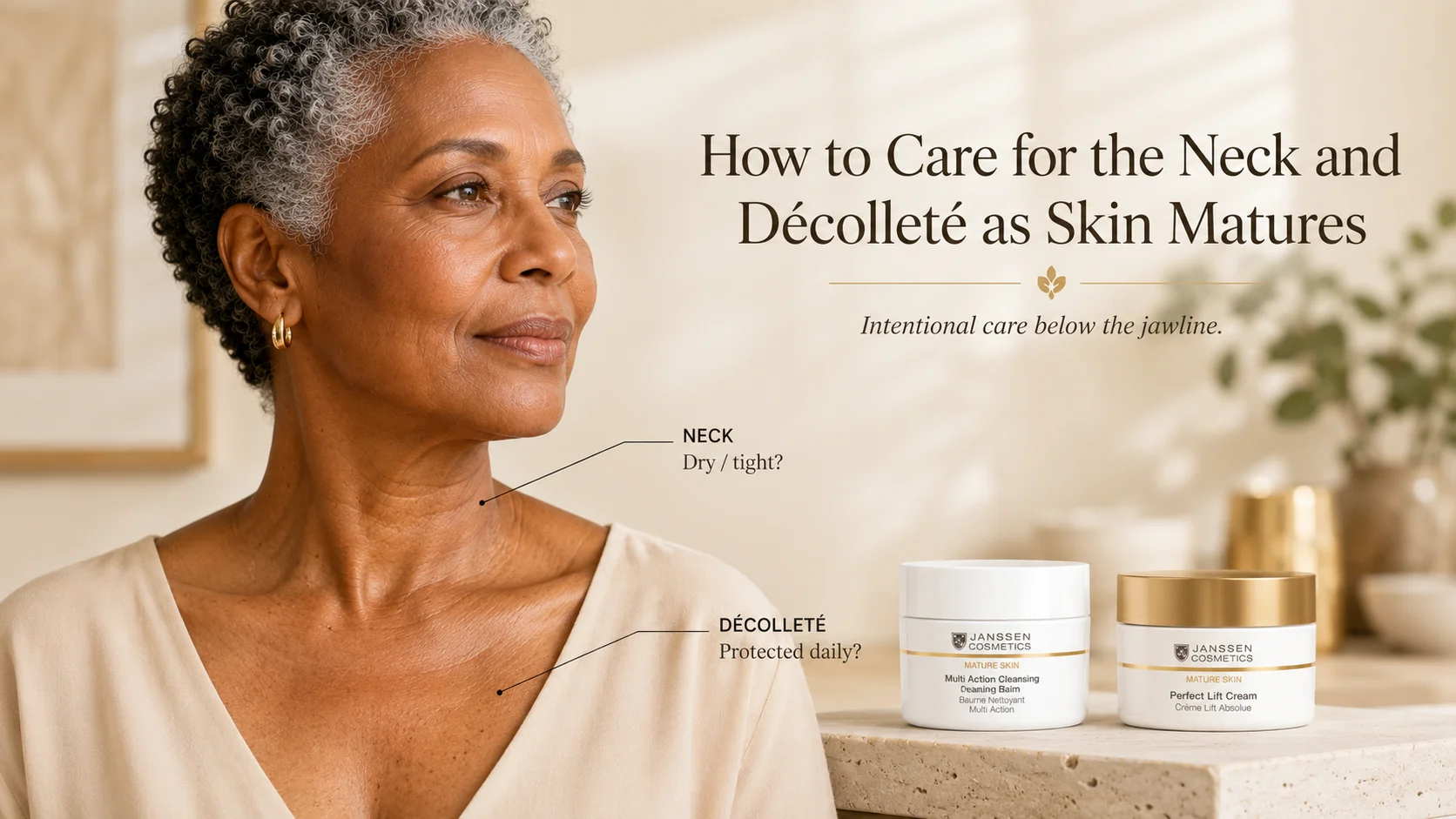
Pro-Firming Neck & Décolleté Cream is specifically formulated for the neck and décolleté.
Its verified formula includes:
The formula may help support:
The texture is described as light and readily absorbed.
This may make it practical for:
The official home-care directions recommend applying the product to cleansed neck and décolleté in the morning and/or evening and massaging it in gently.
A possible evening routine may be:
Gentle cleansing → selected serum if needed → Pro-Firming Neck & Décolleté Cream
The cream should be distributed with light pressure.
Do not pull or massage the area aggressively.
The official Janssen guidance recommends Face Guard Advanced as a daytime base beneath Pro-Firming Neck & Décolleté Cream.
A possible product-specific order may be:
Gentle cleansing → optional serum → Face Guard Advanced → Pro-Firming Neck & Décolleté Cream
This Janssen-specific order should be followed rather than replaced with a generic sunscreen chart.
Do not mix the protection concentrate into the neck cream.
Apply each product according to its own directions.
Multi Action Cleansing Balm may be considered when the routine needs to remove:
from the face, neck, and décolleté.
Its verified home-care directions include application to dry skin on the face, neck, and décolleté, followed by emulsification with moist fingers and removal with warm or lukewarm water.
Use gentle movements.
Do not massage the neck for an unnecessarily long time.
Although the balm has additional uses, those optional uses should not be added automatically to every routine.
Luxury Oil Cleanser may be considered when dry mature skin prefers a light emulsifying oil cleanser.
Its primary verified directions focus on facial application.
A consultation should confirm whether and how it belongs in the broader neck-and-décolleté routine.
Do not assume every cleanser has identical application areas.
Micellar Skin Tonic is an alcohol-free post-cleansing product for mature skin.
Its verified formula includes:
The official directions include gentle application over the:
A possible order may be:
Cleanser → Micellar Skin Tonic → serum if needed → moisturizer or specialized neck cream
The tonic is optional.
Use light pressure with the cotton pad.
Do not repeatedly rub the same area.
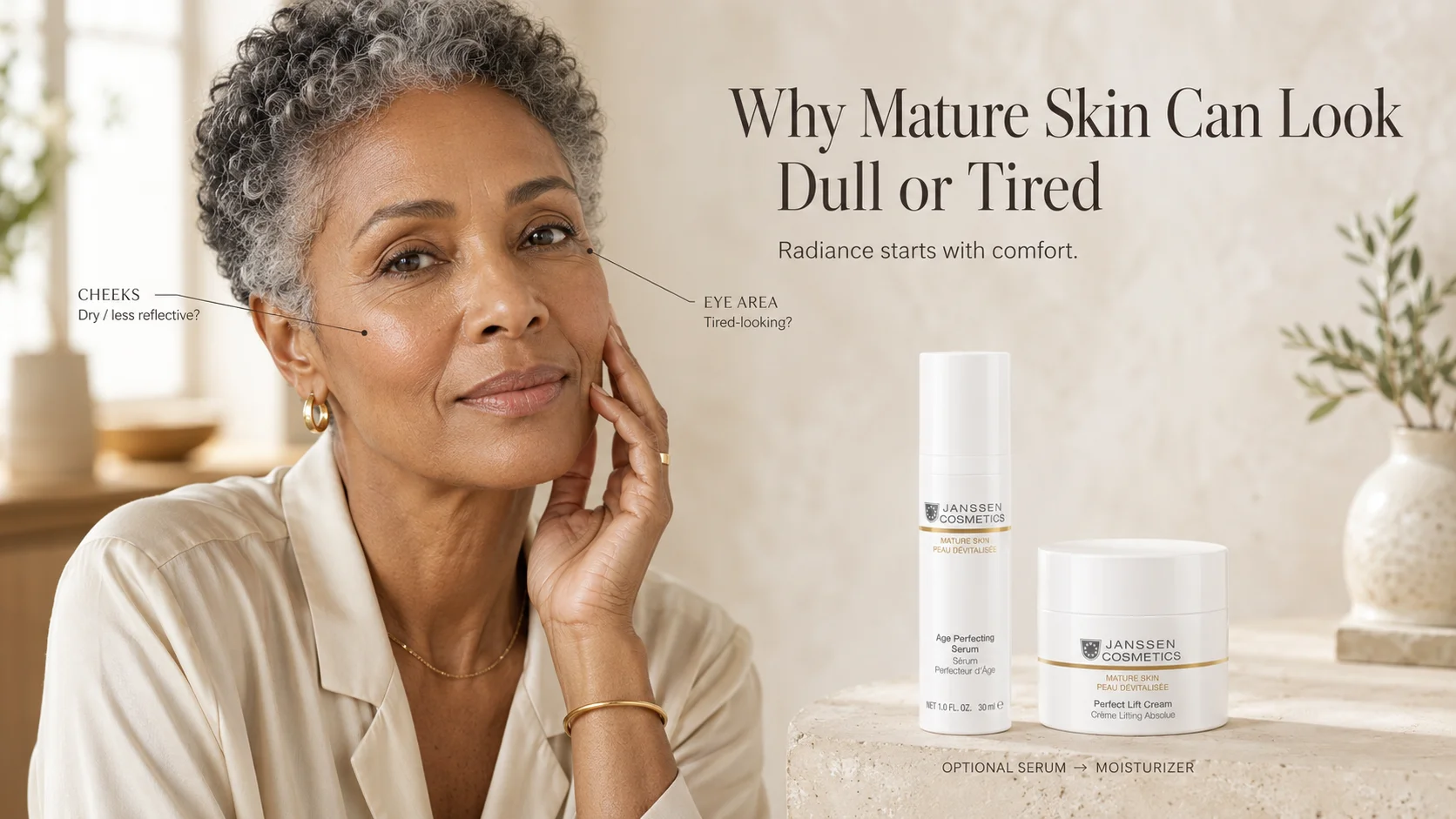
Age Perfecting Serum is a lightweight Mature Skin serum that may be applied to the cleansed face and décolleté according to its verified directions.
Its ingredient profile includes:
It may support:
A possible routine may be:
Cleanser → optional Micellar Skin Tonic → Age Perfecting Serum → selected moisturizer
When using a specialized neck cream, the serum should not be layered automatically beneath it without assessing:
The official directions mention the décolleté.
Introduce neck use carefully according to consultation and tolerance.
Perfect Lift Cream may be applied to the cleansed face and décolleté according to its official directions.
Its verified formula includes:
It may support:
It may be considered when the person prefers one daily mature-skin cream across the face and décolleté.
However, Pro-Firming Neck & Décolleté Cream may be more appropriate when specialized neck-and-chest support is desired.
Both products do not need to be layered heavily over the same area.
Rich Recovery Cream is the richer Mature Skin cream.
Its verified water-in-oil texture includes:
It may suit a dry décolleté that needs richer comfort, particularly:
Its official directions include use on the face and décolleté.
It may feel too rich beneath:
A specialized lighter neck cream may be more comfortable during the day.
A simplified consultation-led comparison may be:
May suit:
May suit:
May suit:
The correct choice depends on:
Dark Spot Perfector may be considered when selected visible spots on the face, hands, or décolleté are the primary concern.
Its verified formula includes:
It may support:
A consultation should determine whether:
Do not apply a cosmetic dark-spot product to a spot that is:
Those changes require dermatologist evaluation.
When the area is sensitive, a product from the Sensitive Skin family may be more appropriate than a specialized firmness-focused formula.
Possible routine logic may be:
Gentle cleanser → calming moisturizer → daytime protection
The correct outcome of a consultation may be to delay:
until the area feels stable.
Gentle cleanser or rinse → Face Guard Advanced in its officially directed position → selected moisturizer or Pro-Firming Neck & Décolleté Cream
Gentle cleanser → selected moisturizer or Pro-Firming Neck & Décolleté Cream
This may be enough.
Gentle cleanser → optional Micellar Skin Tonic → selected serum if needed → Face Guard Advanced → Pro-Firming Neck & Décolleté Cream
Gentle cleanser → optional tonic → selected serum if needed → Pro-Firming Neck & Décolleté Cream
The serum should have a clear purpose.
Multi Action Cleansing Balm when needed → optional Micellar Skin Tonic → hydrating serum if appropriate → Pro-Firming Neck & Décolleté Cream or Rich Recovery Cream according to texture needs
Do not layer both rich creams automatically.
Gentle cleansing → appropriate tone-support product if selected → Face Guard Advanced → Pro-Firming Neck & Décolleté Cream
Gentle cleansing → selected tone-support product → moisturizer
Patience and consistent daytime protection remain important.
Product recommendation should wait when the neck or décolleté has:
Medical evaluation comes before cosmetic product selection.
Professional peel products belong in professional treatment settings.
Do not treat natural neck lines as a failure.
Do not promise permanent lifting or tightening.
Do not assume every facial product belongs on the neck.
Do not assume facial tolerance guarantees neck tolerance.
Do not use the richest cream only because the skin is mature.
Do not depend only on leftover facial moisturizer.
Do not apply products with forceful pulling.
Do not massage until the area becomes hot or red-looking.
Do not use very hot shower water.
Do not wash the area repeatedly with strong body soap.
Do not scrub the neck or décolleté with exfoliating gloves.
Do not dry-brush sensitive skin.
Do not combine retinol, AHA, BHA, scrub, enzyme peel, and strong vitamin C.
Do not apply facial retinol to the entire neck and chest on the first use.
Do not use the same retinol frequency as the face automatically.
Do not spray perfume over retinol-treated or exfoliated skin.
Do not apply undiluted essential oils.
Do not use lemon juice, baking soda, toothpaste, or harsh home remedies.
Do not treat every chest bump with several acids.
Do not squeeze deep or painful bumps.
Do not use professional peel products at home.
Do not extend peel contact time beyond official directions.
Do not skip daytime protection after retinol or exfoliation.
Do not mix a separate sunscreen into serum, facial oil, or moisturizer unless specifically designed for that use.
Do not apply sunscreen only to visible spots.
Do not ignore the sides or back of the neck when exposed.
Do not cover rash-like, blistered, bleeding, crusting, or infected-looking skin with body makeup.
Do not apply cosmetic dark-spot products to a changing or non-healing spot.
Do not ignore persistent one-sided swelling, severe itching, difficulty swallowing, or rapid neck swelling.
These areas may experience dryness, sun exposure, uneven-looking tone, texture changes, fragrance, clothing friction, and inconsistent moisturizer or SPF use.
It may differ in dryness, oil production, sensitivity, environmental exposure, and product tolerance.
The décolleté is the upper chest area commonly visible above the neckline of clothing.
Yes. Natural neck movement, anatomy, posture, dryness, and skin maturation may all influence horizontal lines.
No. Hydration and moisturizer may support a smoother-looking surface, but they cannot permanently remove natural folds or movement lines.
The neck may receive less moisturizer, more hot water, more fragrance, more clothing friction, and less consistent daytime protection.
The upper chest may receive repeated sun exposure, fragrance, friction, and less consistent skincare.
Yes, when the cleanser’s directions and skin tolerance support that use.
Some body cleansers may feel too strong or fragranced for the exposed upper chest. Assess after-cleansing comfort.
It depends on sweat, sunscreen, makeup, oiliness, and skin comfort. A morning rinse may be enough for dry or sensitive skin.
Only when one cleanser does not comfortably remove heavy makeup, water-resistant sunscreen, or product buildup.
Yes, when it remains comfortable and the formula is appropriate for the area.
Not always. A separate neck cream may be useful when facial moisturizer is insufficient or specialized support is desired.
Dry skin may prefer a medium or rich cream. Oily or humid-weather skin may prefer a lotion or lightweight cream.
Gentle upward or outward smoothing may help distribute the product without pulling. It does not create permanent lifting.
Some hydrating, peptide, or antioxidant serums may be used when product directions and tolerance support it.
Yes, in an appropriate serum or moisturizer. It may support hydration and smoother-looking dryness lines.
Peptide products may support smoother-looking texture and firmness appearance. They cannot permanently lift the neck.
Some formulas may support barrier comfort and more even-looking tone. Sensitive skin should introduce the finished product carefully.
Some skin may tolerate retinol carefully. The neck should be introduced separately and usually more slowly than the face.
The neck may be more sensitive and may tolerate a lower frequency or smaller amount.
Possibly, when the product directions permit and the area is introduced separately with moisturizer and consistent daytime protection.
Some mature skin may tolerate a suitable AHA product carefully. It should not be combined blindly with retinol or other exfoliants.
BHA may be appropriate for selected clogged-looking or oily areas. It should not be assumed that every bump is congestion.
Exfoliation is optional and should be less aggressive than many facial routines. Sensitive or dry neck skin may need very little.
Physical scrubs may create too much friction, especially on dry, sensitive, retinol-treated, or sun-stressed skin.
Yes, exposed neck skin should be included in the daytime protection routine.
When the area is exposed, consistent daytime protection supports a well-aging and more even-looking routine.
Follow the directions for the exact products. Face Guard Advanced has Janssen-specific instructions placing it beneath the selected care cream.
Too many serum or moisturizer layers, facial oil, product incompatibility, or repeated rubbing may contribute.
Some formulas may transfer before they settle. Apply before dressing when practical and follow the product directions.
Yes. Fragrance may contribute to stinging, itching, dryness, or rash-like changes in sensitive skin.
Avoid applying fragrance directly over retinol-treated or recently exfoliated skin.
Jewelry may create friction, sweat buildup, or a contact reaction. Persistent symptoms should be evaluated.
Possible contributors include sweat, hair products, sunscreen, heavy moisturizer, fragrance, clothing friction, or another skin concern.
A very rich or occlusive texture may contribute for some people. The area may need a lighter product.
Dryness, dehydration, natural folds, firmness appearance, sun exposure, and skin maturation may influence a crepey-looking surface.
A cosmetic neck cream may support the appearance of firmness and elasticity. It cannot permanently lift or restructure the area.
Tone-support products may help improve the appearance of selected spots over time. Changing or concerning spots require dermatologist evaluation.
Not necessarily. The neck and décolleté may have different dryness, exposure, and sensitivity.
Retinol, acids, fragrance, hot water, strong cleanser, shaving, jewelry, or the moisturizer formula may contribute.
Pause active products and fragrance, use only tolerated basic care, and seek dermatologist guidance if water or basic moisturizer continues causing discomfort.
Seek guidance for persistent burning, severe itching, swelling, painful cracking, bleeding, blistering, crusting, oozing, a changing spot, a non-healing sore, or a spreading rash-like reaction.
If your neck or décolleté feels drier than your face, looks uneven, or reacts whenever you extend facial products downward, a free virtual consultation can help you understand what the area needs.
At Zendevie, we review your cleanser, moisturizer texture, retinol, exfoliation, sunscreen, perfume, jewelry, clothing friction, visible spots, sensitivity, climate, and current facial routine before discussing products.
The goal is not to erase every natural line or apply the strongest firmness product available.
The goal is to support a softer, more comfortable, smoother-looking, and consistently protected neck and décolleté through care selected for your skin’s current needs.

Zendevie is guided by Haby Diallo, a licensed esthetician with more than 20 years of professional skincare experience. Her approach is rooted in education, professional judgment, and personal care.
years of experience