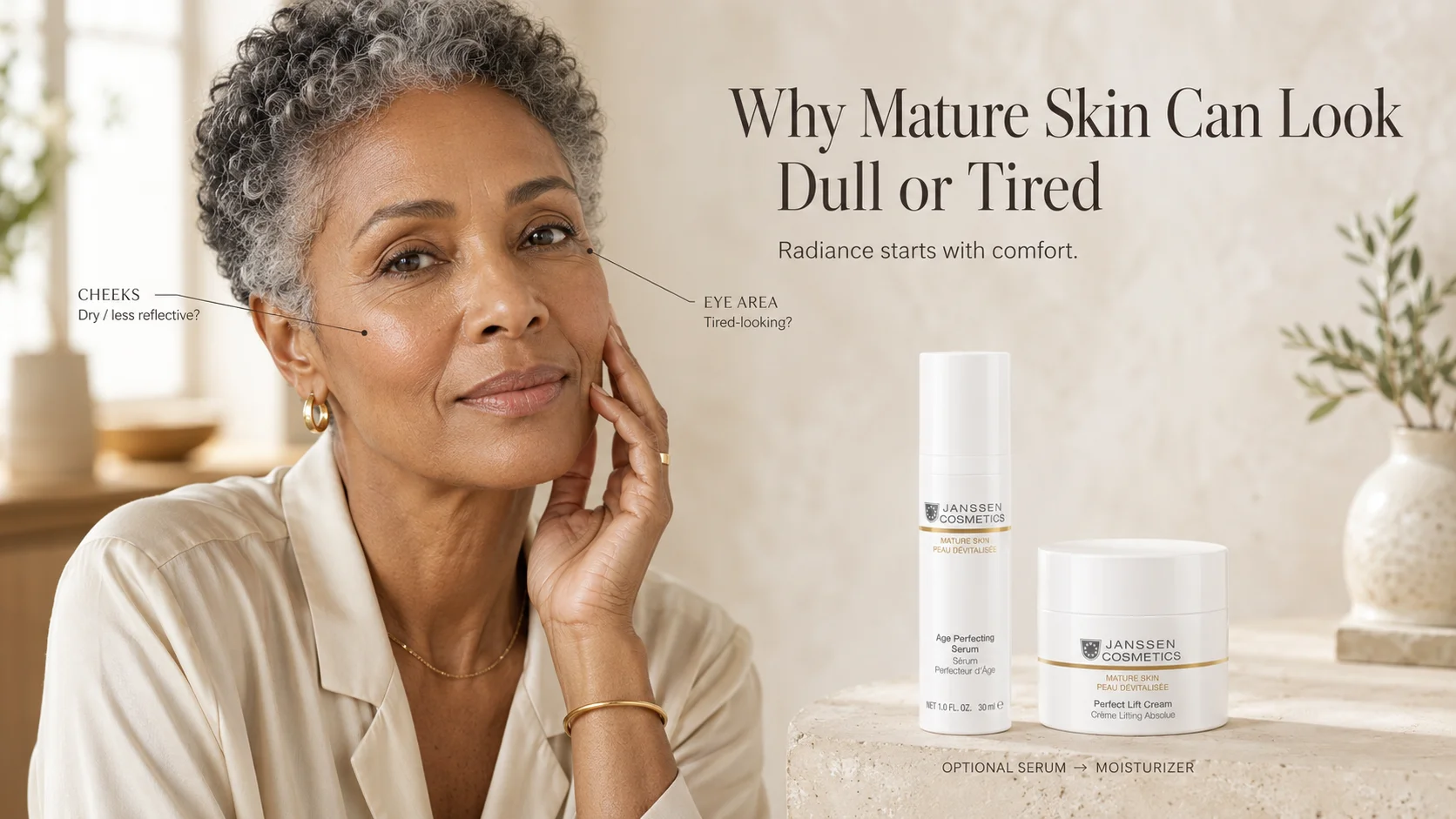


The eye area may begin to look drier before the rest of the face.
The cheeks may feel comfortable while the under-eye area looks finely lined.
A facial moisturizer may feel rich enough everywhere except around the eyes.
Concealer may begin settling into small creases.
Powder may make the area appear flatter or more textured.
Retinol applied to the cheeks may still contribute to dryness near the eye contour.
Sunscreen may migrate toward the lash line and cause watering.
Makeup removal may leave the area feeling tight.
These changes do not mean the eye area has been neglected.
The skin around the eyes is delicate and is affected by more than eye cream alone.
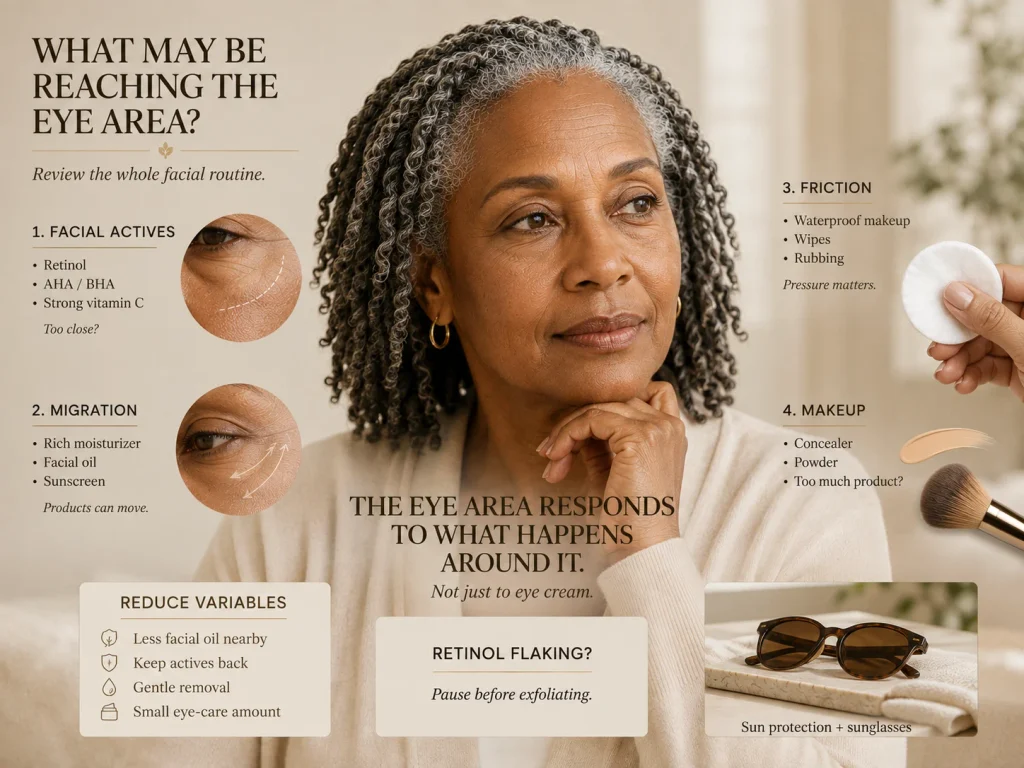
Its appearance may be influenced by:
At Zendevie, our licensed esthetician first reviews the complete facial routine before recommending another eye product.
The question is not only:
Which eye cream should I use?
It is also:
The eye area needs gentle, controlled care.
More product is not automatically more supportive.
The eye area may look drier on mature skin because it is delicate and may show changes in hydration, flexibility, fine-line appearance, and surface comfort more visibly than other facial areas.
Common contributors include:
A simple eye-area routine may be:
Gentle cleansing or rinse → small amount of appropriate eye care → facial moisturizer kept away from the lash line → carefully applied daytime protection → makeup if desired
Gentle makeup and sunscreen removal → gentle cleanser → small amount of appropriate eye care
Avoid applying facial retinol, exfoliating acids, scrubs, essential oils, or heavily fragranced products directly to the eyelids or immediate lash line unless the exact product is specifically designed and directed for that area.
Seek medical or eye-care guidance for:
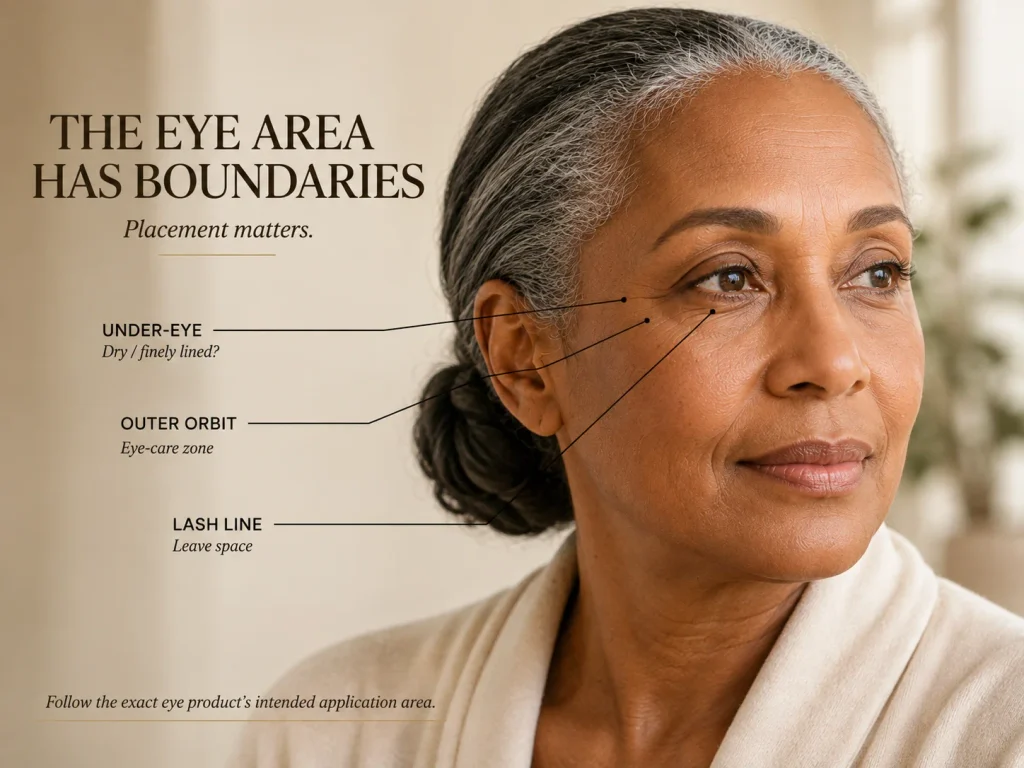
The eye contour includes:
These areas do not all tolerate products in the same way.
A product intended for the orbital contour may not be intended for:
The exact directions matter.
Do not assume that every facial product can be extended close to the eyes simply because it is gentle on the cheeks.
The eye area is constantly moving through:
When the surface is dry or dehydrated, these movements may make fine lines look more noticeable.
The area may appear:
Hydration and moisture support may soften the appearance of fine dryness lines.
They cannot permanently remove natural expression lines or stop facial movement.
A mature eye area may naturally show:
These are not signs that the routine has failed.
Safe cosmetic care may help the area look:
It should not promise to erase every line or recreate a filtered surface.
Dry eye-area skin may lack lipid comfort.
It may feel:
Dehydrated eye-area skin lacks water.
It may look:
The eye area may be both dry and dehydrated.
This is why a watery eye serum may not always be enough.
Some skin may need a more supportive eye cream.
Other skin may find a rich cream too heavy.
A person may have:
The eye area does not produce or retain comfort in the same way as the T-zone.
Do not use strong oil-control products near the eyes simply because the rest of the face is oily.
Avoid extending:
toward the orbital area.
The face may need zone-based care.
Combination mature skin may have:
A practical approach may include:
The whole face does not need the same product amount or texture.
Sensitive mature skin may experience:
A simple routine may be more useful than layering:
all together.
Introduce one product at a time.
Comfort should come before targeted active ingredients.
The eye area may feel dry after cleansing when:
The skin should not feel raw or tight after cleansing.
If the eye area becomes uncomfortable before eye cream is applied, review the cleansing step first.
Facial cleansers containing:
should be kept away from the immediate eye area unless they are specifically designed and directed for that location.
A rinse-off active product may still feel too strong around mature eyelids.
The eye area should not be treated like an oily nose or congested chin.
Very hot water may contribute to:
Use lukewarm water.
Avoid holding a very hot washcloth over the eyes as part of a cosmetic routine.
If a healthcare provider has recommended a specific warm-compress method for an eye concern, follow that medical guidance instead.
Eye makeup may include:
Removing these products through repeated rubbing may contribute to:
Use an appropriate remover.
Allow the formula time to loosen makeup.
Do not scrub until the cotton pad appears completely clean.
Waterproof makeup may require:
Do not remove it by:
A suitable remover may reduce friction.
Keep the product out of the eyes and follow its exact directions.
Makeup wipes may feel convenient, especially during travel.
However, they may involve:
If wipes regularly leave the under-eye area tight or stingy, they may not be the best daily method.
A gentle remover followed by an appropriate cleanser may feel more comfortable.
Frequent wiping during:
may leave the eye area:
Blot gently.
Avoid rubbing from side to side.
Use soft tissues and keep active products away from recently rubbed areas.
Rubbing may increase:
People may rub because of:
Persistent itching should not be managed through repeated rubbing or additional eye cream alone.
Medical evaluation may be appropriate.
Retinol may support:
It may also cause:
Retinol does not need to be applied directly to the eyelid to affect it.
The formula may migrate through:
Keep facial retinol at an appropriate distance from the eyes according to its directions.
Do not apply a standard facial retinol product directly to:
unless the product is specifically formulated and directed for that area.
An eye-specific retinoid formula may still require:
Eye-area labeling does not guarantee universal tolerance.
Possible adjustments include:
If eye-area dryness continues, pause retinol until the skin is comfortable.
Do not exfoliate the flakes.
Exfoliating acids may cause:
Avoid applying acid toner, AHA serum, BHA serum, exfoliating pads, or peel products close to the eyes.
Do not use facial exfoliation products to smooth crow’s-feet or under-eye lines.
The eye contour requires products specifically designed for that area.
Vitamin C formulas vary in:
A facial vitamin C serum may migrate toward the eyes or feel uncomfortable when applied too close.
Keep it away from:
unless the formula is specifically intended for eye-area application.
Fragrance exposure may come from:
The eye area may react even when the cheeks feel comfortable.
Possible signs include:
Review the entire routine, not only the eye product.
Do not apply undiluted:
near the eye contour.
They may cause:
Do not add essential oils to eye cream or moisturizer.
Natural fragrance is still fragrance exposure.
A rich facial moisturizer may feel comfortable on dry cheeks but move toward the lash line.
This may cause:
Keep facial cream slightly away from the immediate eye area.
Use less around the orbital bone.
Consider a separate eye product when more controlled application is needed.
A heavy layer of eye cream may cause:
More product does not provide faster results.
Use a small amount according to the directions.
The skin should feel supported, not coated.
A separate eye product may not be necessary when:
A separate eye cream may be useful when:
The product should solve a clear need.
An eye serum is usually lighter.
It may support:
An eye cream usually provides more:
Dry mature eye areas may prefer:
Eye serum → eye cream
but this combination is not always necessary.
For many people, one well-matched eye cream is enough.
Several layers may create heaviness or migration.
A rich eye cream may suit:
A lightweight eye gel or emulsion may suit:
A rich product is not automatically better because the eye area is mature.
The correct texture depends on dryness, sensitivity, puffiness, and makeup.
Follow the exact product directions.
Use enough to create a thin, controlled layer.
Too much may increase:
The eye area should not look heavily coated.
Apply according to the product directions.
Many eye products are intended for the skin around the orbital contour rather than:
Use light pressure.
Keep the product out of the eye.
Allow it to settle before sunscreen or makeup.
Use:
Avoid:
The ring finger is sometimes used because people naturally apply less pressure with it, but the most important point is gentle application.
A simple morning routine may be:
Gentle cleanser or rinse → small amount of eye cream → facial moisturizer → daytime protection applied carefully → makeup
The exact order may depend on product textures and official directions.
A lightweight facial serum may be used before eye care when it is suitable for the contour.
Keep strong facial actives away from the eyelids.
A simple evening routine may be:
Gentle makeup and sunscreen removal → gentle cleanser → small amount of eye cream
A facial moisturizer may then be applied to the rest of the face.
Avoid layering:
all at once without a clear need.
Gentle cleansing → supportive eye cream → moisturizer kept away from the lash line → carefully applied daytime protection
Gentle makeup removal → gentle cleanser → supportive eye cream
Possible adjustments:
Gentle cleansing → lightweight hydrating eye product or suitable eye cream → daytime protection
Gentle cleansing → hydrating eye care → optional richer support only when needed
A watery eye serum may need a cream over it.
However, several hydrating layers may pill under concealer.
Gentle rinse → lightweight eye care → carefully applied daytime protection
Use:
Persistent, painful, sudden, or one-sided swelling should be medically evaluated.
Gentle rinse or cleanser → previously tolerated eye care → carefully applied SPF
Gentle makeup removal → gentle cleanser → tolerated eye care
Avoid:
Introduce one new product at a time.
Eye care in a small amount → allow it to settle → daytime protection → thin concealer and eye makeup
Appropriate eye-makeup remover → gentle cleanser → eye cream
Do not use so much eye cream that mascara or concealer moves.
Clean makeup tools regularly.
Do not share eye makeup.
Daytime protection remains important around the eye contour.
Sun exposure may influence the appearance of:
However, sunscreen may sting when it migrates.
Apply carefully.
Avoid:
Use:
as additional protection.
Sunscreen may move because of:
Review:
Do not abandon daytime protection because one formula is uncomfortable.
A different formula or application method may be needed.
Facial oil may move:
toward the eye contour.
If stinging begins after facial oil is added, review:
Facial oil is optional.
Keep it away from the immediate eye contour when migration is a concern.
Concealer may settle into fine lines when:
Use a small amount.
Apply only where coverage is needed.
A thin, flexible layer often looks more natural than heavy full-area coverage.
Dark-circle appearance may involve:
For some people, concealer is needed mainly near the inner eye area.
Using less product over the outer eye contour may reduce creasing.
Makeup should move naturally with expression.
Powder may help set concealer.
Too much may make the area look:
Use a very small amount when needed.
Some mature eye areas may look better with little or no powder.
Do not bake the eye area simply because it is a popular makeup technique.
A suitable eye cream may help:
However, too much eye cream may make makeup move.
Use a controlled amount and allow it to settle before applying concealer.
Rough tools may pull the eye area.
Use:
Avoid dragging a dense brush across dry under-eye skin.
A fingertip or soft sponge may provide more controlled application for some people.
Stop using eye makeup that:
Do not share:
Persistent eye redness, discharge, pain, or swelling needs medical evaluation.
Dark-circle appearance may be influenced by:
An eye cream may support a fresher-looking appearance.
It cannot guarantee complete removal of dark circles.
Do not promise that one product will erase every under-eye shadow.
Puffiness may appear more noticeable:
A lightweight eye product may feel more comfortable for puffiness-prone skin.
Persistent, painful, rapidly increasing, or one-sided swelling needs medical evaluation.
When the eye area is dry:
Supporting hydration may help the contour look softer and more refreshed.
It cannot change every structural or hereditary contributor to dark circles.
A tired-looking eye contour may relate to:
Skincare may support moisture and cosmetic appearance.
It cannot diagnose or manage eye strain, allergies, or another medical concern.
Poor rest may make:
Eye care may support a smoother-looking contour.
It cannot replace adequate rest.
Persistent fatigue or other health concerns should be discussed with an appropriate healthcare provider.
Long periods of screen use may be associated with:
Skincare cannot treat eye strain.
Take appropriate breaks and seek eye-care guidance for:
People who wear contact lenses may notice discomfort from:
Follow the directions provided by the eye-care professional and lens manufacturer.
Keep cosmetic products out of the eyes.
Seek prompt eye-care guidance for:
Cold wind and low humidity may increase:
A winter routine may need:
Do not use very hot water afterward.
Heated indoor air may make the eye contour feel:
Review:
Do not layer several oils and balms automatically.
One supportive eye product may be enough.
Air-conditioned rooms, cars, airplanes, and offices may contribute to:
Redirect direct airflow away from the face when possible.
A lightweight eye product may be used during humid weather, while a richer texture may feel better at night.
Travel may involve:
Bring a familiar eye product.
Do not test:
during travel.
Eye patches may feel cooling or hydrating.
They may also contain:
Do not use an unfamiliar patch immediately before an event or while traveling.
A familiar eye cream may be a more predictable option.
A cool compress may temporarily support comfort or reduce the appearance of puffiness for some people.
Do not place ice directly on the eyelids.
Extreme cold may cause:
Use clean materials and gentle temperature.
Medical eye conditions require healthcare guidance rather than cosmetic cooling tools.
After crying, the eye area may appear:
Blot tears gently.
Avoid applying:
immediately afterward.
Significant or persistent swelling should be evaluated.
Pool water, salt water, sunscreen, and rubbing may contribute to:
After swimming:
Persistent pain, redness, discharge, or vision changes need medical guidance.
Some lines become more visible when the surface is dry or dehydrated.
These may look softer after:
Other lines relate more to:
Eye care may support a smoother-looking appearance.
It cannot permanently erase expression lines.
“Crepey-looking” is a cosmetic description that may refer to:
The answer is not automatically:
Begin with gentle cleansing, moisture support, and active-product review.
Persistent or suddenly changing eyelid texture should be medically evaluated when concerning.
The eye contour and neck may be less tolerant of:
Introduce products separately.
Do not assume that tolerance on the forehead predicts tolerance near the eyes.
Many eye products are directed for morning and evening use.
Others may be used:
The correct frequency depends on:
More frequent use is not automatically better.
A general order may be:
Facial serum → eye cream → facial moisturizer
This can help control eye-product placement before richer facial cream is applied.
However, exact directions and product texture should guide the sequence.
Do not apply heavy facial moisturizer directly over eye cream if it causes migration.
Eye care is generally applied before daytime protection.
Allow it to settle.
Then apply sunscreen carefully according to its directions.
Avoid moving the eye cream into the lash line while applying sunscreen.
Use sunglasses and hats as additional protection.
Some moisturizing products may spread well over slightly damp skin.
However:
Damp-skin application is not a universal rule.
Introduce a new eye product carefully.
A cautious method may include:
A passed patch test does not guarantee full eye-area tolerance.
Do not begin by applying a new product:
The eye contour is delicate.
Start conservatively.
Stop using it.
Remove it gently if needed.
Avoid rubbing.
Review whether:
Persistent stinging or symptoms affecting the eye itself need medical guidance.
The formula may be migrating.
Try:
Stop the product if watering repeatedly returns.
Possible contributors include:
Stop the product and observe.
Persistent, painful, significant, or one-sided swelling should be evaluated.
Use less.
Consider:
Do not layer several eye products.
A lightweight gel may not provide enough lipid comfort for dry mature eye areas.
Consider:
More watery layers are not always the answer.
Possible contributors include:
Use less or consider a lighter texture.
Persistent bumps that are itchy, swollen, spreading, painful, or rash-like need professional evaluation.
Review:
Use less product.
Apply only where needed.
Press away excess before setting.
Some natural creasing may still occur.
Review:
Do not exfoliate the under-eye area.
A more supportive eye product or lighter concealer may help.
Use less powder or skip it on the driest areas.
Powder may collect in:
A small amount may be enough.
The eye area does not need to be fully matte.
Possible reasons include:
Try:
Do not reduce protection across the entire face because one area is reactive.
Pause retinol.
Also pause:
Use:
Do not scrub away the flakes.
Restart retinol only after the area is fully comfortable and at a more cautious placement or schedule.
Avoid applying:
to the area.
Use only tolerated basic care.
Persistent, itchy, swollen, painful, crusting, or recurrent eyelid flaking should be evaluated by a dermatologist or eye-care provider.
Possible contributors include:
Persistent one-sided swelling, pain, redness, discharge, or vision changes need medical evaluation.
Stop suspected products.
Do not rub.
Review:
Persistent, severe, swollen, crusting, or sleep-disrupting itching requires professional evaluation.
Pause active products near the eyes.
Avoid:
Persistent, painful, swollen, crusting, or worsening eyelid redness needs medical evaluation.
Review:
Use a smaller amount of a lighter product.
Persistent or significant puffiness should be evaluated.
Dark-circle appearance may relate to:
Eye care may support a fresher-looking contour.
It cannot guarantee complete removal.
The concern may be mainly cosmetic.
Review:
A gentle eye product may support a smoother or more luminous-looking appearance.
Do not begin strong active products simply because the area looks tired.
Stop testing additional products.
Simplify the entire routine.
Review whether:
Seek professional evaluation if basic care cannot be tolerated.
Gentle facial rinse or cleansing → tolerated facial moisturizer kept away from the lash line → tolerated daytime protection applied carefully
Gentle makeup and sunscreen removal → gentle cleanser → only a previously tolerated eye product if it remains comfortable
Temporarily avoid:
The routine should feel simple and predictable.
Once the eye contour feels comfortable:
Do not introduce a new eye serum, eye cream, retinol, concealer, and sunscreen at the same time.
Seek dermatologist or eye-care guidance when the eye area develops:
Seek prompt eye-care evaluation for:
Seek urgent medical care for:
Cosmetic eye care cannot diagnose eyelid dermatitis, allergy, infection, dry-eye disease, or another medical condition.
After consultation, our licensed esthetician may consider Janssen Cosmetics eye-care options according to whether the mature eye contour is dry, sensitive, puffy-looking, tired-looking, makeup-wearing, or uncomfortable with facial products.

Possible options may include:
These products should not all be applied together automatically.
Tri-Care Eye Cream is the Mature Skin family’s rich eye-care cream.
Its verified formula includes:
The formula may help support:
The official home-care directions recommend gently dabbing Tri-Care Eye Cream onto cleansed skin around the eyes in the morning and/or evening.
It is also positioned as an eye-makeup foundation.
A possible routine may be:
Gentle cleanser or rinse → facial serum if needed → Tri-Care Eye Cream in a small amount → Face Guard Advanced and selected moisturizer in their officially directed sequence → makeup
Gentle makeup removal → gentle cleanser → facial serum if needed → Tri-Care Eye Cream → selected facial moisturizer
Use a controlled amount.
Although the formula is rich, more product does not create faster results.
Too much may contribute to:
The catalog contains vitamin A palmitate within the finished eye-care formula.
This does not mean facial retinol should also be applied around the eyes automatically.
Avoid stacking a separate facial retinol or another active eye treatment over the same contour without professional guidance.
Some mature eye areas are defined more by sensitivity than by the need for the richest mature-skin texture.
Comfort Eye Care from the Sensitive Skin family may be considered when the eye contour is:
Its verified formula includes:
It may support:
The official directions recommend applying Comfort Eye Care around the eyes in the morning and evening and patting it gently.
The choice between Tri-Care Eye Cream and Comfort Eye Care should depend on:
The Mature Skin family product is not automatically the correct choice simply because the person has mature skin.
A simplified consultation-led comparison may be:
May suit:
May suit:
Neither product should be applied into the eye or wet lash line.
The official Janssen directions state that Age Perfecting Serum may be applied close to the eyes before the usual eye-contour care.
Its verified formula includes:
A possible order may be:
Age Perfecting Serum → Tri-Care Eye Cream or another selected eye product → facial moisturizer
However:
Age Perfecting Serum is optional.
It should not automatically be combined around the eyes with:
Perfect Lift Cream or Rich Recovery Cream may be used on the face according to the selected routine.
They should not automatically be layered heavily over the eye cream.
Keep rich facial cream controlled around the orbital area to reduce:
The separate eye product may provide enough support for the contour.
Face Guard Advanced is a lightweight SPF 30 protection concentrate.
Its official Janssen directions place it beneath the selected care cream.
A possible Janssen morning sequence may be:
Cleanser → optional tonic → Age Perfecting Serum if needed → Tri-Care Eye Cream or Comfort Eye Care → Face Guard Advanced applied carefully → selected facial cream
Because the eye contour is delicate:
Do not mix Face Guard Advanced into eye cream or moisturizer.
Gentle cleanser or rinse → selected eye care → Face Guard Advanced and facial moisturizer in their officially directed sequence
Gentle makeup removal → gentle cleanser → selected eye care
This may be enough.
Gentle cleanser → Age Perfecting Serum if needed → Tri-Care Eye Cream → daytime protection and selected moisturizer
Gentle makeup removal → gentle cleanser → Tri-Care Eye Cream → facial moisturizer
Soft Cleansing Mousse or another selected gentle cleanser → Comfort Eye Care → carefully applied daytime protection → selected sensitive-skin moisturizer if needed
Gentle cleanser → Comfort Eye Care → selected facial moisturizer
Do not automatically add active mature-skin serum around an irritated eye contour.
Gentle cleansing → very small amount of Tri-Care Eye Cream → allow it to settle → carefully applied protection → thin concealer
Tri-Care Eye Cream is verified as suitable as an eye-makeup foundation.
The amount should remain controlled.
A new cosmetic eye product should wait when there is:
Medical evaluation comes before cosmetic product selection.
Professional peel and exfoliation products should never be used around the eye contour at home.
Do not treat natural eye lines as a skincare failure.
Do not promise to erase crow’s-feet permanently.
Do not apply facial scrubs under the eyes.
Do not apply AHA or BHA close to the lash line.
Do not use professional peel products around the eyes.
Do not apply standard facial retinol directly to the eyelids unless specifically directed.
Do not combine facial retinol with a separate active eye treatment blindly.
Do not apply strong vitamin C directly to irritated eyelids.
Do not apply undiluted essential oils near the eyes.
Do not add essential oils to eye cream.
Do not apply lemon juice, toothpaste, baking soda, or home remedies around the eyes.
Do not use very hot water.
Do not place ice directly on the eyelids.
Do not rub or pull the eye contour.
Do not scrub waterproof mascara away.
Do not use rough makeup wipes repeatedly.
Do not apply several eye serums, creams, oils, balms, masks, and patches together.
Do not use a heavy amount of eye cream.
Do not apply eye products into the eyes or wet lash line.
Do not apply facial oil so close that products migrate.
Do not continue a product that repeatedly causes watering, burning, or itching.
Do not cover swollen, crusting, blistering, bleeding, or infection-looking eyelids with makeup.
Do not share eye makeup or applicators.
Do not use contaminated-looking or significantly changed eye makeup.
Do not assume every dark circle can be removed with skincare.
Do not assume every puffy eye area needs a richer product.
Do not apply heavy powder to make concealer look smoother.
Do not exfoliate the under-eye area because makeup creases.
Do not ignore persistent one-sided swelling.
Do not treat eye pain, discharge, crusting, or vision changes as a normal cosmetic reaction.
The eye contour is delicate and may show dryness, dehydration, fine lines, facial movement, environmental exposure, and product-related stress more visibly than other areas.
Some increase in visible dryness or fine-line appearance may occur, but persistent burning, severe flaking, swelling, pain, or crusting should be evaluated.
Not always. A suitable facial moisturizer may be enough when it is appropriate for the area and does not migrate. A separate eye cream may help when the contour has different needs.
Dry mature eye areas may prefer a richer cream. Puffy, oily, or humid-weather eye areas may prefer a lighter gel or emulsion.
No. A rich texture may feel heavy or contribute to puffiness and concealer movement for some people.
Yes. The eye area may be dry even when the forehead and nose produce noticeable oil.
Some products are designed for both. Follow the exact directions and adjust according to comfort, makeup, and texture
A general order is facial serum, eye cream, and then facial moisturizer. Product-specific directions may differ.
Eye care is generally applied before daytime protection. Allow it to settle and keep sunscreen out of the eyes.
Only when the product is specifically designed and directed for eyelid use. Many products are intended for the surrounding orbital contour.
Use a small amount according to the product directions. Too much may cause migration, puffiness, pilling, or concealer creasing.
They can when both serve distinct purposes and are well tolerated. One product may be enough for many people.
Possibly, when the formula and directions allow and it does not sting or migrate.
Facial retinol should not be applied directly to the eyelids unless specifically formulated and directed for that area. Eye-specific retinoid products still require caution.
The product may be applied too close, used too frequently, or migrating through moisturizer or facial oil.
Facial exfoliating acids should generally be kept away from the eye contour unless a product is specifically designed and directed for that location.
Only when the formula is intended for the eye area and is tolerated. Strong facial vitamin C may sting if applied too close.
It may migrate with sweat, moisturizer, facial oil, heat, or rubbing. Placement and formula texture may need adjustment.
Stop using a formula that repeatedly causes eye discomfort, but maintain protection through a more tolerable product, careful application, sunglasses, hats, and shade.
The formula may be applied too close to the lash line, used in excess, or migrating into the eye.
Too much product, an overly rich texture, formula sensitivity, or another eye concern may contribute.
Natural movement, dryness, too much concealer, heavy eye cream, sunscreen movement, and powder may contribute.
Use a small amount of eye cream and concealer, allow layers to settle, place coverage strategically, and use minimal powder.
Powder may absorb surface oils and emphasize dryness, fine lines, flaking, and natural texture.
Eye care may support hydration and a fresher-looking contour. It cannot guarantee complete removal of dark circles.
Some formulas may help improve the appearance of puffiness. Persistent, painful, sudden, or one-sided swelling needs medical evaluation.
Natural facial structure, shadowing, dryness, puffiness, pigmentation appearance, allergies, makeup, and lighting may contribute.
They may temporarily support hydration or a refreshed feeling. They are optional and may contain ingredients that do not suit sensitive skin.
Facial oil may migrate and carry other products into the eyes. Use caution and keep it away from the immediate lash line.
Possible contributors include retinol, acids, cleanser, makeup remover, rubbing, fragrance, weather, or a medical skin concern. Persistent eyelid flaking should be evaluated.
Stop testing products, simplify the facial routine, keep active ingredients away from the eyes, and seek professional guidance if basic care cannot be tolerated.
Seek guidance for persistent burning, significant swelling, severe itching, pain, discharge, crusting, blistering, vision changes, light sensitivity, one-sided symptoms, or reactions that do not improve.
If the skin around your eyes looks drier, feels tight, or makes concealer settle into fine lines, a free virtual consultation can help you review more than the eye cream alone.
At Zendevie, we look at your cleanser, makeup remover, facial moisturizer, retinol, exfoliation, vitamin C, sunscreen, facial oils, eye products, makeup, climate, travel, sensitivity, and reaction history before discussing recommendations.
The goal is not to cover the eye contour with the richest product available.
The goal is to support a softer, more comfortable, and smoother-looking eye area with a texture and routine selected for your skin’s current needs.

Zendevie is guided by Haby Diallo, a licensed esthetician with more than 20 years of professional skincare experience. Her approach is rooted in education, professional judgment, and personal care.
years of experience