


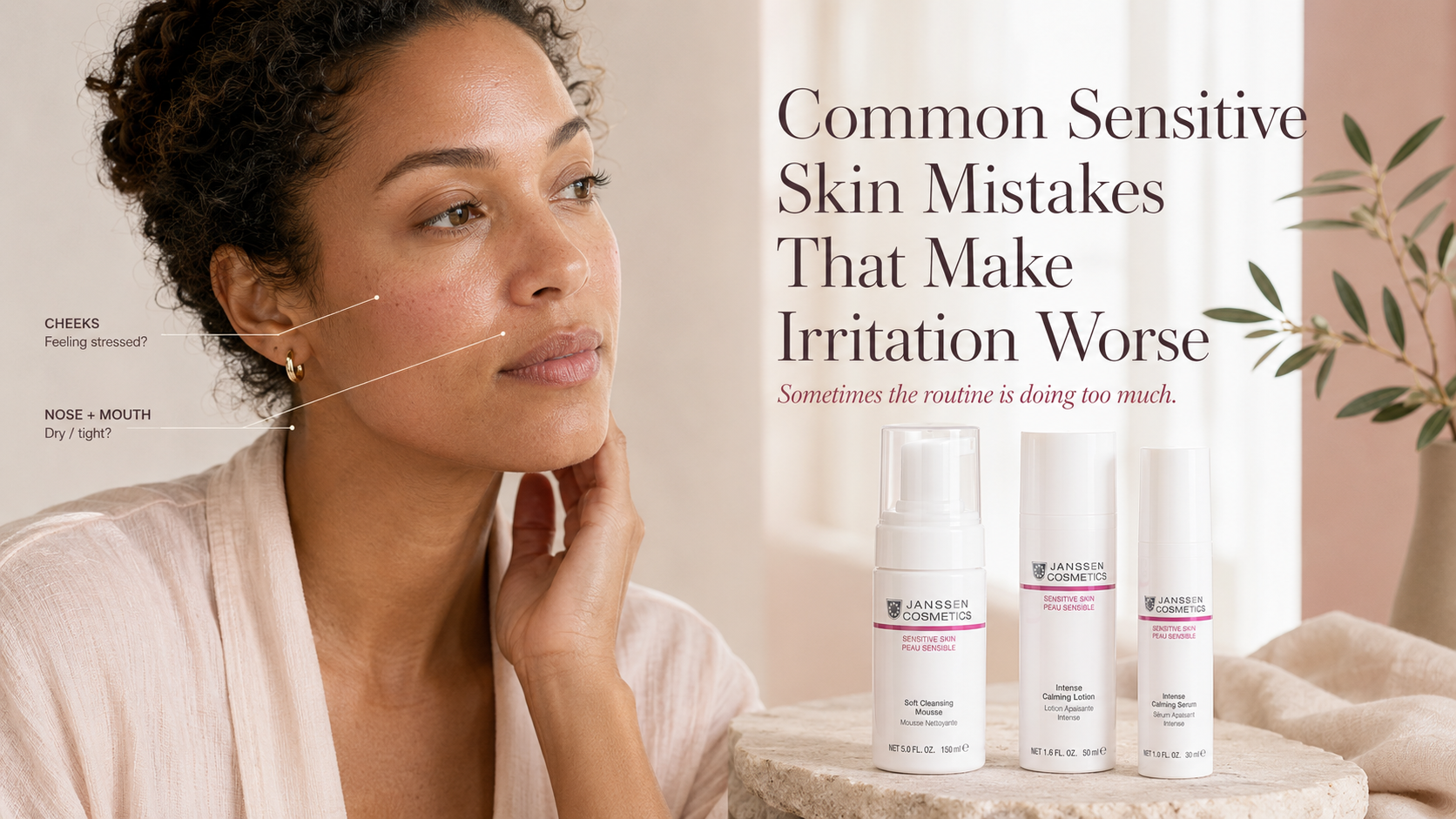
Sensitive skin does not always react because a single product is too strong.
Sometimes the routine becomes uncomfortable because several small habits are working against the skin at the same time.
A cleanser may be slightly too drying.
The water may be too hot.
An acid toner may be used every day.
Retinol may be layered with vitamin C.
Moisturizer may be skipped because the skin looks oily.
SPF may be avoided because it stings.
A facial scrub may be used to remove the flakes created by over-exfoliation.
Each step may seem reasonable on its own.
Together, they can make sensitive skin feel increasingly tight, warm, stingy, flaky, or redness-prone.
At Zendevie, our licensed esthetician does not begin by adding another active product. The first step is reviewing what the skin is already experiencing and which parts of the routine may be creating unnecessary stress.
Sensitive skin often needs fewer variables before it needs more products.
Common sensitive skin mistakes include:
A calmer starting point is:
Morning: Gentle cleanser or rinse if appropriate → moisturizer → SPF
Evening: Gentle cleanser → moisturizer
Once the skin feels stable, add only one product at a time.
If irritation is persistent, painful, swollen, rash-like, crusting, bleeding, infection-looking, close to the eyes, blistering, or continuing to worsen, stop experimenting and seek dermatologist guidance.
Cleansing removes dirt, makeup, excess oil, and sunscreen residue.
But more cleansing does not always mean cleaner or healthier-looking skin.
Sensitive skin may become more uncomfortable when it is washed:
Over-cleansing may contribute to:
Some sensitive skin may do well with a gentle cleanser morning and evening.
Other skin may prefer a lukewarm-water rinse in the morning and cleanser at night.
The correct frequency depends on makeup, SPF, oiliness, dryness, climate, exercise, and the cleanser formula.
The skin should feel clean, not stripped.
A squeaky-clean feeling is often treated as proof that the cleanser worked.
For sensitive skin, that feeling may signal that cleansing was too aggressive.
After cleansing, the skin should not feel:
A cleanser can remove residue without removing every trace of natural surface comfort.
If the skin feels tight every time it is washed, review:
Sensitive skin should not have to recover from cleansing twice a day.
Hot water may feel relaxing, especially during colder weather.
But sensitive skin may become more reactive after repeated exposure to very hot water.
Hot water may contribute to:
Use lukewarm water.
The water does not need to feel cold.
It should not make the face feel hot after rinsing.
Long hot showers can also affect the face, neck, and body even when the facial cleanser is gentle.
A longer cleansing massage is not always better.
Sensitive skin may be stressed by:
Follow the cleanser directions.
Use enough time to loosen daily residue without turning cleansing into exfoliation.
If heavy makeup or water-resistant sunscreen is difficult to remove, a suitable first-cleansing step may be considered rather than rubbing one cleanser aggressively.
Cleansing brushes, textured cloths, facial sponges, and rough washcloths create mechanical friction.
Some people enjoy these tools.
Sensitive skin may find them too stimulating, especially when used daily.
They may contribute to:
Hands may be enough for daily cleansing.
If a cloth is used, it should be soft, clean, and applied without aggressive rubbing.
Do not scrub the skin because it feels rough.
Roughness may be a sign that the routine is already too active.
Double cleansing can be useful for heavy makeup, water-resistant sunscreen, or significant product buildup.
It is not automatically necessary for everyone every night.
Sensitive skin may become dry or tight when two strong cleansers are used back to back.
Review:
A double cleanse should not mean double stripping.
Some cleansers contain:
These cleansers should be counted as active products.
Sensitive skin may react when an active cleanser is used twice daily and followed by:
A cleanser is not automatically mild because it is rinsed away.
If the skin is already burning or flaky, use a gentler cleansing foundation before considering an active cleanser.

Over-exfoliation is one of the most common sensitive skin mistakes.
It may happen through:
A person may use each product on a different day and still exfoliate too frequently overall.
Signs of over-exfoliation may include:
When these signs appear, adding another exfoliant is not the answer.
Pause active products and simplify.
When the skin flakes, it is tempting to remove the visible texture with:
But flakes may be a sign of dryness, retinol irritation, acid overuse, weather exposure, or a stressed skin surface.
Scrubbing them away may make the underlying skin feel more raw.
Instead:
If flaking is persistent, painful, rash-like, crusting, or worsening, seek dermatologist guidance.
Sensitive skin may be exposed to acids through:
The products may have different names, but they may perform similar exfoliating functions.
Do not assume every category needs to be represented in one routine.
One exfoliating step may be enough.
Some sensitive skin may not need any acid while it is reactive.
Retinol may already feel drying or active.
Combining it with:
may make sensitive skin increasingly uncomfortable.
Do not begin several active ingredients during the same week.
Introduce them separately.
Some people may eventually use more than one active ingredient on a careful schedule.
That does not mean every sensitive complexion needs those combinations.
A product does not need to burn to be effective.
Sensitive skin should not be forced through:
Phrases such as “beauty is pain” or “your skin is purging” should not be used to dismiss every reaction.
Some active products may create a mild temporary sensation.
Repeated or worsening discomfort is different.
Stop and reassess.
More product does not automatically create better results.
Using too much may increase:
This is especially relevant for:
Use the amount directed by the product.
Do not repeatedly add layers because the skin still looks dry or textured.
The formula may not be the right match.

A new routine may include:
If the skin reacts, it becomes difficult to identify the cause.
Sensitive skin benefits from staged introduction.
Begin with foundational products.
For example:
Observe each change.
A complete routine does not need to be built in one day.
Sensitive skin may need time to show whether a product feels comfortable.
Constantly switching:
creates more variables.
It may also prevent the skin from reaching a stable pattern.
Do not abandon a comfortable basic product simply because a new trend appears.
At the same time, do not keep using a product that repeatedly burns or causes visible discomfort.
The goal is consistency with tolerated products.
A routine that works for a friend, influencer, family member, or content creator may not match your skin.
Differences may include:
Sensitive skin should not use a ten-step routine simply because someone else has visible results.
Skin understanding comes before product copying.
Products marketed for sensitive skin may be formulated with comfort in mind.
That label does not guarantee that every reactive complexion will tolerate the formula.
A sensitive-skin product may still contain:
Patch test carefully.
Introduce one product at a time.
Evaluate the actual response, not only the front label.
Natural skincare may contain:
These ingredients may feel comfortable for some people.
Others may experience stinging, itching, warmth, or redness-looking areas.
Natural does not automatically mean mild.
Synthetic does not automatically mean harsh.
The complete formula matters.
Pure tea tree, lavender, peppermint, eucalyptus, lemon, or another essential oil should not be applied directly to sensitive facial skin.
Concentrated essential oils may contribute to:
Do not add essential oils directly to moisturizer, toner, water, or facial mist.
Use professionally formulated products designed for facial use.
One lightly fragranced product may feel comfortable.
But total fragrance exposure may come from:
If the skin reacts, review the complete exposure.
Do not assume the facial moisturizer is the only possible source.
Hair products, perfume, and sprays may also touch the face, neck, or eye area.
Oily skin can still be sensitive or dehydrated.
Skipping moisturizer may leave the skin feeling:
A moisturizer does not need to be heavy.
Oily-sensitive skin may prefer a lighter lotion or emulsion.
The goal is not to coat the skin.
It is to support comfort after cleansing and active products.
A rich cream may feel comfortable on dry-sensitive skin.
It may feel heavy or occlusive on oily-sensitive skin.
If the moisturizer causes:
a lighter texture may be more appropriate.
Sensitive skin does not automatically mean dry skin.
Texture should match both sensitivity and oil needs.
Dry-sensitive or mature-sensitive skin may need more comfort than a thin gel provides.
If the skin remains:
the moisturizer may be too light.
A richer texture may be considered after assessing the skin.
Sensitive-skin care should not be based only on what feels weightless.
It should support lasting comfort.
Some hydrating products are commonly applied to slightly damp skin.
But applying active products to very wet skin may make them feel more intense.
Sensitive skin should be cautious with:
Follow the product directions.
Do not assume every product should be applied to wet skin.
SPF is an important daytime step.
If sunscreen stings, review:
Do not assume all sunscreen will feel the same.
A more comfortable option may be needed.
Pausing daytime protection while continuing acids or retinol can weaken the routine structure.
Sensitive skin benefits from consistent daytime protection throughout the year.
Sun exposure can still occur during:
SPF is especially important when the routine includes:
Daily consistency matters more than occasional heavy use.
A morning routine may include:
Sensitive skin may not need every layer.
Too many layers may contribute to:
Use only the steps that serve a clear purpose.
Facial serums, acids, retinol, fragrance, SPF, and moisturizers may migrate toward the eyes.
This can contribute to:
Avoid applying strong facial products directly on the eyelids or close to the lash line unless they are designed for that area.
Use a dedicated eye product when appropriate.
If the eye area is swollen, painful, crusting, or persistently irritated, seek medical guidance.
The mouth and nostril folds are often more sensitive than the rest of the face.
Products may collect in these areas.
Be cautious with:
Avoid applying active products over cracked-looking, flaky, burning, or rash-like areas.
Persistent mouth-area irritation should be evaluated by a dermatologist.
Clay masks may be useful for oily-looking areas.
They may feel too drying on:
For combination-sensitive skin, clay may only be appropriate on the T-zone.
Do not assume every mask should cover the whole face.
Treat different zones according to their needs.
Masks are add-ons.
They are not required every day.
Sensitive skin may become uncomfortable when several masks are used each week:
A soothing mask may still be unnecessary if the rest of the routine is already comfortable.
More masks do not automatically mean better care.
Waxing, threading, shaving, dermaplaning, and hair-removal creams may leave the skin more reactive.
Avoid immediately applying:
Wait until the skin feels comfortable again.
If the area becomes swollen, blistered, painful, rash-like, or persistently irritated, seek professional guidance.
Do not apply retinol, acids, or strong aromatic products to skin that feels:
After sun exposure, simplify the routine.
Use products the skin already tolerates.
If the skin is blistering or severely painful, seek medical guidance.
Travel can change skin tolerance because of:
Do not introduce several new active or fragranced products during travel.
Bring products the skin already knows.
A simple travel routine is easier to manage.
Hotel soaps, body washes, and fragranced lotions may not be designed for sensitive facial skin.
Avoid using body soap as facial cleanser.
Bring a small amount of the cleanser and moisturizer the skin already tolerates.
Aggressive towel drying can increase friction.
Pat the skin gently.
Use a clean, soft towel.
Do not rub the face dry, especially when it is already flaky or irritated.
Picking may increase:
Do not squeeze whiteheads or scrape blackheads aggressively at home.
Painful, deep, swollen, persistent, or scarring blemishes should be evaluated by a dermatologist.
When the skin looks red, people may layer:
Too many layers may make it difficult to identify what the skin tolerates.
Begin with the simplest comfortable routine.
Add only what is necessary.
Purging is often used to explain bumps after active products.
Not every reaction is purging.
Stop and reassess when bumps are:
Do not continue an uncomfortable product simply because someone online described the reaction as normal.
Sensitive skin should not be trained through pain.
Stop a product when it repeatedly causes:
Returning to basics is not failure.
It is useful information.
After irritation improves, do not immediately restart:
all together.
Reintroduce one product at a time.
Wait long enough to observe the response.
Some products may no longer be necessary.
Professional exfoliation systems are designed for trained use, controlled application, and appropriate aftercare.
Do not copy professional peel protocols at home.
High-strength exfoliation can make sensitive skin significantly more uncomfortable.
Professional treatments should remain in professional settings.
Patch testing cannot guarantee full-face tolerance.
It may still help identify an immediate or delayed reaction before broader use.
Patch test finished skincare products carefully.
Do not test undiluted essential oils or professional peels at home.
Introduce one product at a time even after a comfortable patch test.
When skin reacts often, it may help to record:
A product record may make patterns easier to understand.
It may also make a professional consultation more useful.
Ingredients matter.
The routine also matters.
A gentle ingredient may still feel uncomfortable when:
Do not review the ingredient list without reviewing the behavior around the product.
Facial sensitivity may be affected by:
If irritation appears around the hairline, temples, ears, neck, or sides of the face, review hair and fragrance products.
The cause may not be facial skincare alone.
Sensitive skin often benefits from consistency.
Frequently changing products in search of immediate visible improvement may increase irritation.
The goal is not an overnight transformation.
The goal is a routine the skin can tolerate and use consistently.
Sensitive skin may also be:
A rich cream may suit dry-sensitive skin and feel too heavy on oily-sensitive skin.
A BHA product may be relevant for clogged-looking pores but unnecessary for dry-sensitive cheeks.
Sensitivity is one part of the skin pattern.
The full pattern matters.
Oily but tight skin may be over-cleansed, dehydrated, or using too many clarifying products.
Review:
Do not respond by washing more often.
A lighter moisturizer may be appropriate.
If moisturizer burns, the skin may already be irritated.
Review products used before it:
Pause active products.
Use only what remains comfortable.
If moisturizer continues to burn, or the skin is swollen, rash-like, painful, or worsening, seek dermatologist guidance.
SPF may sting because of:
Pause unnecessary actives.
Do not stop daytime protection without reviewing another formula or routine structure.
Unusual shine paired with tightness, burning, or moisturizer stinging may suggest over-exfoliation.
Do not add more acids.
Pause active products and simplify.
Shiny does not always mean oily or healthy-looking.
Do not scrub.
Review:
Persistent, painful, rash-like, crusting, or worsening flaking should be evaluated by a dermatologist.
Pause active products.
Avoid:
If heat is persistent, painful, swollen, rash-like, or worsening, seek dermatologist guidance.
Stop introducing new products.
Return to the simplest routine that remains comfortable.
The skin may be over-exfoliated, weather-stressed, reacting to another product, or experiencing a concern that needs medical evaluation.
If cleanser, moisturizer, SPF, or water continues to cause significant discomfort, see a dermatologist.
Return to familiar products.
Avoid new hotel products, strong exfoliation, and several active steps.
Consider:
If the reaction is painful, swollen, blistering, rash-like, or worsening, seek medical guidance.
Pause actives and fragranced products.
Use only a simple routine that remains comfortable.
Do not exfoliate bumps or redness-looking areas.
Seek guidance for persistent swelling, pain, blistering, or infection-looking changes.
That is useful information.
It may suggest that the previous routine contained:
Do not rush to add everything back.
Reintroduce only what serves a clear purpose.
Pause retinol, acids, scrubs, strong vitamin C, and clarifying masks when the skin is:
Active products can wait.
Gentle cleanser or lukewarm-water rinse if appropriate → tolerated moisturizer → tolerated SPF
Gentle cleanser → tolerated moisturizer
Temporarily avoid:
The routine should feel boring, predictable, and comfortable.
That is often helpful during irritation.
A dermatologist should evaluate the skin when irritation includes:
Cosmetic skincare can help organize a routine.
It cannot diagnose an allergy, dermatitis, rosacea, infection, or another medical condition.
After consultation, our licensed esthetician may consider Janssen Cosmetics options based on whether the skin is dry-sensitive, oily-sensitive, combination-sensitive, mature-sensitive, redness-prone, or currently uncomfortable.
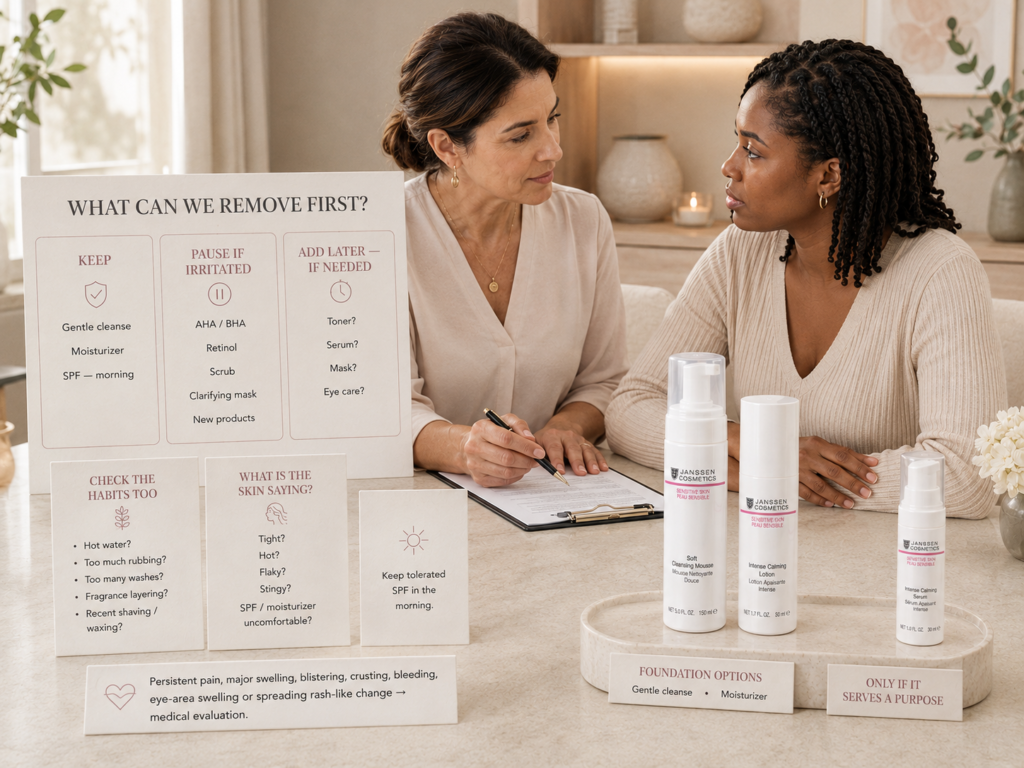
For a simple sensitive-skin foundation, possible options may include:
These products are not one automatic routine.
A person may need only a cleanser, moisturizer, and SPF at first.
Serums, masks, tonics, and eye products should be added only when they serve a clear purpose and the skin tolerates the foundation.
For oily-sensitive skin with clogged-looking pores, products such as Purifying BHA Serum may be discussed only after the basic routine is stable and BHA has a clear purpose.
For texture or exfoliation concerns, AHA, BHA, enzyme, and retinol products should not be added automatically to reactive skin.
Professional exfoliation systems belong in professional treatment settings.
If the skin is burning, swollen, rash-like, reacting to moisturizer, or unable to tolerate SPF, active Janssen options should wait.
Do not wash sensitive skin repeatedly throughout the day.
Do not use very hot water.
Do not treat a squeaky feeling as the goal of cleansing.
Do not scrub with brushes, rough cloths, or exfoliating pads when the skin is irritated.
Do not combine an acid cleanser, acid toner, BHA serum, scrub, retinol, and exfoliating mask.
Do not scrub away flakes.
Do not continue products that strongly burn.
Do not assume tingling proves effectiveness.
Do not skip moisturizer because the skin looks oily.
Do not use the richest moisturizer automatically because the skin is sensitive.
Do not introduce a full routine in one day.
Do not change products every few days.
Do not copy another person’s routine blindly.
Do not assume “natural,” “clean,” “gentle,” or “for sensitive skin” guarantees tolerance.
Do not apply undiluted essential oils to the face.
Do not apply active facial products close to the eyes or mouth corners.
Do not use strong products after waxing, shaving, sun exposure, or professional exfoliation.
Do not start new actives during travel.
Do not use professional peel systems as home care.
Do not pick flakes, blackheads, whiteheads, or irritated areas.
Do not ignore haircare, perfume, makeup, and body products that touch the face.
Do not keep restarting every active after irritation.
Do not ignore persistent, painful, swollen, blistering, crusting, bleeding, eye-area, infection-looking, or worsening reactions.
Common mistakes include over-cleansing, using hot water, frequent exfoliation, layering too many actives, skipping moisturizer, avoiding SPF, using fragranced or essential-oil products on irritated skin, and changing products too quickly.
Yes. Frequent or aggressive cleansing may leave sensitive skin tight, dry, hot, or more reactive.
Some sensitive skin may tolerate occasional exfoliation, but it is not required. Exfoliation should wait when the skin is burning, flaky, swollen, or reacting to basic products.
A brief mild sensation may happen with some active products. Strong, persistent, painful, or worsening tingling is a reason to stop and reassess.
No. Flaking may indicate dryness or irritation. Scrubbing may make the skin feel more raw.
Oily-sensitive skin may still need moisturizer. A lighter lotion or emulsion may be more appropriate than a heavy cream.
The moisturizer may not suit the skin, or the skin may already be irritated from cleansing, acids, retinol, scrubs, weather, or another product.
SPF may sting because of the formula, fragrance, eye migration, dryness, over-exfoliation, or retinol use. A calmer routine or different sunscreen may be needed.
Sensitive skin should not introduce them together. Each active should be assessed separately and spaced carefully if the skin tolerates both.
No. Some sensitive skin tolerates selected fragranced products. Other skin may sting, itch, or become red-looking. Individual tolerance matters.
Some professionally formulated products may be tolerated, but undiluted essential oils should not be applied directly to sensitive facial skin.
Toner is optional. A gentle tonic may fit some routines, but an acid, drying, or fragranced toner may increase discomfort.
There is no required number. A basic routine may include cleanser, moisturizer, and SPF. Additional products should serve a clear purpose.
Keep the routine simple until basic products feel consistently comfortable. Persistent or severe irritation should be evaluated by a dermatologist.
Masks are optional. Choose them carefully and avoid frequent exfoliating, warming, or drying masks when the skin is reactive.
The skin may be oily, dehydrated, over-cleansed, or over-exfoliated. More washing may worsen the problem.
Patch testing may help identify immediate or delayed reactions, but it cannot guarantee full-face tolerance.
See a dermatologist if irritation is persistent, painful, significantly swollen, blistering, crusting, bleeding, infection-looking, near the eyes, repeatedly returning, or not improving after products are stopped.
If your routine is filled with products for sensitive skin but your face still burns, stings, flakes, or becomes redness-prone, a free virtual consultation can help identify which steps may be creating unnecessary stress.
At Zendevie, we review your cleanser, toner, serums, moisturizer, SPF, exfoliation schedule, retinol use, fragrance exposure, masks, makeup, haircare, and reaction history before discussing what to add or remove.
The goal is not to create the longest routine.
The goal is to help your skin tolerate a simple foundation and add only the products that serve a clear purpose.

Zendevie is guided by Haby Diallo, a licensed esthetician with more than 20 years of professional skincare experience. Her approach is rooted in education, professional judgment, and personal care.
years of experience