
Oily skin does not always disappear with age.
Many adults over 40 still notice shine through the T-zone, clogged-looking pores around the nose, blackheads, whiteheads, chin bumps, or makeup separation. At the same time, the skin may also feel drier, thinner, duller, more sensitive, or less tolerant of strong products.
This combination can feel confusing.
The skin looks oily in some areas, but it may feel tight after cleansing. Blemishes still appear, but the face no longer tolerates the same drying products used years ago. A rich anti-aging cream may feel comfortable on the cheeks but too heavy around the nose and chin.
Mature oily skin needs a more thoughtful plan.
In consultation, our licensed esthetician looks at both sides of the pattern: the oily or clogged-looking areas and the mature-skin changes that affect comfort, texture, and product tolerance.
Blemishes can still happen after 40 because oily areas, clogged-looking pores, product buildup, heavy textures, hormonal changes, dehydration, and slower-looking skin renewal can all affect mature skin.
Mature oily skin should not be treated like teenage oily skin.
A simple structure may look like:
Cleanser → Toner if appropriate → Targeted step if needed → Lightweight moisturizer → SPF in the morning
The key is to manage shine and clogged-looking pores without stripping skin that may already be more dryness-prone or sensitive.
Oil production can change with age, but it does not stop for everyone.
Some people still have an oily T-zone, visible pores, blackheads, or whiteheads after 40. Others become more combination: oily in the center but dry or tight on the cheeks.
You may notice:
This is why mature oily skin needs more interpretation than the label “oily.”
Teenage oily skin often has more oil and may tolerate stronger cleansing or active products more easily.
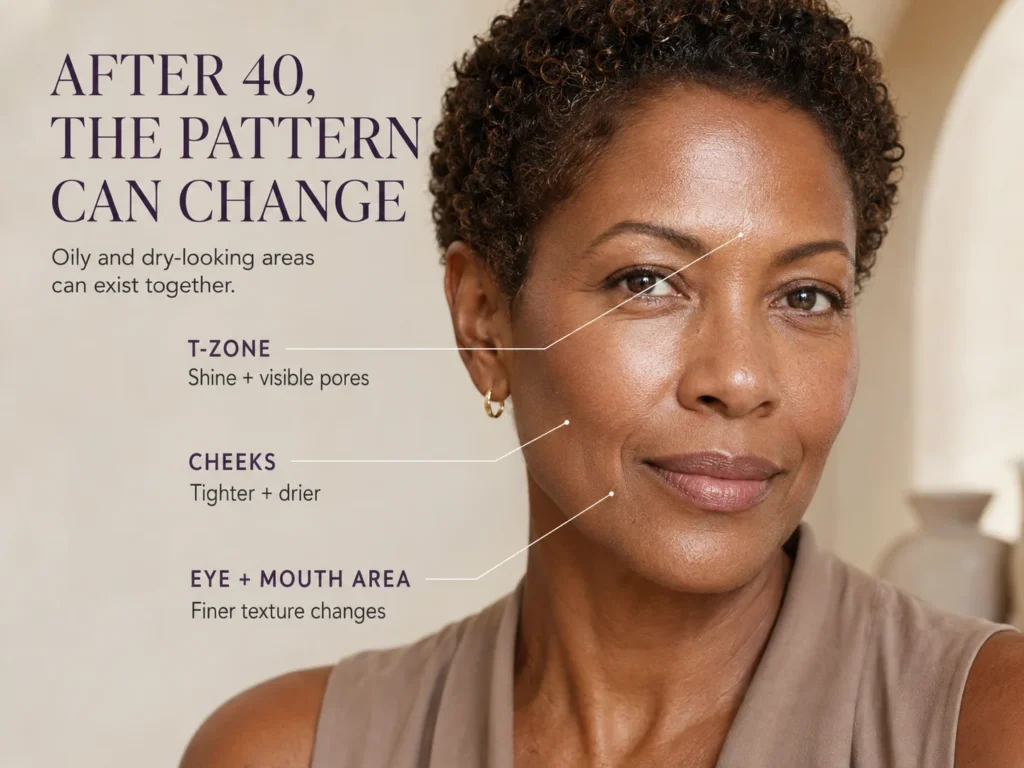
Mature oily skin may be different.
After 40, the skin may still have clogged-looking pores, but it may also show:
A routine that only tries to dry out the skin can make mature oily skin look rougher, tighter, or more irritated.
The goal is not to attack oil. The goal is to manage visible shine while keeping the skin comfortable.
Blemish-prone concerns after 40 may be influenced by several factors.
Possible contributors include:
This is why the solution is not always stronger acid or more cleansing.
Sometimes the skin needs lighter textures. Sometimes it needs better makeup removal. Sometimes it needs less exfoliation. Sometimes it needs a dermatologist.
Some oily or blemish-prone skin feels moist, shiny, and visibly oily. Other blemish-prone skin may be more dryness-prone, mature, or dehydrated.
This difference matters because a person over 40 may have blemishes but not the same oil level they had at 18.
If the skin is shiny, thick-feeling, and oily, clarifying care may be considered.
If the skin has blemishes but feels dry, tight, or sensitive, the plan needs to be much more careful.
Mature blemish-prone skin should not automatically be treated with the strongest oil-control steps.
One of the most common mature oily patterns is oily but dry.
The face may look shiny through the center, but the cheeks, mouth area, and under-eye area feel tight or dry.
This can happen when:
If the skin feels oily and dry at the same time, the plan needs texture control, not just oil control.
Pores may look more noticeable after 40 because oil, texture, dehydration, and makeup can all make the surface look less smooth.
Clogged-looking pores may appear as:
BHA may be considered when clogged-looking pores are part of the concern, but mature skin may need slower introduction and better moisturizer support.
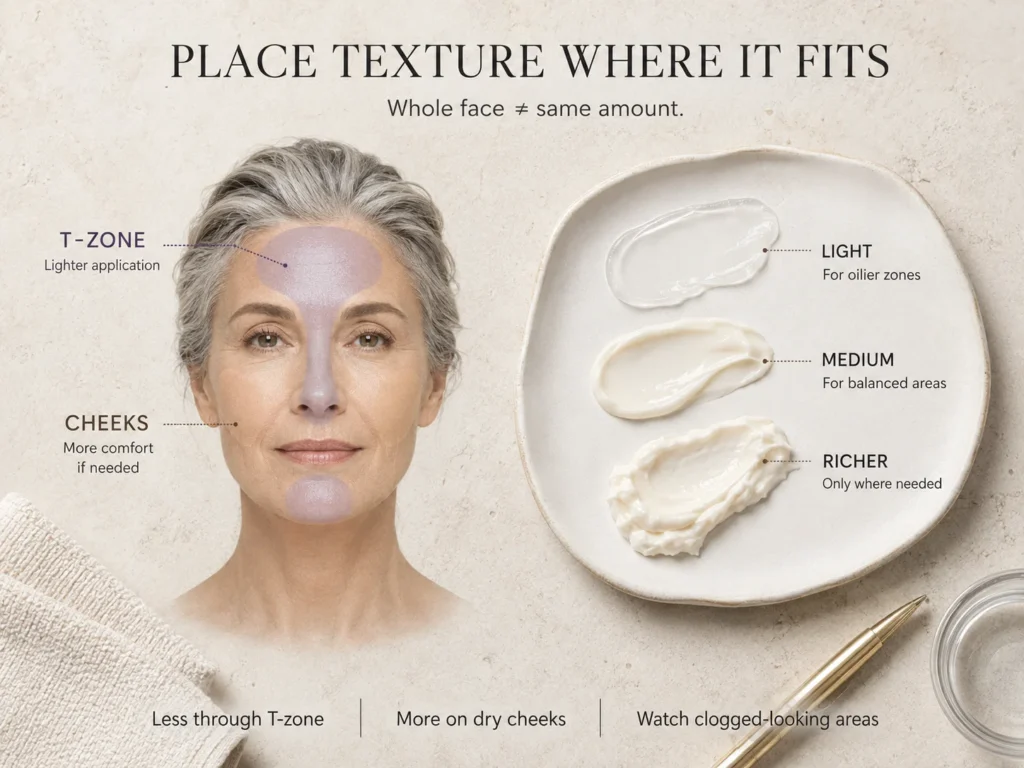
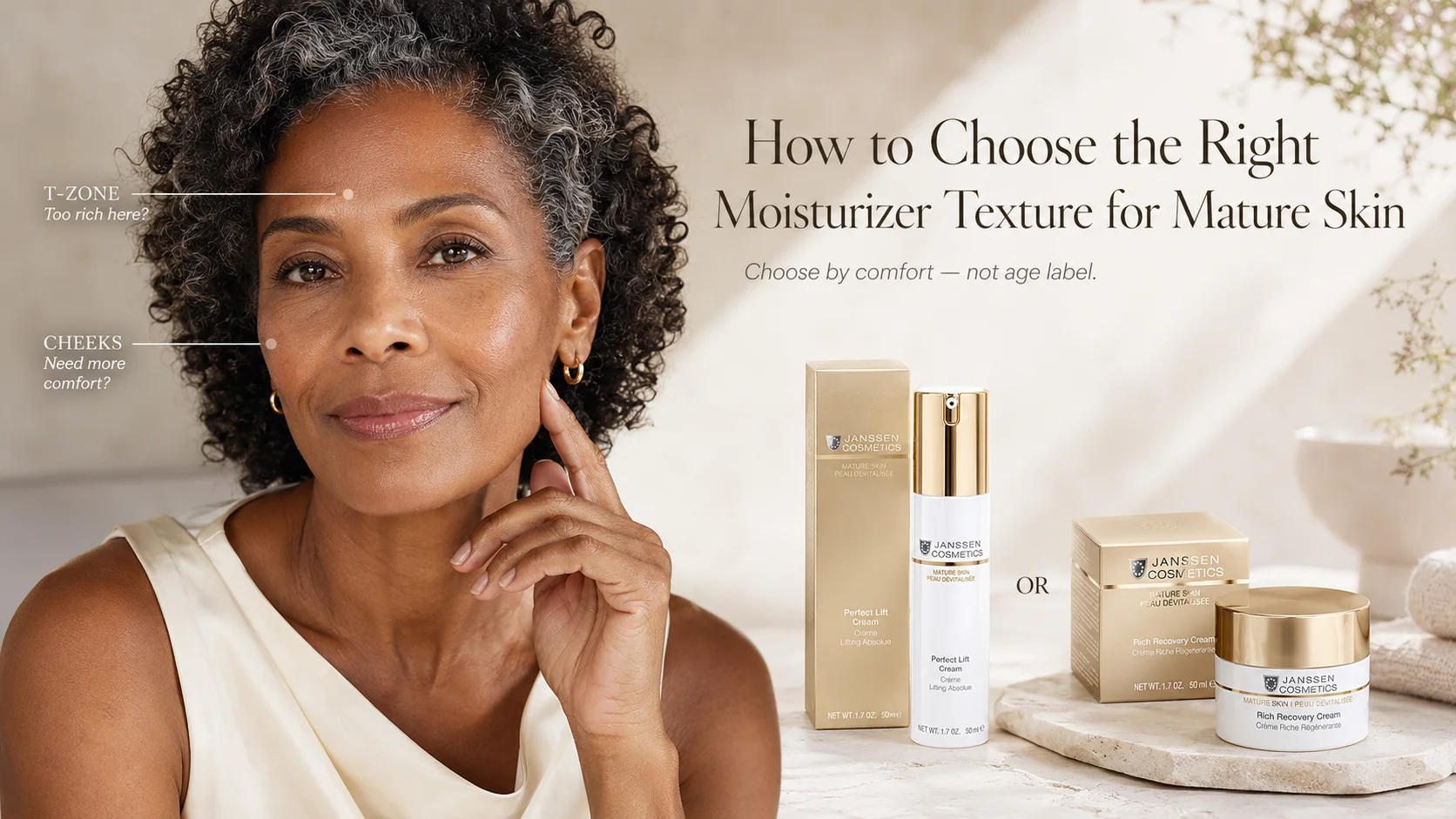
Many mature-skin products are rich and comforting.
That can be helpful for dryness, but not every rich cream belongs everywhere on mature oily skin.
A heavy cream may feel good on the cheeks but too much on the nose, chin, or forehead.
It may contribute to:
This does not mean mature oily skin should avoid moisturizer. It means texture and placement matter.
Some adults with oily skin avoid moisturizer because they are afraid of blemishes.
But mature oily skin can become tight, dehydrated, or irritated when moisturizer is skipped.
This may make fine lines look more visible and make makeup sit poorly.
A light moisturizer can help mature oily skin feel smoother without adding a heavy finish.
The question is not “moisturizer or no moisturizer.”
The question is:
Which texture belongs where?
Cleansing is important, especially when SPF, makeup, sweat, and oil collect during the day.
But mature oily skin should not feel stripped after cleansing.
A cleanser should remove daily buildup without leaving the face tight or raw.
If the cheeks feel tight but the nose still gets oily, the cleanser may be too strong or the face may need zone-specific care.
Mature oily skin often does better with cleansing that is effective but not aggressive.
Toner may help oily areas feel fresher after cleansing.
But toner should not burn, sting, or make mature skin feel stretched.
If the T-zone likes toner but the cheeks do not, placement can be adjusted.
If toner feels sharp after cleansing, the skin may be over-cleansed, over-exfoliated, or dehydrated.
For mature oily skin, toner should support the cleansing step, not create dryness.
BHA may be considered when mature oily skin has clogged-looking pores, blackheads, whiteheads, or congestion.
It may be useful for:
But mature skin may not tolerate BHA the same way it did years earlier.
Start carefully, avoid layering it with every other active product, and moisturize afterward.
If the skin stings, flakes, or feels tight, reduce active steps.
AHA may be considered when mature oily skin looks dull, rough, or uneven on the surface.
But AHA and BHA should not be layered casually.
If the concern is clogged-looking pores, BHA may be discussed first. If the concern is dull surface buildup, AHA may be considered. If the skin is irritated, neither may be the right first step.
For mature oily skin, exfoliation should make the skin look smoother, not thinner or more reactive.
Retinol-style products may be discussed for mature skin, texture, and blemish-prone patterns.
But they need careful timing.
If the skin is already using BHA, AHA, active cleanser, clay masks, and drying spot products, adding retinol-style care may be too much.
Retinol-style products should not be treated as an automatic answer for every mature oily skin concern.
They may make sense when the skin can tolerate them and when the rest of the routine is not already overloaded.
Clay masks can be helpful for oily areas, especially the T-zone.
But mature oily skin may become tight if clay masks are used too often or applied all over the face.
A better approach may be:
The mask should make oily areas feel refreshed, not leave the whole face stretched.
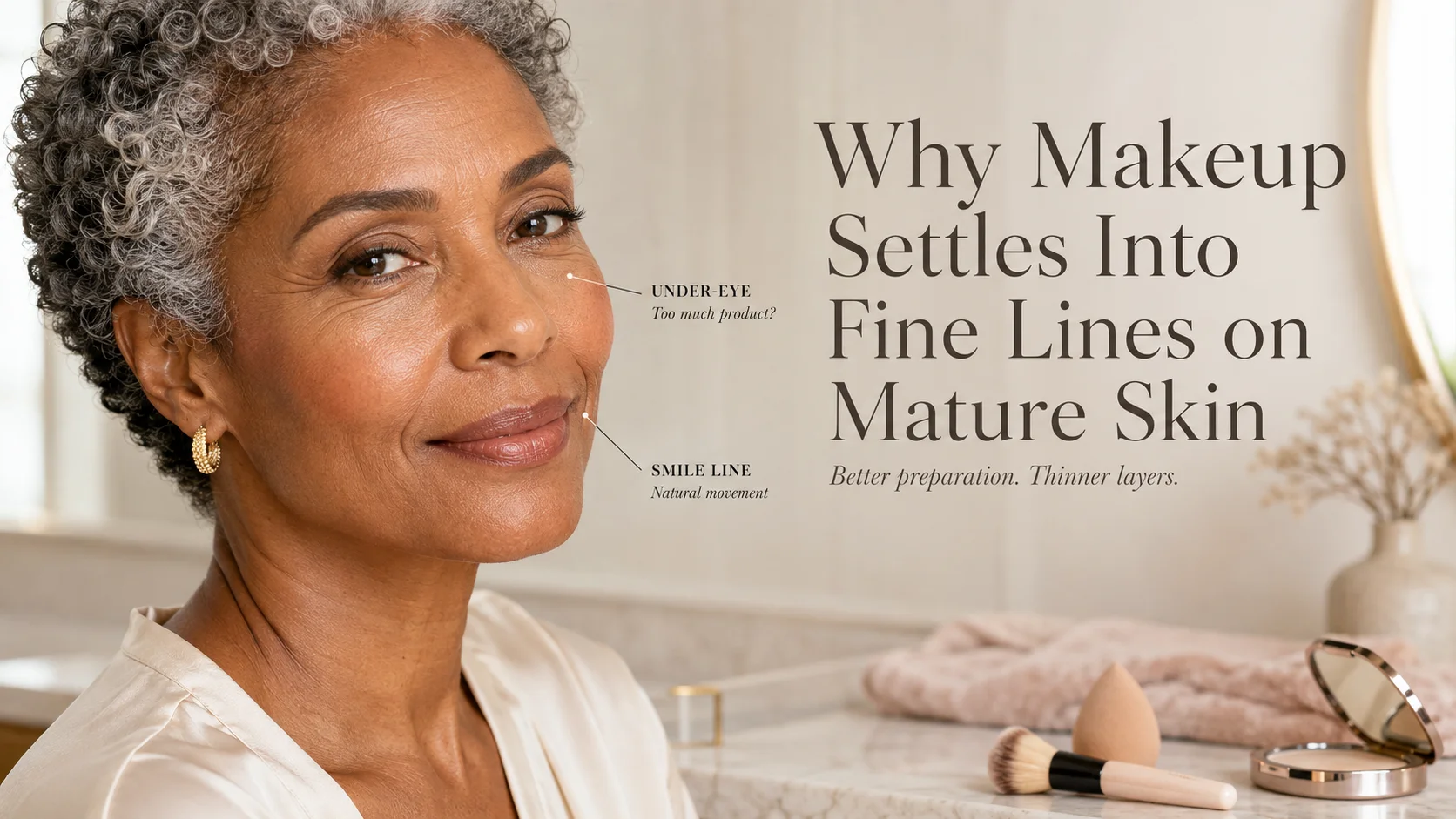
Makeup can reveal the pattern clearly.
You may notice:
This usually means the routine needs better texture placement.
The T-zone may need lighter layers. The cheeks may need a softer moisturizer. SPF may need a better match. Exfoliation may need to slow down if makeup looks rough.
SPF is important in mature skin care and even more important when exfoliating products are used.
The challenge is texture.
Some SPF products feel too heavy for oily areas. Others feel too matte and make mature skin look dry.
The right SPF should protect during the day while layering well over moisturizer and under makeup.
If SPF makes the T-zone greasy, adjust moisturizer amount or SPF texture.
If SPF makes the cheeks tight, the skin may need a more comfortable moisturizer underneath.
Morning care should prepare the skin for the day without making it greasy or tight.
A simple order may be:
Cleanser → Toner if appropriate → Lightweight moisturizer → SPF
If the T-zone is oily, use less moisturizer in the center of the face.
If cheeks feel dry, use a little more there.
If makeup follows, let SPF settle before applying foundation.
Morning care should feel wearable, not heavy.
Evening care should remove the day and support the skin without overworking it.
A simple order may be:
Cleanser → Toner if appropriate → Targeted serum if needed → Lightweight moisturizer
If clogged-looking pores are present and the skin can tolerate it, BHA may be considered.
If dull texture is the main concern, AHA may be discussed.
If the skin feels tight or reactive, skip active products temporarily and focus on cleansing and moisture.
Mature oily skin often does better with selected active nights instead of active products every night.
A simple weekly structure may be:
Most mornings:
Cleanser → Lightweight moisturizer → SPF
Most evenings:
Cleanser → Lightweight moisturizer
Selected nights if needed:
BHA for clogged-looking pores or AHA for dull surface texture
Occasionally:
Clay mask only on oily zones
Pause active products:
When the skin feels tight, stingy, flaky, or irritated
This helps avoid the common mistake of treating mature oily skin too aggressively.
Oily sensitive mature skin needs fewer variables.
A simple plan may be:
Morning: Cleanser → Lightweight moisturizer → SPF
Evening: Cleanser → Lightweight moisturizer
Once the skin feels calm, toner or targeted products can be reconsidered.
If products burn, sting, or make the skin red-prone, do not keep adding more.
The skin needs to feel stable before clarifying care can be judged fairly.
This is often a combination pattern.
The T-zone may need oil-aware textures, while the cheeks need more comfort.
Try:
Mature combination-oily skin needs placement strategy more than product strength.
Some blemish-prone concerns need dermatologist evaluation.
Home skincare can help with cosmetic care, clogged-looking pores, shine, and product texture. But it should not replace medical care when the skin needs it.
A dermatologist should evaluate blemishes that are:
Do not keep applying stronger acids, drying products, or masks if the skin is getting worse.
Before adding another mature-skin or oily-skin product, review what is already happening.
Ask:
These questions can reveal whether the skin needs clarifying care, lighter texture, fewer active products, or dermatologist guidance.
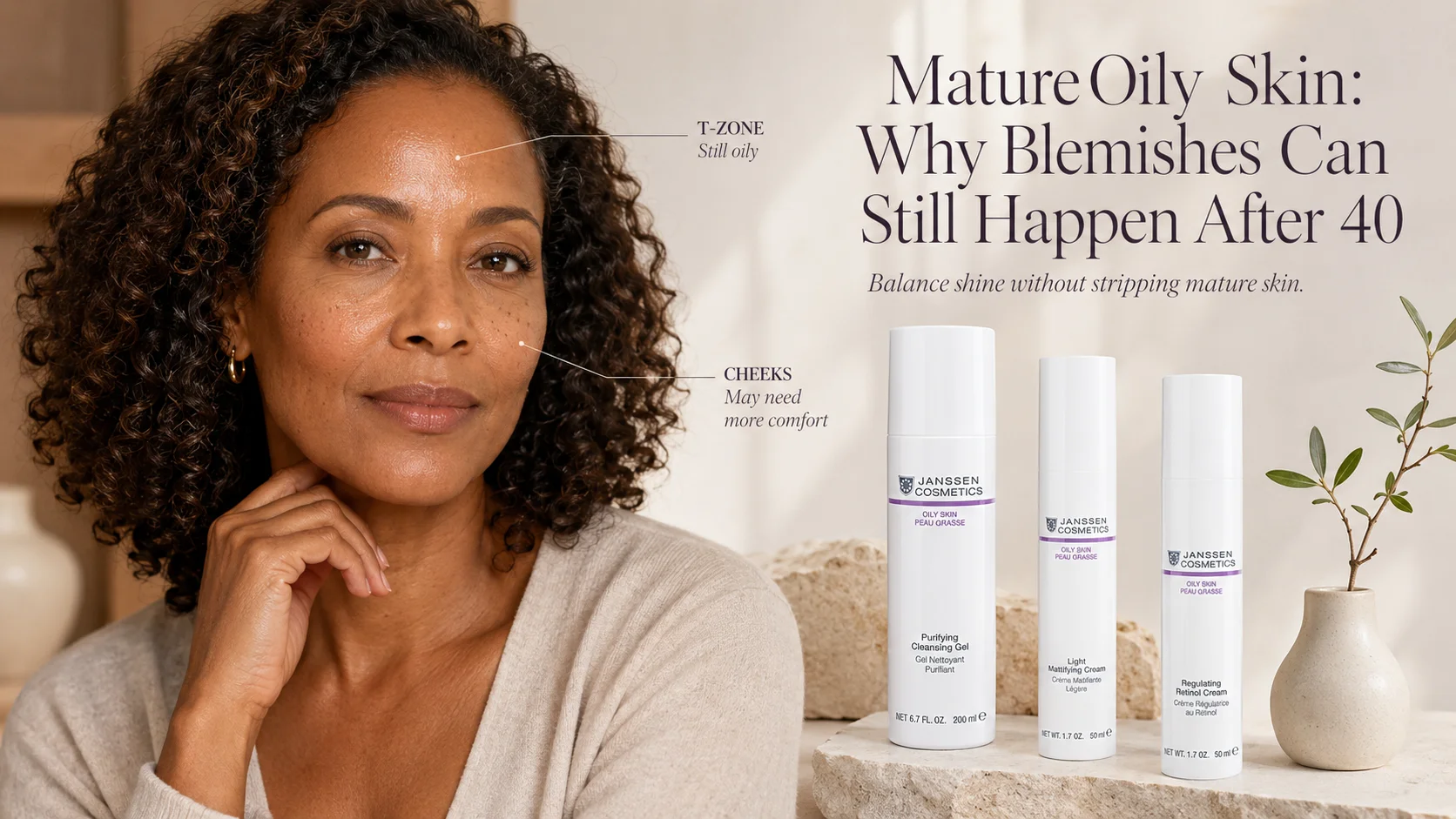
After consultation, our licensed esthetician may consider Janssen Cosmetics options depending on whether mature oily skin is shiny, clogged-looking, dryness-prone, sensitive, dull, or overloaded by heavy products.
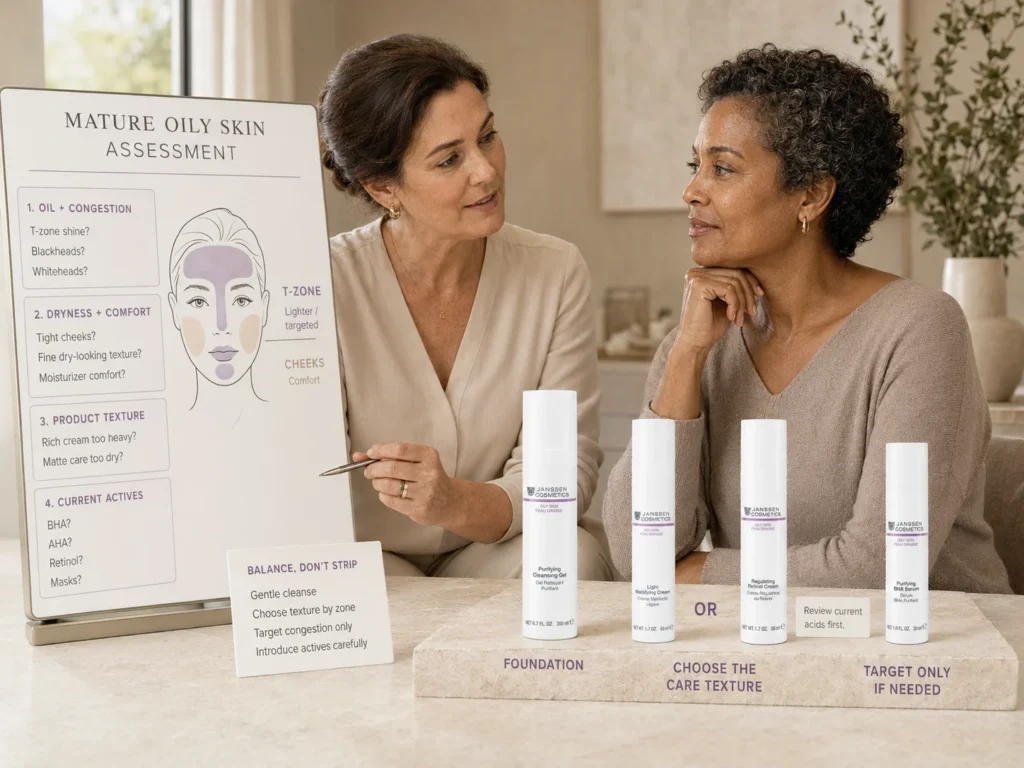
Possible oily-skin options may include:
If the mature-skin concern is more dryness, firmness appearance, or comfort than oil, mature-skin options may be discussed instead of forcing an oily-skin plan.
These options are not automatic recommendations. The right match depends on the balance between oil, dryness, texture, clogged-looking pores, sensitivity, and product tolerance.
Do not treat mature oily skin like teenage oily skin.
Do not strip the face because blemishes appear after 40.
Do not use rich anti-aging cream everywhere if the T-zone becomes congested.
Do not skip moisturizer because the nose gets oily.
Do not layer BHA, AHA, retinol-style products, scrubs, and clay masks all at once.
Do not apply clay masks over dry or sensitive cheeks.
Do not ignore makeup separation as a clue about texture.
Do not keep experimenting if blemishes are painful, deep, swollen, infected-looking, scarring, rash-like, or persistent.
Yes. Some people still have an oily T-zone, visible pores, blackheads, whiteheads, or shine after 40. The skin may also become more dryness-prone at the same time.
Blemish-prone concerns after 40 may be connected to clogged-looking pores, heavy products, incomplete cleansing, hormonal changes, stress, makeup residue, SPF texture, or product overload.
No. Mature oily skin may still have shine and clogged-looking pores, but it may also be drier, more sensitive, duller, or less tolerant of harsh products.
BHA may be considered when blackheads, whiteheads, or clogged-looking pores are present. It should be introduced carefully if the skin feels dry, tight, or sensitive.
Retinol-style care may be considered for some mature blemish-prone skin, but it should not be layered casually with several exfoliating products. Skin tolerance matters.
Many mature oily skin types do well with gel-cream, light lotion, lightweight cream, or mattifying cream textures. The T-zone and cheeks may need different amounts.
The texture may be too rich for oily or clogged-looking areas. It may work better on dry cheeks than on the T-zone, depending on the skin pattern.
A dermatologist should evaluate painful, deep, swollen, cystic-looking, infected-looking, scarring, rash-like, suddenly worsening, or persistent blemishes.
If your skin is over 40 and still oily, blemish-prone, tight, or textured, a free virtual consultation can help you understand what your skin is showing now.
At Zendevie, we look at shine pattern, dryness, clogged-looking pores, product texture, makeup behavior, sensitivity, and current active products before recommending next steps. The goal is to help mature oily skin feel clearer-looking and more comfortable without stripping it

Zendevie is guided by Haby Diallo, a licensed esthetician with more than 20 years of professional skincare experience. Her approach is rooted in education, professional judgment, and personal care.
years of experience