

Yes, over-exfoliation can make oily skin worse.
That can sound confusing because oily skin often looks like it needs more exfoliation. The face gets shiny. Pores look clogged. Blackheads show up around the nose. Whiteheads appear on the forehead or chin. Makeup separates in the T-zone and catches on texture.
So the natural response is to exfoliate more.
But oily skin can be overworked. It can look shiny and still feel tight. It can have oil on the surface and still feel stingy after toner. It can look congested while also becoming flaky around the mouth or nose.
When this happens, the skin may not need another acid, scrub, or mask. It may need fewer active steps for a while.
In consultation, our licensed esthetician looks at how much exfoliation is already happening across the entire plan before adding another clarifying product.
Over-exfoliation can make oily skin feel tight, stingy, flaky, raw, shiny but dry underneath, or more sensitive to products.
It can happen when someone uses too many exfoliating steps at once, such as:
AHA/BHA cleanser + acid toner + BHA serum + scrub + clay mask + retinol-style product
Oily skin may still need exfoliation when clogged-looking pores or rough buildup are present, but the frequency should match skin tolerance.
If your skin feels irritated, simplify first:
Cleanser → Lightweight moisturizer → SPF in the morning
At night:
Cleanser → Lightweight moisturizer
Oily skin is easy to over-treat because shine is visible.
When the face looks greasy, people often assume oil needs to be removed more aggressively. When pores look clogged, they assume stronger exfoliation is needed. When whiteheads appear, they add another acid.
Each choice can seem reasonable by itself.
The problem is the total amount.
One exfoliating product may be fine. Several exfoliating products layered together may leave the skin tight, irritated, and harder to manage.
Exfoliation is not only a scrub.
Many products can contribute to exfoliation or active resurfacing, including:
If you use several of these in the same week, your oily skin may be getting more active care than you realize.
Over-exfoliated oily skin may show a mixed pattern.
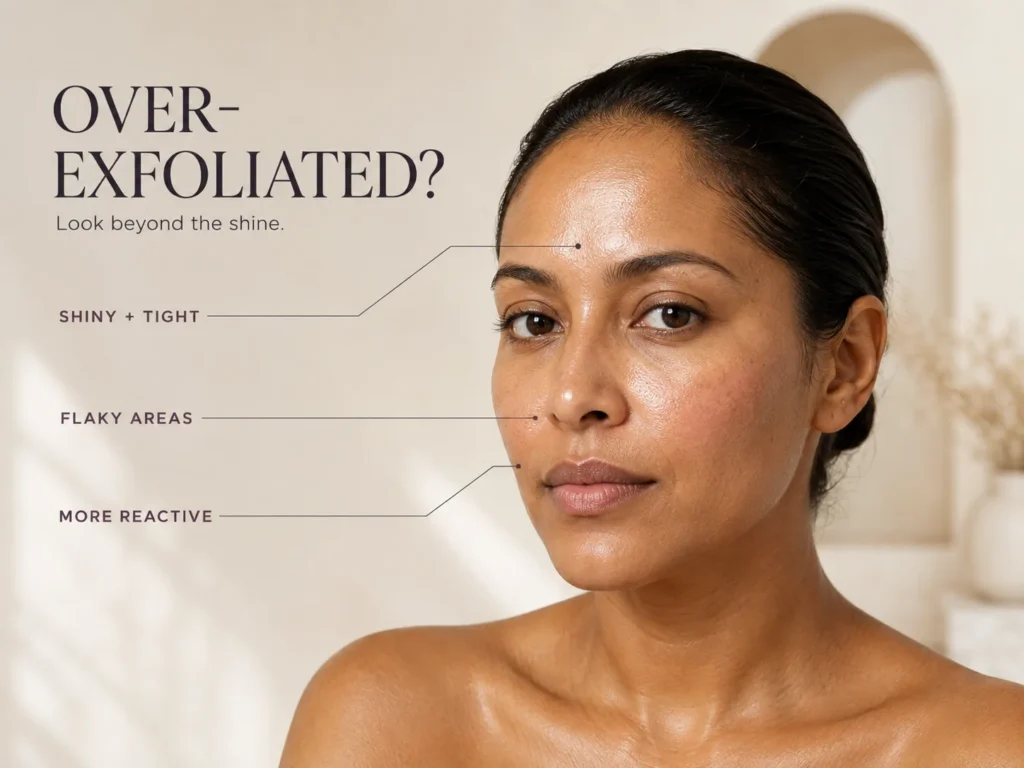
You may notice:
These signs matter more than the label on your skin type.
Oily skin can still be irritated.
This is one of the most common signs.
The mirror shows oil, but the skin feels stretched. This can happen when exfoliation removes too much from the surface or when exfoliating products are layered with a harsh cleanser and drying toner.
That tight feeling is not a sign that the skin is getting clearer. It may be a sign that the skin is becoming dehydrated or reactive.
If your skin feels shiny and tight at the same time, pause before adding more acids.
Moisturizer should usually make the skin feel less bare.
If moisturizer suddenly burns or stings, the issue may not be the moisturizer alone. The skin may already be irritated before moisturizer is applied.
This often happens when exfoliation is used too often or combined with strong cleansing.
Before buying another moisturizer, review the active products you are using.
Flaking does not always mean the skin needs more exfoliation.
If flakes appear while the T-zone still gets oily, the skin may be over-exfoliated or dehydrated.
Scrubbing those flakes can make the situation worse. The surface may become rougher, and makeup may cling even more.
In this situation, the skin usually needs fewer active products, not more friction.
If toner used to feel fine but now feels sharp, the skin may be more reactive than usual.
This can happen after repeated acid use, scrubs, masks, or retinol-style products.
Toner should not feel like a test the skin has to pass. If it stings every time, pause it and simplify.
Over-exfoliation can make makeup look uneven.
You may notice:
This does not always mean the makeup is bad. The skin surface may be irritated or dehydrated.
A smoother makeup result often begins with a less aggressive skincare plan.
Over-exfoliation does not always reduce shine.
Sometimes it makes the skin feel stripped, so the face becomes tight while oil still appears on the surface. The person then sees shine and exfoliates again, creating a cycle.
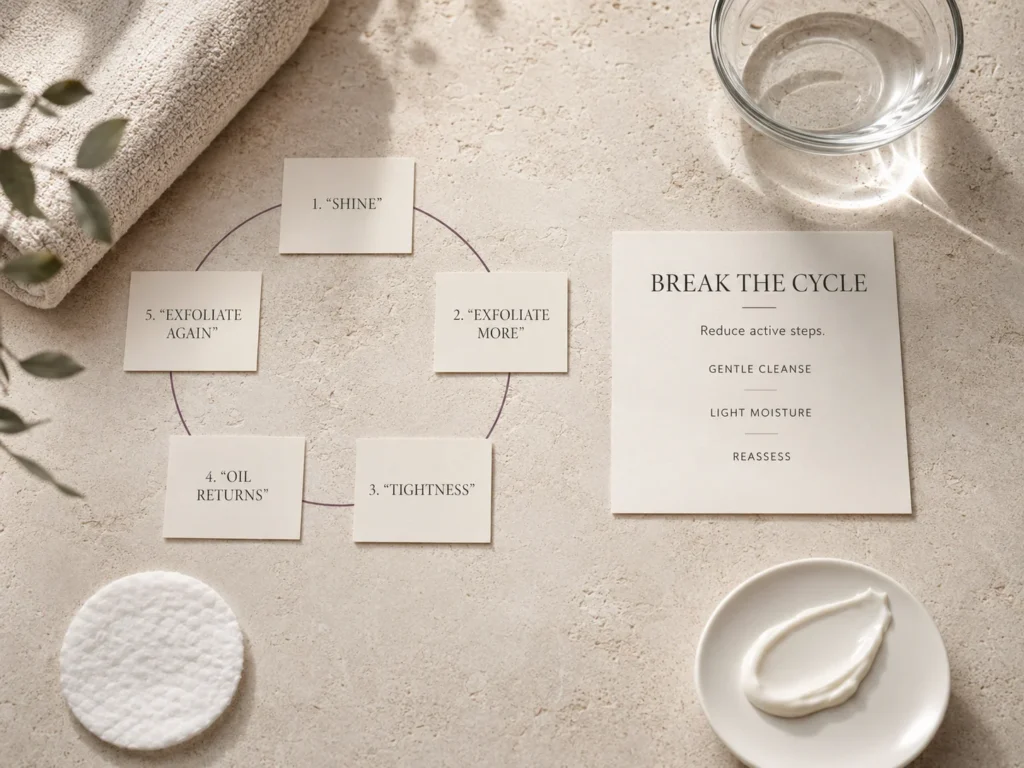
The cycle may look like this:
Shine → exfoliate more → tightness → oil returns → exfoliate again → irritation
The better move is to break the cycle.
Oily skin needs enough cleansing and clarifying care, but not constant removal.
BHA, often known as salicylic acid, may make sense for clogged-looking pores, blackheads, whiteheads, and oily congestion.
But using BHA too often can leave the skin tight, dry, or stingy.
BHA overuse may happen when someone uses:
BHA can be useful. It should not be everywhere in the plan.
AHA may be considered when oily skin has dull surface buildup or rough texture.
But if AHA is used too often, the skin may feel thin, tight, warm, or irritated.
This is especially true when AHA is combined with BHA, scrubs, and retinol-style products.
If rough texture gets worse after exfoliating more, the roughness may be irritation rather than buildup.
Scrubs can feel satisfying because they give immediate smoothness. But on oily or blemish-prone skin, friction can become a problem.
If the skin has bumps, whiteheads, tender blemishes, or red-prone areas, rough scrubbing may make the surface look more irritated.
A scrub is not always the best choice for oily skin with congestion.
If the goal is clogged-looking pores, BHA may be considered more thoughtfully than aggressive friction.
Clay masks can help reduce the look of shine temporarily, especially in the T-zone.
But if clay masks are used too often, left on too long, or applied over the whole face, they can make oily skin feel tight.
This is especially common when someone also uses acids and active cleansers.
Clay masks should match the area. The nose and chin may need them more than the cheeks.
Retinol-style products may be considered for texture and well-aging concerns, but they should not be layered casually with several exfoliating steps.
If oily skin is already using AHA, BHA, scrub, or masks, retinol can push the skin too far.
That does not mean retinol can never be used. It means timing and tolerance matter.
If the skin feels tight, stingy, or flaky, pause and review the entire active schedule.
The first step is to stop adding more active products.
Do not try to fix irritation with another exfoliant.
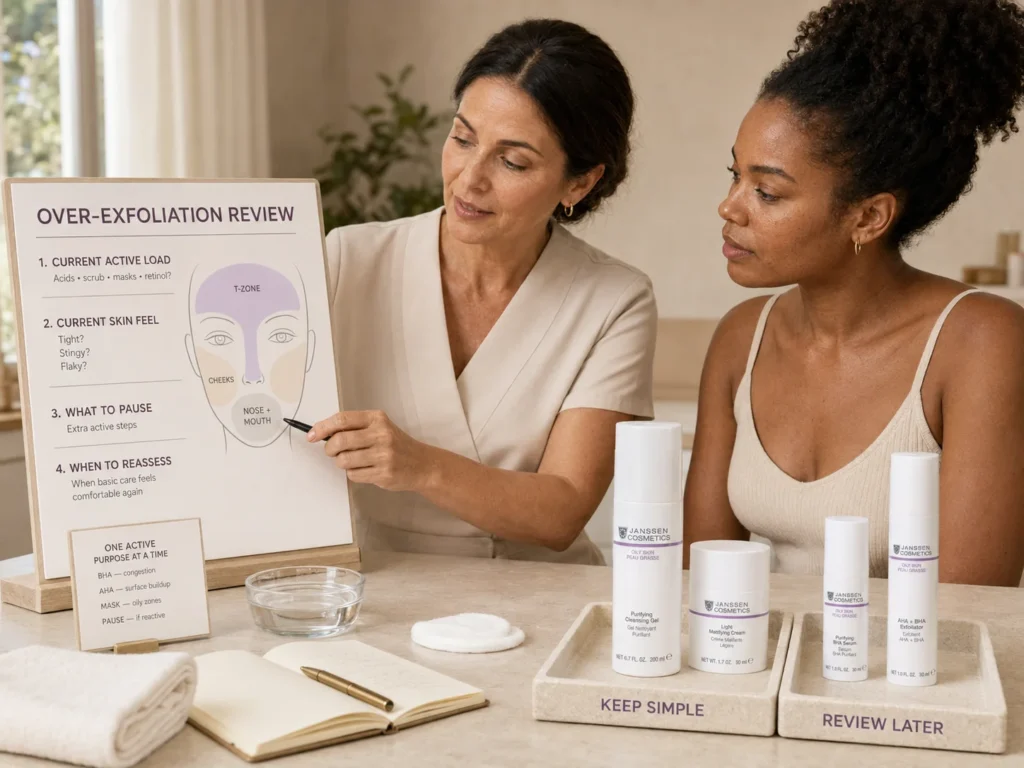
For a short period, simplify:
Morning:
Cleanser → Lightweight moisturizer → SPF
Evening:
Cleanser → Lightweight moisturizer
Keep the cleanser mild, use lukewarm water, avoid scrubbing, and stop acid products until the skin feels less reactive.
If oily skin feels over-exfoliated, pause:
This pause is not permanent. It gives the skin a chance to become easier to read.
When simplifying, keep the basics.
Use a cleanser that removes oil, SPF, makeup, and buildup without leaving the skin tight.
Choose a texture that does not feel heavy but keeps the face from feeling bare.
Use SPF in the morning when the skin tolerates it. If SPF stings, review the formula and the skin’s irritation level.
The plan should feel boring for a little while. That is often what irritated oily skin needs.
There is no exact number for everyone.
The skin should guide the timing.
Wait until:
If irritation does not improve, or if the skin becomes painful, swollen, crusting, infected-looking, or rash-like, seek professional evaluation.
When the skin feels more stable, reintroduce only one active step at a time.
Do not restart the entire old plan.
Choose based on the main concern:
Start slowly. Watch how the skin feels the next day.
If tightness returns, slow down.
BHA may still make sense if clogged-looking pores are present.
But it may need a better schedule or placement.
For example:
BHA is not the problem by itself. The problem is often too much, too soon, or too many actives together.
AHA may still make sense if dull surface buildup or rough texture is present.
But if the skin became over-exfoliated, AHA should be reintroduced carefully.
Avoid using AHA on skin that is still flaking, burning, or stingy.
AHA should make the surface look more refined over time, not raw.
Clay masks may be useful again once the skin feels less reactive.
Use them occasionally and mainly on oily areas.
Do not apply clay to dry cheeks, irritated areas, or skin that still feels tight from over-exfoliation.
If the mask leaves the entire face stretched, it may be too frequent or left on too long.
Morning care should be simple.
A practical order:
Cleanser → Lightweight moisturizer → SPF
Skip active toner, exfoliating serum, and clay masks in the morning while the skin feels reactive.
If the skin feels oily but tight, use a light moisturizer that keeps the face from feeling bare without adding a heavy finish.
Evening care should remove the day without creating more irritation.
A practical order:
Cleanser → Lightweight moisturizer
If makeup or SPF is heavy, remove it carefully but avoid aggressive rubbing.
Do not use night as a time to layer every active product again.
It can be frustrating to pause exfoliation when clogged-looking pores are still present.
But irritated skin is harder to improve cosmetically.
If the skin is tight, stingy, or flaky, jumping back into strong exfoliation may make the surface look worse.
Once the skin feels less reactive, blackheads or whiteheads can be approached more strategically with BHA, texture review, night cleansing, and product placement.
For blemish-prone oily skin, over-exfoliation can be especially tempting.
But painful, deep, swollen, cystic-looking, infected-looking, scarring, or persistent blemishes should be evaluated by a dermatologist.
At-home exfoliation is not a replacement for medical care when the skin needs it.
For cosmetic home care, focus on reducing product overload and choosing clarifying steps carefully.
After consultation, our licensed esthetician may consider Janssen Cosmetics options depending on whether the skin is over-exfoliated, oily-dehydrated, clogged-looking, or ready for clarifying steps again.
Possible options may include:
These are not automatic recommendations. If the skin is stingy, flaky, or burning, clarifying products may need to wait. The right timing depends on how the skin feels, not only how oily it looks.
Do not exfoliate more because the skin is shiny.
Do not scrub flakes caused by irritation.
Do not use BHA, AHA, retinol, scrub, clay mask, and drying products all at once.
Do not keep using toner if it burns.
Do not skip moisturizer because the face is oily.
Do not apply active products to raw or flaky areas.
Do not use clay mask on dry cheeks.
Do not continue experimenting if the skin becomes painful, swollen, infected-looking, rash-like, scarring, or worsening.
Yes. Over-exfoliation can make oily skin feel tight, stingy, flaky, raw, or irritated, even when shine still returns.
Signs include tightness after cleansing, burning after products, flaking, rough makeup, skin that feels oily but dry underneath, and new sensitivity.
If your skin feels tight, stingy, or flaky after BHA, pause it and simplify your plan. BHA may be reintroduced later if clogged-looking pores are still present and the skin feels stable.
Some skin may tolerate mild exfoliation often, but many oily skin types do better with less frequent exfoliation. Daily use is not necessary for everyone.
Use a simple plan: cleanser, lightweight moisturizer, and SPF in the morning. At night, cleanse and moisturize. Avoid acids, scrubs, masks, and retinol-style products until the skin feels less reactive.
It can make the skin feel stripped and tight while oil still appears on the surface. That may make the face feel oily and dry at the same time.
Yes. Choose a light texture that keeps the skin from feeling bare without adding a greasy finish.
A dermatologist should evaluate painful, deep, swollen, cystic-looking, infected-looking, scarring, suddenly worsening, rash-like, or persistent concerns.
If your oily skin feels tight, stingy, flaky, or more reactive after exfoliating, a free virtual consultation can help you understand whether your plan is doing too much.
At Zendevie, we look at your exfoliation schedule, cleanser, toner, active products, masks, moisturizer texture, and SPF before suggesting next steps. The goal is to make your skin easier to read before adding more clarifying products.

Zendevie is guided by Haby Diallo, a licensed esthetician with more than 20 years of professional skincare experience. Her approach is rooted in education, professional judgment, and personal care.
years of experience